

By Samah El Hage and J. Mark Munoz
Transformation is accelerating, yet many programs fail to deliver sustained value. This article introduces the DOTS model—Direction, Operating model, Team and adoption, and Systems—to diagnose where transformation breaks and what to fix first. DOTS aligns decisions, capability, adoption, and scalable execution, so performance shifts and results last longer.
Transformation is reshaping corporate activities worldwide. AI, digital tools, new customer expectations, and new rules are forcing companies to reconfigure their business model to gain a competitive edge. Many transformations, however, fail to deliver real value. Research has shown that about 70 percent of transformations fail.¹ Even in cases where companies invest heavily to implement change, only about 30 percent meet their target value and create sustainable advantage.²
Companies roll out change, but they do not build the conditions for people to perform differently. In many cases, technology is in place, but the organization does not move in tandem.
Companies roll out change, but they do not build the conditions for people to perform differently. In many cases, technology is in place, but the organization does not move in tandem.
There is also a disconnect in velocity. Leadership intent is often to “move faster,” but the implementation system cannot keep up. Business demand regularly outruns real capacity. In one industry report, business leaders believed that IT teams could deliver 10 times more than their actual capacity, and 40 percent of digital innovation work was wasted due to shifting priorities. ³
That gap between ambition and capability creates burnout, rework, and stalled outcomes.
Transformations do not fail at rollout. They fail weeks later when old incentives, old ownership, and old habits become the primary basis for actions and decisions.
This article shows why connecting operational dots decides success across people, technology, and mindset. When these dots are aligned, transformation becomes real and scalable. When they are not, it stays as projects, presentations, and a basis for organizational frustration.
Operational clutter
Inadequate operational linkages are a result of five key issues:
1. The importance of people readiness is underestimated.
Teams are expected to deliver new ways of working without the skills, time, or support to do it properly. This is where transformation becomes fragile. In one study, 67 percent of digital transformations were delayed because teams did not have the needed skills in place, leading to quality issues and missed revenue goals.⁴ This is evident in organizations when the same few people become the permanent bottleneck for decisions, exceptions, stakeholder alignment, and training while the rest of the organization keeps operating as usual. The cost is burnout, slow execution, and a solution that does not become scalable.
2. Ownership is unclear.
Work slows down when nobody truly takes ownership of the outcomes from end to end. Meetings multiply, but decisions drift. One survey found nearly that four in five (78 percent) struggle to get their work done because of how many meetings they are expected to attend, and many end up working overtime because of meeting overload.⁵
In transformation programs, this shows up as “everyone is involved” but no one can make a final call. Priorities shift, approvals stall, and teams stop believing that the change will actually happen.
3. Adoption is treated as training rather than real change.
A solution can be delivered and still fail. If workflows do not change, people will keep doing work in the usual manner. A recent workplace survey found that one in seven employees refuse to use new workplace tools, and 39 percent describe themselves as reluctant users.⁶
In practice, usage may look “fine” on dashboards, but the real work still happens through side spreadsheets, screenshots, and informal approvals because the new flow does not match reality. It gets labeled as organizational resistance, but most of the time it is a result of an ineffective operational design.
4. Foundations are weak.
Data is messy, systems are not connected, and teams rely on manual workarounds. When companies try to add automation or AI on top of weak foundations, complexity explodes. A 2023 survey of 200 data professionals found that many teams spend more than half of their time on data quality work, and that data incidents and time to resolve them are increasing year over year.⁷ Definitions shift, numbers change depending on who pulled the report, and progress depends on a few people who can stitch it together manually. The cost is slow delivery, poor quality, and limited confidence in the results.
5. Compliance and governance are handled too late.
When requirements are added near the end, it creates rework, delays, and risk. Research also points to governance effects, where governance and ownership structure can accelerate or slow digitalization, and late-stage digital maturity depends heavily on capabilities and governance choices. ⁸ In practice, controls and documentation requirements appear after key design decisions are made, forcing redesign and exceptions. Leaders then lose confidence in what is being delivered, and teams slow down further.
The real problem is not grounded on change itself but rather operational disconnect and ineffective performance. Most transformations fail because the organization keeps measuring and rewarding the old world while asking people to operate in a new one. When incentives, ownership, and decision-making stay the same, the transformation becomes optional. When those shift, adoption becomes natural and results show up in performance, not just presentations.
Connecting the dots
Connecting the dots matters because transformation rarely fails for one big reason. It fails because small gaps add up across people, technology, and mindset. Leaders often fix these gaps separately, with a new tool here, a training effort there, and a governance check at the end. But value only shows up when the dots connect end to end. When direction is clear, decisions move fast, people are set up to adapt, and systems scale in the real world. The organization starts operating differently. Performance then starts to move in a measurable way. When one dot is missing, the transformation becomes less effective, and results stay stuck. Table 1 below highlights warning signs in the transformation process:
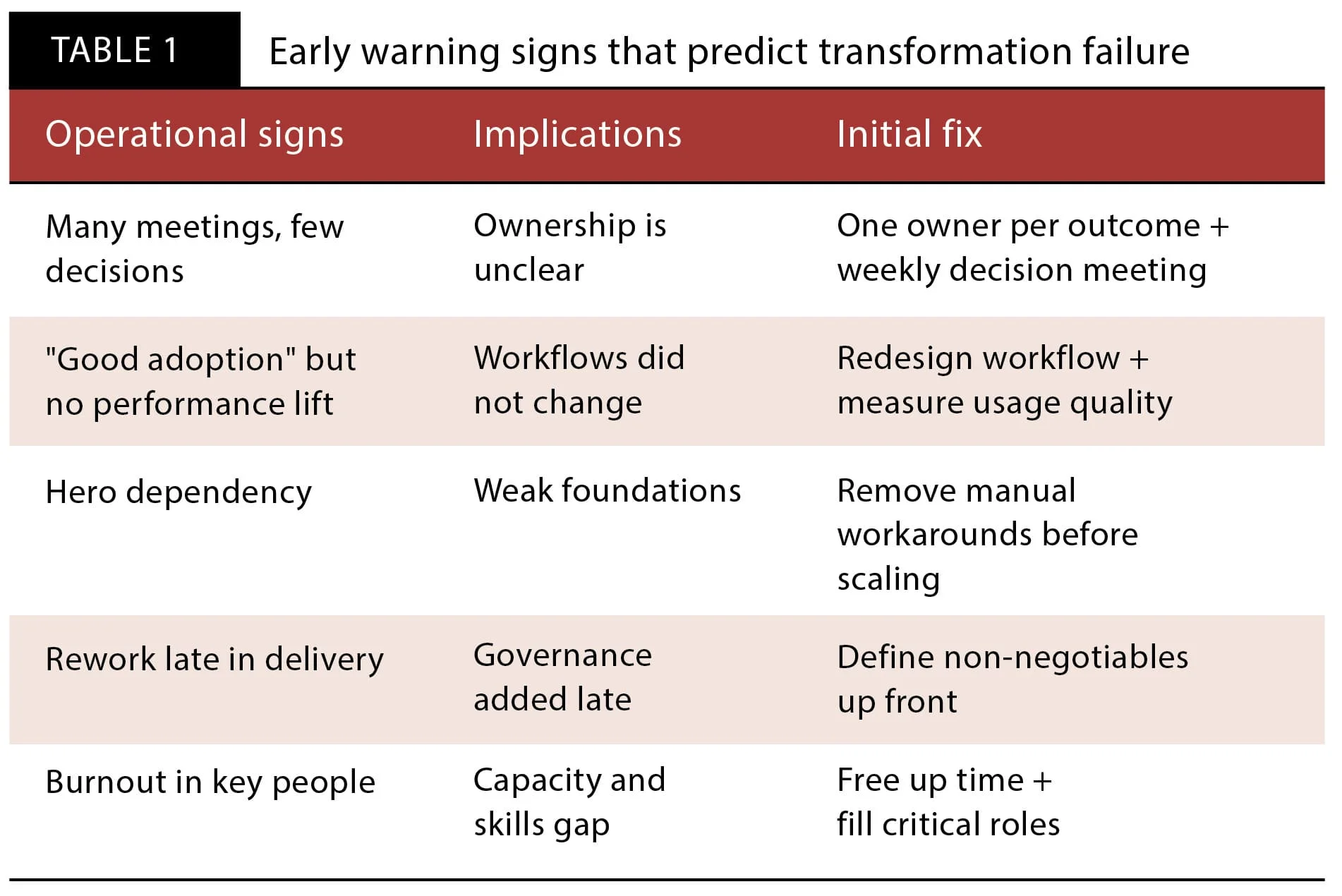
In many cases, these signals appear early. If leaders act on them fast, they avoid months of wasted effort.
The DOTS Model
Transformations work when leaders treat them as a shift in how the business runs, not a technological rollout. The organizations that succeed are clear on outcomes, run decisions in a disciplined way, build real ownership, and treat adoption as a core workstream. They fix foundations while delivering value, and they design governance from day one so speed does not create risk.
The authors recommend a simple model called DOTS (Direction, Operation, Team and adoption, Systems). DOTS is a simple way to spot where transformation will break before time and effort are wasted. It keeps the focus on performance, not just delivery.
- Direction (D) underscores the importance of clarity. What are the outcomes in business terms, what is non-negotiable, and how will success be measured weekly? If leaders cannot clearly articulate answers in a few lines, the transformation becomes a collection of activities rather than a cohesive and effective business agenda.
- Operation (O) highlights approaches where decisions actually happen. Who owns what end to end, how are priorities set, and how do blockers get removed fast? If the operating setup is fragmented, delivery slows down and teams lose momentum.
- Team and adoption (T) emphasizes the importance of the organizational ability to perform differently. Do the right people have the time, skills, and incentives to execute? Adoption does not happen because people “understand.” It happens because the new way becomes the easiest way to do the job.
- Systems (S) accentuates how the transformation can get scaled in the real world. What data quality, system connections, day-to-day usability, and built-in controls are needed? If scaling depends on heroes and workarounds, results will be questionable.
The DOTS Model provides a framework for the alignment of people, technology and mindset. Table 2 below shows a simple scorecard to assess the organization’s transformational preparedness.
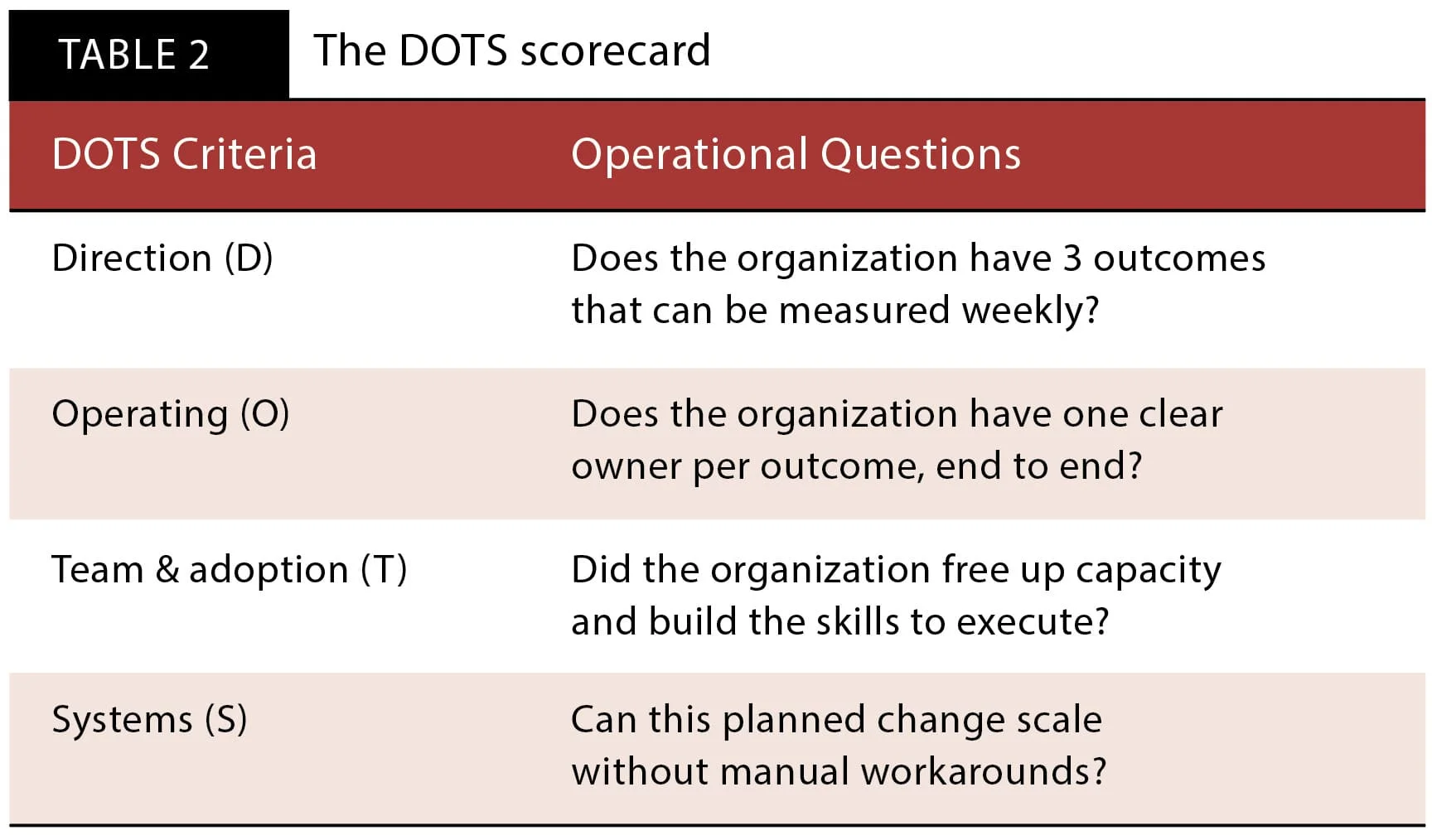
This simple assessment tool can help organizations think through the transformation process and plan ahead. This evaluation approach can be implemented as a simple test. Score each dot from 1 to 5. If any dot is a 2 or below, do not scale yet. Fix the weakest dot first, because performance collapses under pressure exactly where the dot is weakest.
Utilizing the DOTS for successful transformation
Most transformations stall because leaders try to push speed on top of a system that is not set up to deliver. Three strategies can help improve the outcome:
1. Create clarity that can be executed.
Start with a one-page clarity document that makes outcomes specific, explains what will change in day-to-day work, and states what cannot be compromised. If the transformation cannot be explained simply, teams will interpret it differently and execution will break down.
2. Lock ownership and decision speed.
Assign one owner per outcome end to end. Shared ownership is often where delivery stalls. Hold a simple weekly decision meeting where blockers are removed fast, so momentum is not lost in meetings and priorities do not have to be reset every week.
3. Make adoption and scaling part of the design.
Treat adoption as a real workstream. Redesign workflows, support managers, and measure usage quality, not just implementation. Strengthen foundations while delivering value so scaling does not depend on a few individuals, manual workarounds, or late changes.
Successful transformation is not about creating technology. It is about changing performance. Most transformations fail because companies ask people to work in a new way while measuring and rewarding an older method. What carries transformation forward is DOTS and the strategic alignment of people, technology, and mindset. The DOTS Model sets a clear direction, a simple way of running decisions, a team set up to adopt and execute, and systems that can scale without workarounds. Connect these dots early and transformation stops being a project and starts showing up in day-to-day results that last.
About the Authors
 Samah El Hage is a global innovation and AI strategy executive with 20+ years of experience driving transformation across telecom, mobility, and retail. She has led 100+ innovations and pilots across global markets and focuses on connecting data, AI systems, and scalable architecture to deliver measurable business value.