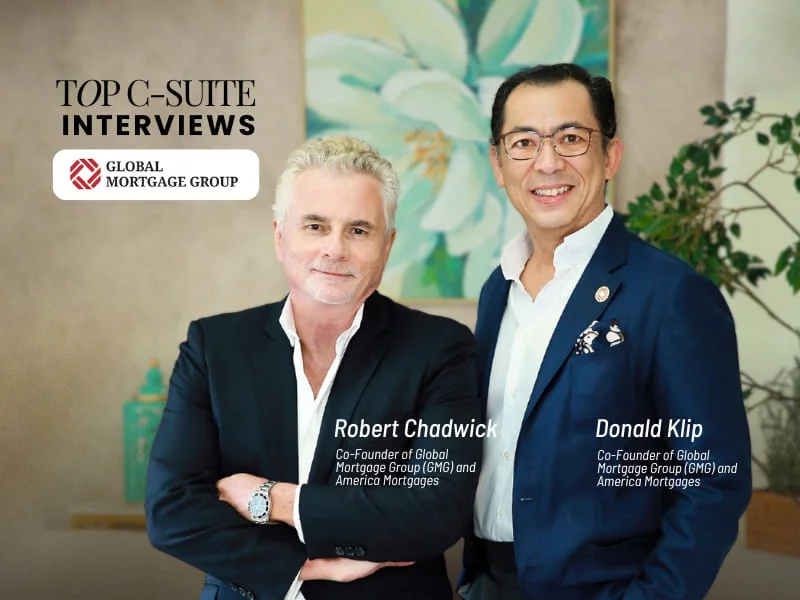

Interview with Donald Klip and Robert Chadwick of Global Mortgage Group (GMG) and America Mortgages
Asset-rich but bank-poor? Now there’s help on hand to release the capital tied up in your marble, bricks, and mortar.
Time was when, even though you owned a hugely expensive property in Palm Beach or Manhattan, you couldn’t release the money tied up in it if you were a foreign national with no US tax return. The banks weren’t designed to help you. Step forward, Global Mortgage Group and America Mortgages. Let’s hear from them as they explain just what their services can do for you.
Good day, Mr Klip and Mr Chadwick! It’s such an honor to have you both with us today. Let’s start at the beginning. How did the idea for Global Mortgage Group first come about? What problem were you both trying to solve when you founded the company?
Global Mortgage Group (GMG) was founded to solve one of the most persistent problems in international wealth management: how to help globally mobile, high-net-worth individuals access institutional real estate financing across borders. Robert came from US wholesale lending with Saxon Capital and Citadel Servicing; I was an investment banker at Citibank, BNP Paribas, and bulge bracket banks. We kept seeing extraordinary clients with extraordinary balance sheets rejected because banks weren’t built to underwrite them. A Singaporean entrepreneur with a USD 5 million Manhattan condominium couldn’t refinance — no US tax return. A Swiss family with a Beverly Hills home held free and clear couldn’t release equity. Today, GMG operates across 23-plus jurisdictions, and America Mortgages is the world’s only dedicated US mortgage lender and broker for foreign nationals, expatriates, and green card holders — with loan officers globally.

You both bring decades of experience from different corners of the financial world — hedge funds, lending, and entrepreneurship. How did those backgrounds shape GMG’s founding vision and approach?
Our backgrounds are the reason GMG looks and behaves nothing like a traditional mortgage brokerage. Between us, we have more than 60 years of institutional finance experience. When a Swiss private banker refers a client to us, they’re handing the client to an advisory team that understands how private banks think and how cross-border wealth actually flows. Our second instinct is structuring — we treat a mortgage as a structured financing solution, not a commoditized product. That is why GMG Capital Advisory, our private credit and structured lending arm, sits alongside the mortgage business. A HNW client can access US residential mortgages, international bridging loans across the US, UK, Singapore, Australia, and Thailand, and bespoke private credit — all under one institutional roof.
We kept seeing extraordinary clients with extraordinary balance sheets rejected because banks weren’t built to underwrite them.
European and British capital has flowed into US real estate for more than a century — from British families buying Manhattan brownstones in the 1900s to today’s Mayfair and Zurich family offices deploying into New York, Miami, and Los Angeles. What’s different about the current cycle, and why is equity release — rather than new acquisition — becoming the dominant conversation?
The transatlantic capital flow into US real estate is one of the oldest and most durable patterns in global wealth. European and British families have been buying prime US property for more than a hundred years — Fifth Avenue mansions in the Gilded Age, Palm Beach estates between the wars, Manhattan penthouses in the 1980s, Beverly Hills and Bel Air estates throughout the modern era, Miami oceanfront in the 2000s, and Aspen ski compounds across generations. What is different about this cycle is the sheer quantum of equity that has accumulated. A Beverly Hills home bought for USD 8 million in 2005 may be worth USD 25 to USD 40 million today; a Palm Beach estate, similar appreciation.
That is why equity release — cash-out refinancing against existing US property — has become the central conversation. European and Swiss family offices are not selling; they want to extract 50 to 65 percent loan-to-value in US dollars and redeploy. America Mortgages is the only institutional platform globally purpose-built to deliver US equity release financing to non-US residents — including high-loan-size cash-out refinancing on California luxury homes, Beverly Hills and Los Angeles bridging loans, and trophy-asset financing across Manhattan, Miami, Palm Beach, and Aspen.
What were some of the challenges you faced at the start in launching a company that aimed to globalize real estate financing — a sector traditionally tied to local markets and local banks?
Every underwriting model presumes a local borrower with local income, local tax returns, and a local credit history.
The biggest challenge was that the entire mortgage industry assumes the borrower lives where the property is. Every underwriting model presumes a local borrower with local income, local tax returns, and a local credit history. When your client is a Singaporean entrepreneur buying in Manhattan or a Swiss family releasing equity from their Beverly Hills home, none of those assumptions hold. We had to build the lender side, the cross-border origination capability, and the credibility simultaneously. Today, America Mortgages works with 70-plus US wholesale lenders who underwrite foreign nationals, expatriates, and green card holders. We are also direct lenders, with 5 to 10 more loan programs being added before year end.
A theme you’ve spoken about frequently is that high-net-worth families globally are, in your words, ‘asset-rich but bank-poor’ when it comes to global real estate. Can you unpack that paradox — why do some of the world’s wealthiest property owners struggle to access financing against assets they already own outright?
The “asset-rich, bank-poor” paradox is the central insight behind everything GMG does, and it affects virtually every HNW family with cross-border real estate exposure. These are clients who own a Beverly Hills home, a Manhattan apartment, a Palm Beach estate, an Aspen retreat, and a London townhouse — total real estate frequently in the USD 20 to USD 100 million range, often unencumbered. On paper they are among the wealthiest people in the world. In practice they cannot get a mortgage.
The reason is structural. Traditional banks underwrite mortgages on local tax returns, local credit, and local income. A Swiss entrepreneur with CHF 50 million of net worth but no US tax return is unbankable to a US bank. Private banks themselves are limited — they Lombard-lend against securities, not against your Beverly Hills home or New York condominium. Through America Mortgages, foreign nationals access US cash-out refinancing up to 75 percent loan-to-value — including high-loan-size California luxury home equity release — without a US credit score, US tax return, or US-sourced income.
Global Mortgage Group is often described as “Asia’s only US mortgage lender and broker” through your America Mortgages subsidiary. How does this distinction set you apart, and what is it structurally about US banks that makes them unable to serve foreign nationals, expats, and global citizens?
America Mortgages is the only dedicated US mortgage lender and broker headquartered in Asia, and the distinction is operational, not marketing. We are fully US-licensed direct lenders, working with 70-plus US wholesale lenders — meaning 70 different loan programs to fit the exact requirements of our borrowers. US banks cannot serve foreign nationals because their underwriting is built around three pillars: the IRS tax return, the US credit bureau file, and W-2 employment income. Strip one away and a Fannie Mae-eligible loan becomes impossible. Our programs include full-doc, alternative-doc, asset-based, DSCR for investment properties, and cash-out refinancing for equity release. A Singaporean buying a USD 4 million Manhattan condominium and a Swiss family releasing USD 6 million from a Beverly Hills home are different loan products — and we have all of them.
You’ve mentioned that GMG doesn’t just connect clients with banks but actually creates tailored loan programs with lenders. Can you share an example of how this model has transformed a client’s financing experience?
A representative example: a Hong Kong family came to us wanting to release USD 8 million from a Manhattan apartment owned free and clear for 20 years. Two US private banks had already declined them — no US tax return, no US credit score, BVI ownership structure. We worked with a specialist non-QM partner to underwrite on three alternative pillars: asset quality, the family’s verified global balance sheet, and 24 months of debt-service reserves. The loan closed at 60 percent LTV — USD 8 million released — in under 90 days.
A second example: a Swiss family office referred a client looking to release equity from a Beverly Hills home valued at USD 28 million, owned outright for over a decade. The client wanted USD 15 million to redeploy into a Los Angeles commercial real estate opportunity. Income declared only in Switzerland, ownership through a Liechtenstein structure. We structured an asset-based foreign national cash-out refinance at 55 percent LTV, closed in 75 days. That is what high-net-worth Beverly Hills equity release financing actually looks like when it is built around the client.
Your clients include high-net-worth individuals, family offices, and global property investors in Asia, Europe, the Middle East, and beyond. What are the most common financing challenges they face — and how does GMG help them unlock equity that has historically been frozen inside their real estate holdings?
Three challenges come up in nearly every HNW conversation: income that doesn’t look conventional on paper, wealth held across multiple jurisdictions, and property owned outright with no existing lender relationship in the country where the asset sits. Each is enough to get a client declined by a mainstream bank. Together they are the norm for HNW families. The frozen equity problem is where the conversation has shifted most. A USD 20 million Beverly Hills home, a USD 10 million Palm Beach estate, or an Aspen ski property with zero debt looks great on a balance sheet but is economically dead capital. Through America Mortgages, a non-US resident can release up to 75 percent of that equity — redeployable into new investments. Through GMG Capital Advisory, similar equity release is available in the UK, Singapore, Australia, and Thailand. We turn static real estate wealth back into productive capital.
You’ve noted that some of your strongest demand in recent years has come from global private banks, specifically from Swiss private banks and their clients. Why Switzerland specifically — and what is it about the Swiss wealth management model that makes GMG’s US equity release solution such a natural complement to a private banking relationship?
Swiss private banks have become one of our strongest referral channels, and the reason is structural. Switzerland manages roughly USD 2.5 trillion in cross-border private wealth — about a quarter of the global total — and a large proportion of that wealth sits with clients holding significant US real estate. Zurich, Geneva, Lugano, and Basel are home to UBS, Julius Baer, Pictet, Lombard Odier, Vontobel, Bordier, and Mirabaud, and the family offices that cluster around them.
Swiss private banks are world-class at discretionary management, Lombard lending, and multi-generational structuring. What they structurally do not do is originate residential mortgages against US real estate. So when a private banker has a client sitting on USD 15 million of unlevered equity in a Beverly Hills estate, a Manhattan townhouse, or a Miami oceanfront condominium, they refer to GMG. We have become, in effect, the US mortgage origination desk that Swiss private banks do not have internally — handled to the same service standards they would expect from a Zurich institution.
London, Hong Kong, and Singapore remain some of the great global capital hubs and, meanwhile, European family offices have long held significant US real estate exposure. What conversations are you having with European-based family offices right now, and how do currency dynamics, and the desire for dollar diversification factor into their thinking about US-denominated debt?
The conversations with European and UK family offices in 2026 are fundamentally different from three years ago. Historically, European family offices viewed their US real estate — a Beverly Hills home, a Manhattan townhouse, a Palm Beach estate, a Miami penthouse — as a long-duration trophy. Today, the conversation is about optimization.
Three dynamics drive this. First, currency: European wealth denominated in euros, sterling, or Swiss francs wants dollar exposure as a structural hedge, and a US-dollar mortgage against an existing US-dollar asset is one of the cleanest ways to add it. Second, cost of capital: a family office releasing equity at 7 to 8 percent and redeploying into US private credit, US equities, or additional US real estate creates real economic value. Third, generational: the next generation is more comfortable with strategic debt and capital efficiency. London is our largest European hub, with Zurich, Geneva, and Monaco close behind. On the US side, California — Beverly Hills, Bel Air, Malibu — together with Manhattan, Miami, Palm Beach, and Aspen, dominates the asset side of these conversations.
You’ve expanded into markets like the UK, Australia, Thailand, and Singapore for international bridging loans and private credit through GMG Capital Advisory. How do these complementary business lines serve the same HNW client base, and what are the next frontiers for GMG’s global expansion?
GMG Capital Advisory is the strategic extension of the same thesis that built America Mortgages: HNW clients are underserved by traditional banks whenever financing becomes cross-border or structurally complex. While America Mortgages handles long-term US mortgages and equity release, GMG Capital Advisory solves shorter-duration, bespoke problems: international bridging loans, senior secured private credit, and structured lending across the US, UK, Singapore, Australia, and Thailand. The same client often needs both — refinancing a Manhattan condominium with America Mortgages while bridging a London townhouse through GMG Capital Advisory; releasing equity from a Beverly Hills property while drawing on a Singapore Prime Bridge facility. The next frontiers are Continental Europe — Switzerland, Monaco, Spain, Portugal, Italy, France — and the Middle East, where UAE, Saudi, and Qatari HNW families are deploying actively into US and UK markets.
Much of your work is with private bankers, family office advisors, and wealth managers. How has GMG positioned itself as a partner to the advisor community rather than a competitor — and what is the feedback you get from private bankers about why they refer to you?
We solve cross-border real estate financing — the one problem private bankers and wealth managers cannot solve in-house.
From day one, GMG was built as a partner to the advisor community, never as a competitor. We don’t manage money, take client assets, or provide investment advice. We solve cross-border real estate financing — the one problem private bankers and wealth managers cannot solve in-house. Three themes come up consistently. Capability completeness: one introduction, one institutional counterparty, every product. Client retention: when a private banker refers to GMG, the client stays with the private bank — we don’t compete for the securities portfolio, and solving the financing need actually strengthens the private banking relationship. Service standard: discretion, multilingual capability, and institutional communication that meets the bar of a tier-one private bank.
Looking ahead, what’s next for Global Mortgage Group in the coming decade — and what is the problem you most want to have solved for clients when you look back on this chapter?
The problem we want to have solved is the complete unfreezing of HNW real estate equity globally. Within 10 years, no high-net-worth family should have to hold a property free and clear because their bank cannot underwrite them — whether that property is in Beverly Hills, Manhattan, Palm Beach, Aspen, Mayfair, or Singapore. Equity release for the globally mobile HNW client should be as standard as Lombard lending is today.
Operationally: deepen America Mortgages as the definitive US mortgage solution for foreign nationals, expatriates, and green card holders; extend our international bridging platform across Continental Europe and the Middle East; grow GMG Capital Advisory into a leading institutional private credit platform. Technology will make the experience seamless — digital onboarding, faster underwriting, AI-assisted document review — without compromising institutional judgment. We’re not trying to be the biggest mortgage firm in the world. We’re trying to be the one that globally mobile HNW families trust most, across every jurisdiction that matters.
About Global Mortgage Group
(GMG) Global Mortgage Group (GMG) is a Singapore-headquartered international real estate finance firm operating across 23-plus jurisdictions. Its subsidiary, America Mortgages, is the world’s only dedicated US mortgage lender and broker for foreign nationals, expatriates, and green card holders — including specialist programs for high-net-worth equity release and cash-out refinancing on California luxury homes in Beverly Hills, Bel Air, and Los Angeles, as well as Manhattan, Miami, Palm Beach, and Aspen. GMG Capital Advisory provides international high-net-worth equity release and bridging loans in Singapore, the US, London, Australia, and Thailand, and private credit solutions for Asian companies. GMG was co-founded by Donald Klip and Robert Chadwick.