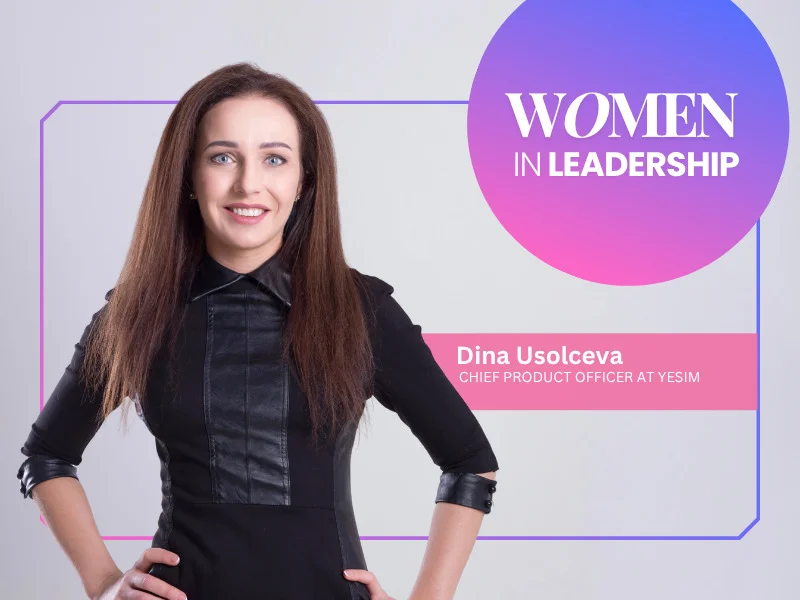

Interview with Dina Usolceva of Yesim
As digital products scale across borders, leaders must navigate complexity while maintaining simplicity, reliability, and user trust. Dina Usolceva shares how her approach to leadership has been shaped by speed, responsibility, and a deep commitment to building products people depend on. She reflects on decision-making, team dynamics, and what it takes to lead effectively in a fast-evolving, technical environment.
Careers in fast-moving industries rarely follow a straight line. Was there a moment that changed the way you began to think about leadership and responsibility?
For me, leadership and responsibility are natural values, something that was instilled in me by my parents. I have never felt that these qualities were artificially developed. I wouldn’t say there was a single moment that changed my thinking, it’s something that has always been part of who I am. If anything shaped it further, it was my passion for speed. As a motorcycle racing athlete, I learned to feel comfortable in fast-moving, constantly changing environments, where you have to stay fully focused, make quick decisions, and improve with every lap. I ride on a moto track, and in many ways it’s similar, you are one hundred percent focused on the process, you make decisions quickly, learn from mistakes, and improve lap by lap. As long as I can remember, I’ve been very responsible – at school, at university, and in different stages of my life. When building Yesim, I approached it as if I were creating a product for myself. I’m very critical of the products I use, and I apply the same standards to what we build.
When a product starts reaching people in many different countries, what usually becomes more demanding than most people expect?
When we launched, there were only a few similar services in the world at the time, and during all the years of our product growing, we were a benchmark in the field. At the very start we didn’t have examples to follow, so we had double pressure to be the best for our customers and at the same time to set an example for competitors.
Behind every eSIM there is a real person, usually standing in an overcrowded airport after a long flight, hoping to connect to the internet and order a taxi.
All we could do was meet the customer’s expectations, as best as we could, and listen to them carefully. Thanks to one of my favourite phrases – behind every eSIM there is a real person, usually standing in an overcrowded airport after a long flight, hoping to connect to the internet and order a taxi. When you think this way, you start building not just a service, but something people really rely on. This mindset helped us stay close to our customers and understand what they really need.
Over time, we realised that we were not just building a travel app, but creating a digital connectivity infrastructure that people rely on in different countries and situations.
People often notice digital services only when something stops working. What do you think users expect today that they did not expect even a few years ago?
In many ways, the core expectations haven’t changed that much, people still want a reliable connection, fair pricing, and quick support when something goes wrong. What has really changed is how users look at the product itself. They’ve become much more sensitive to interface and onboarding. People want everything to be simple and clear, and they are much more used to solving things on their own. We see this a lot when we look at support tickets. Our main goal is to provide a service people can rely on. Being without the internet while abroad is a very unpleasant experience, and in those moments people don’t have time to figure things out they expect everything to just work. That’s why we focus on making the product easy from the start: simple onboarding, clear guidance, and things like one-tap eSIM installation or understandable connection status.
At the same time, expectations around support have also changed. People are used to fast replies, including AI assistants, but they are also quite critical of them. Speed matters, but quality matters just as much. So for us it’s always about balance, giving fast support, but also making sure the user actually gets a useful answer.
As products grow quickly, leaders are often asked to move faster while still making careful choices. How do you decide what deserves attention first when several things matter at once?
In reality, no two choices are equally important. A decision usually feels difficult only when you don’t clearly see the consequences.
Once you start mapping each option to its possible outcomes, the picture becomes much clearer and the choice becomes easier. Every decision leads somewhere, and understanding where each path leads helps me stay calm and make more rational decisions. In practice, there is always a lot on my plate, and I usually have to choose between launching new features and improving stability. At first glance, new features may seem to bring more impact, but at the same time we are never ready to compromise on quality and reliability. So in the end, I choose what is best for the customer.
Over time, I’ve learned that every decision has its own value. The key is to define it correctly. Decisions are rarely one-dimensional, so it’s important to look at them from different angles. In practice, I rely on the data I have, plus a bit of intuition, creativity, and sometimes even luck.
You have worked in a field where many decisions are shaped by technical thinking. How do you make sure discussions stay clear enough for strong decisions to happen?
As Solon once said, “I am growing old, but I continue to learn.” Working in a technically complex field that is constantly evolving never really gives you a chance to relax. For me, the most important thing is having a strong and versatile team you can trust, and being aligned in the way you think and work.
The most important thing is having a strong and versatile team you can trust, and being aligned in the way you think and work.
I remember once, when I was applying for a product role, I was asked how I would work with people who were much stronger than me technically. I was actually surprised by the question and simply answered, I will learn from them. And I think this mindset is still very important. You don’t need to be the most technical person in the room to make strong decisions, but you do need to understand, ask the right questions, and keep the discussion focused. At the same time, clarity comes from keeping things simple. Even when topics are complex, we try to break them down and focus on what really matters for the product and the user. One of the key qualities in the Yesim team is curiosity. It helps us not to be afraid of complex problems, but to approach them with interest and see them as a challenge.
What is one idea about leadership that still gets repeated often, even though it no longer reflects how strong teams actually work?
I think there is still a perception that leadership is about managing or even micromanaging people and having control over everything, without really being hands-on or understanding how things work in practice. For me, it’s very different. A leader is not just a manager, it’s someone who listens with an open mind. I believe it’s important to understand a process before delegating it. You don’t need to do everything yourself, but you need to feel how it works in practice. This approach helps me stay closer to the team and also make more realistic decisions when it comes to timelines. A team is not just a resource. These are people with their own mindset, experience, and way of thinking. And if we bring them together, it means we need that diversity for a reason. Each person brings something unique, and my role is to create an environment where this experience can actually be used both in the work itself and within the team. In that kind of environment, people take ownership, share ideas, and grow together. And that’s what really leads to strong products. You can’t check every pixel in a prototype or proofread every translation. At some point, you have to trust your team. And when people feel that trust, they really flourish. Transparency and clarity are also very important. I also believe in shared responsibility and a healthy failure culture, where people are not afraid to make mistakes and won’t be blamed for them. This creates a more open and effective way of working as a team.
For women building careers in fields where leadership is still often associated with technical authority, what helped you trust your own way of leading?
Honestly, I never really looked for confidence in my way of leading, I just lead. For me, it was never about proving that I have enough technical authority. It was about building something real and making it work. When we started Yesim, we were a team of fewer than 10 people. We had an idea and, more importantly, we believed in it. We were so driven by the idea that we didn’t focus on the difficulties or question whether it was possible, we just kept going and made it happen. When you have a clear goal you truly believe in, you don’t really have time to question whether your knowledge is enough, you catch up along the way.
At the same time, I didn’t come to Yesim unprepared, my previous experience in telecommunications gave me a solid foundation. And in Yesim, I’m learning every single day.
I remember that even the idea behind Yesim started with a simple question: how to install an eSIM without scanning a QR code. Fun fact at that time, it wasn’t actually possible, but that understanding opened up even more possibilities for us. This way of thinking has become part of our approach. Today, I can see the results when I look at our year-on-year growth or simply read customer reviews, and I think this is where confidence really comes from, turning ideas that once seemed unrealistic into real products that people actually use and rely on. Seeing thousands of users trust your product, you no longer feel the need to prove anything, you simply trust your own way of leading.