

By Aidan McKearney
In spite of the moves that many organisations have made towards promoting diversity in leadership roles, their staff progression systems may still harbour invisible barriers yet to be tackled.
Although the business case for diverse leadership is widely recognised and, indeed, many companies have made significant progress in that regard, some may have failed to identify systemic barriers to advancement that underrepresented employee groups face. Here, Aidan McKearney of Hult International Business School outlines some of the key findings of the school’s investigation into the subject.
The obstacles to diverse leadership are rarely surface level. Tackling them demands a systems approach – sustained behavioural and cultural work that ultimately strengthens an organisation’s ability to attract and retain diverse leaders.
Organisations with diverse leadership teams consistently demonstrate higher levels of innovation, stronger customer orientation, greater resilience, and superior financial performance.
The business case for diverse leadership is grounded in extensive empirical evidence. Organisations with diverse leadership teams consistently demonstrate higher levels of innovation, stronger customer orientation, greater resilience, and superior financial performance (Mor Barak et al., 2016).
Many companies invest heavily in formal D&I initiatives, leadership development programmes, and mentoring but, despite this investment, senior leadership remains disproportionately homogeneous (Nishii et al., 2018) and the visibility of underrepresented talent at senior levels continues to lag.
Researching a frustrating phenomenon.
At Hult International Business School, we wanted to hear first-hand the barriers that underrepresented talent face in their journey through leadership pipelines. In particular, we wanted to explore the so-called “leaky pipeline” phenomenon, which describes a situation where women and minorities exit out of leadership roles, or are pushed out by rigid and inflexible environments.
We outline our key findings here, together with recommendations for how organisations can find a better route to more sustainable leadership, that draws the best from all available talent pools.
Homogenous leadership benches are a frustrating truth for many organisations, as illustrated by this leader in his honest reflection:
“For years we have invested so much time, resources, energy, and effort in D&I, and yet, when we look at the outcomes, we still don’t have leadership benches that provide diversity of talent, thought, and experience. Why is it so hard to turn the dial on this?” (Senior partner, male, finance firm, UK)
What are the barriers to achieving diverse leadership?
In-depth interviews with 60 leaders (including 50 women) in the UK and US corporate sectors (finance, insurance, tech, construction, logistics, professional services, and retail) provide an insight into the complexity of the barriers and obstacles that women and minorities tell us they continue to experience, and why “the dial is so slow to turn”. These are the key obstacles our participants cite:
Vertical segregation: “I can’t see people like me in the higher echelons of leadership.
I know it’s a cliché but it holds true, if I don’t see it, I think I can’t be it.”
Affinity bias: “Tendency to lean towards the ‘halo factor’, where people hire people like them.”
Misalignment between policy and practice: Participants tended to “rate policy higher than practices”. “There is an implementation gap, the glossy policies don’t always match the practices on the ground.”
Engagement gaps among senior leaders: “Some care more about inclusion and diverse leadership than others.” Less care equates to less effort, which equates to poorer outcomes on inclusion in those departments and business units.
Fewer advocates who will sponsor: “Pipeline leaders like me need more senior advocates that will support, sponsor, and advocate for people like me, and see my potential.”
Leadership styles: “Still fairly male-centric in the corporate sector; there’s a leadership style that is expected and anything out of that norm is frowned upon.”
Authenticity challenges: “Can’t really lead in the way that feels authentic to me, which would be to be more collaborative.” “Can’t be ‘out’ as a gay leader – not in this role in this organisation.”
Two macro issues were also cited as unwelcome additions to the barriers that diverse talent already face.
Return To Office mandates and erosion of flexibility: “Decisions to have everyone
back four or five days a week, based not on evidence, but on feeling – the feeling of the CEO – no consultation, just a top-down decision.”
New climate around EDI: “Roll-back of corporate support for initiatives here, whereas other competitor firms are doubling down.” “Confusing and a bit dismaying.”
Combined, these act as significant barriers to advancement but (and this is crucial) they are not confined to one part of the organisation; they are found across organisational structures, systems, strategies, management styles, staffing decisions, and shared values. Because they operate at a systems level, they need to be tackled at a systems level.
Adopting a systems approach
A systems approach means looking beyond individual actions to examine how the whole organisation – its culture, processes, structures, and behaviours – shapes people’s experiences.
In this context, it requires stepping back to understand how the interconnected parts of an organisation create, reinforce, or remove barriers to diverse leadership.
McKinsey’s 7S diagnostic tool provides a useful roadmap for organisations to audit and ask questions from a systems perspective.
McKinsey’s 7S diagnostic tool
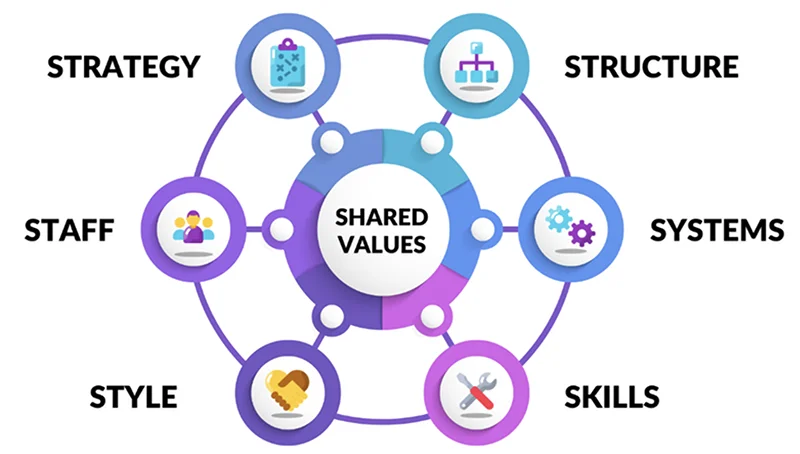
Under the spotlight: Question time for organisations using the 7S
1. Shared values: rhetoric or reality?
What inclusion values do we say we hold dear?
Where do employees’ lived experiences contradict these values?
Where do we not “walk the talk”?
2. Strategy: Is inclusion the Cinderella of strategies?
Is inclusion positioned at the heart of our organisation?
Does inclusion and diverse leadership align with our business strategy?
Is there antipathy or indifference in certain areas of our organisation to the concept of diversity and inclusion?
3. Structures: Elevating vs climbing.
What are the routes to getting to senior roles?
Where do the “bottlenecks” occur?
Who gets secondments, stretch, sponsorship, and fast-track opportunities? Who doesn’t?
4. Systems (Talent, Rewards, Leadership Development, Promotion)
Do systems (un)intentionally benefit some, and disadvantage others?
Do seemingly “neutral” systems produce unequal outcomes?
Where do we search for our talent?
5. Styles of Leadership: Who looks like a leader to us?
What leadership styles do we feel (un)comfortable with?
How is leadership “potential” framed?
Do we have fixed / inflexible views about what constitutes “good” leadership?
6. Skills: All hard?
Do leaders have empathy and understanding for diverse lives?
How comfortable and confident are leaders in navigating difference and discomfort?
Do leaders have skills for deep listening and dialogue with divergent perspectives?
7. Staff: Who are they and where are they (stuck)?
Are there recognisable patterns in (dis)engagement levels?
Who stays and who leaves?
Are there demographic clusters (vertical and horizontal segregation) that raise red flags?
Uncomfortable truths?
In most cases, an honest assessment through a 7S diagnostic will most likely raise uncomfortable questions about culture: assumptions, norms, taken-for-granted assumptions that can form the basis for the logics that underpin our practices, and our decision-making about what and who is leadership material.
Ultimately, this journey requires the organisation to look honestly in the mirror, recognising both the visible behaviours above the waterline and the hidden dynamics beneath it.
The barriers identified by leaders in our research study appear above the waterline but they are also culturally informed and reproduced. They persist because they are historically baked into the norms and cultures of the organisation. They are stubborn and hard to shift. Their effects are profound. They are, in effect, visible and invisible brakes on progression into leadership for women and minorities. But they can be tackled – by co-ordinating above and below the waterline.
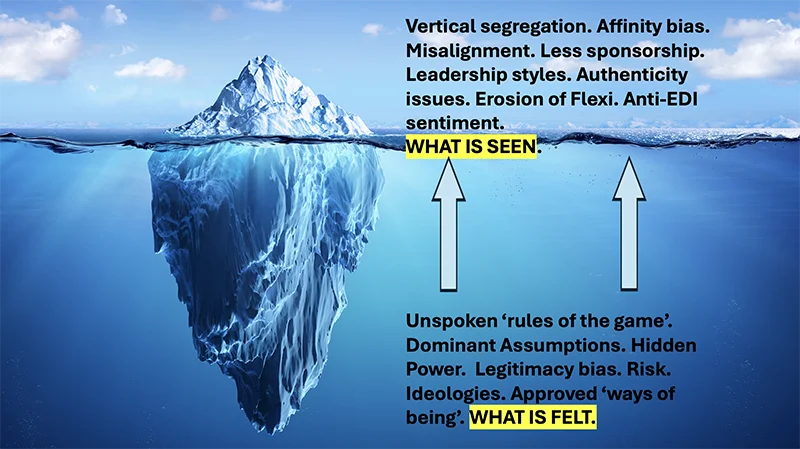
Our research strongly suggests that incremental fixes above the waterline are insufficient if we want to develop sustainable, talented, diverse leadership. Fixing the problems that we see above the waterline only works long-term if we also transform the way the organisation thinks about leadership, the organisational consciousness, and mental models that operate below the waterline. Because if we only fix the problems above the waterline without addressing the forces that lurk below, then problems, obstacles, and barriers will simply keep recurring. Surface what is felt and what is experienced by women and minorities, make it seen and heard, and begin the transformation to a new “way of being” that is open, pluralistic, flexible, and respectful of difference and the business potential that different perspectives can bring.
A systems approach offers a more fundamental route forward because:
- It shifts attention from surface interventions to root causes.
- It emphasises alignment across structures, processes, mindsets, behaviours, and culture.
- It moves organisations away from remedial tinkering toward deeper redesign.
The upshot of this approach is to encourage leaders to question current assumptions and instead sense, reflect, and co-create new logics and practices. When mindsets shift “below the waterline”, behaviours and decisions shift above it. That’s the key.
It can be done
This female leader offers a compelling perspective on how change is possible. Her career story illustrates how this finance firm was transformed over time:
“The company I work for now is the same one I left ten years ago after maternity leave. Back then it was very homogenous, male, white, and there just wasn’t support for someone like me as a new mother. I couldn’t see how I could keep my career going, so I left to the public sector. And I brought my leadership skills there.
Now, I have returned four years ago, and I have been completely shocked. They’d turned it around; respect-based values, inclusive opportunity, safe place for voice, diversity networks and just an all-round flexible approach that says we can make it work for you, rather than you have to fit into a straightjacket, and a ‘take-it-or-leave-it’ attitude. If it was like this ten years ago, I would never have left.” (Female leader)
The “take it or leave it” attitude this leader refers to isn’t an attractive offer anymore. People with ambition, talent, and leadership potential will simply take their talents elsewhere.
Changing the conditions so that they will want to stay and develop in your organisation is more likely to happen with honest reflection and committed, long-term systemic change in the way the organisation thinks about difference, inclusion, talent, and leadership.