How Portugal’s largest retailer and a Brazil-born innovation hub are reinventing how stores think.
The Bet
Two years ago, MC Sonae made a bet. Portugal’s dominant food retailer, with 40,000 employees and brands that touch nearly every household in the country, handed the keys to its innovation pipeline to a partner known for its R&D prowess from the other side of the Atlantic.
CESAR, the nearly 30-year-old R&D powerhouse from Recife, Brazil (Porto Digital), didn’t even have an employee in Portugal yet.
What followed: experiments across food retail, health, and wellness — 64 in total, the majority run by MC Sonae’s own teams, with CESAR managing the curated pipeline of startups, lab environments, and validation frameworks throughout.
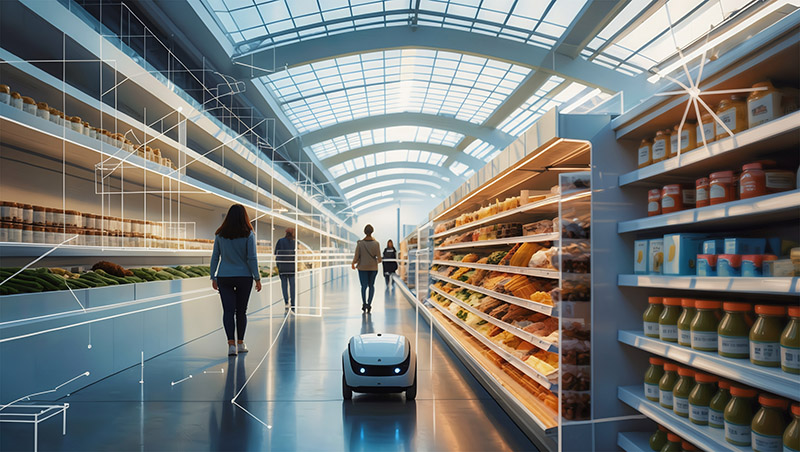
Delivery robots navigating live stores. Holographic product displays. An AI-powered autonomous supermarket. And a few spectacular failures that turned out to be the most valuable lessons of all.
When MC Sonae launched its Test Beds program in January 2024, backed by Portugal’s Recovery and Resilience Plan, the company had a problem that plenty of large retailers will recognize. It could buy technology off the shelf. It could hire consultants.
“We tried pilots with startups before,” says Marlos Silva, who leads R&D and innovation for MC Sonae. “We were slow to respond, slow to give feedback, slow to test, slow to prepare. We knew we needed a different model.”
That model arrived from Brazil. CESAR, one of LatAm’s most established innovation centers.
The fit was immediate: CESAR brought nearly three decades of experience testing technology for companies like Lenovo, Motorola, and Volkswagen, along with a global scouting network that could source startups the Portuguese ecosystem alone could not supply.
“They took a leap of faith with us,” says Juliana Queiroga. “We didn’t even have an employee in Portugal yet. We were doing everything from Brazil, across time zones. But we could show them our process, and they trusted it.”
64 EXPERIMENTS.
NOT ALL WORKED.
The program was ambitious by design: 64 distinct experiments spanning food retail, health, wellness, and multiple store formats under the MC Sonae umbrella, including Continente and Wells. CESAR’s innovation labs served as the staging ground, enhanced with 5G connectivity provided through the Test Beds infrastructure.
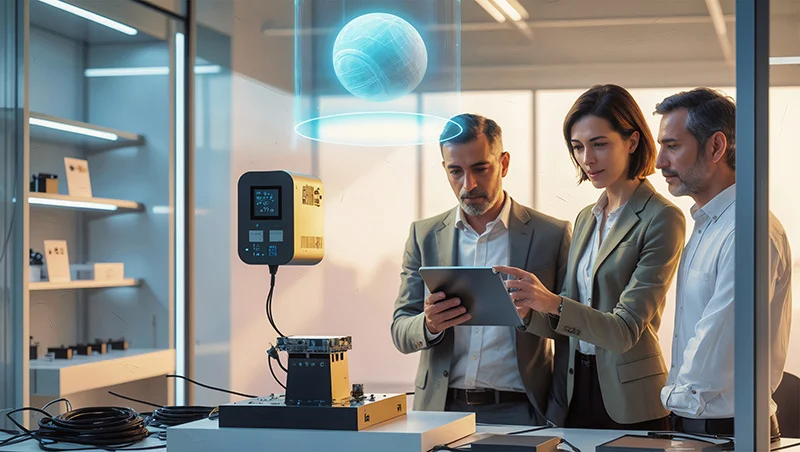
Startups moved through a curated pipeline — from scouting to lab validation to, in some cases, live deployment in actual stores. MC Sonae’s own teams drove the majority of these experiments directly, with CESAR serving as the innovation architecture and startup pipeline behind them.
“One standout: Katchit, a Portuguese imaging company based near Aveiro that can create digital twins of physical spaces, project holograms of products in-store, and enrich the way customers interact with merchandise. “They could turn the shopping experience into something amazing,” Silva says. “They have a couple of cards in their sleeves.”
But not every card played well.
Queiroga recalls one startup with a promising concept that struggled badly the moment real users touched it — though she’s careful to note the company remains active today, still operating and raising investment. It simply wasn’t ready for the scale of real retail back then.
“The app was built for iOS and Android. Nobody with an Android could use it. People spent hours on calls with the startup trying to get it to work. The company finally said, let’s just drop Android entirely. Can you imagine if we had taken that directly into Sonae’s stores?”
The lesson, she says, is exactly why the lab stage matters:
“Startups always believe their solution works. And they have to. But it’s very different to test with five people versus a full retail site. The laboratory step was fundamental.”
Silva puts it more bluntly:
“We didn’t have 64 successes. Some of them failed. But even when they fail, we acquire knowledge, because the problem is still there. We’re just getting closer to the solution.”
“If you look at a retail store, it is a black box. They know what they sell, but they don’t know what happens inside the store. Computer vision will make the store a glass box.” — Marlos Silva, MC Sonae
The Glass Box Future
Ask Silva which technology excites him most, and the answer comes fast:
Computer vision.
“Today, a retail store is a black box. You know what you sell. You don’t know what happens inside. You can’t have a person watching thousands of products and thousands of customers,” he says. “But a camera that sees everything? That changes the game. It will really help us serve our customers better — while protecting their privacy.”
His shorthand for it: turning the store from a black box into a glass box.
MC Sonae’s autonomous Sensei-powered supermarket in Leiria, one of the largest of its kind in the world, is the most visible proof of concept.
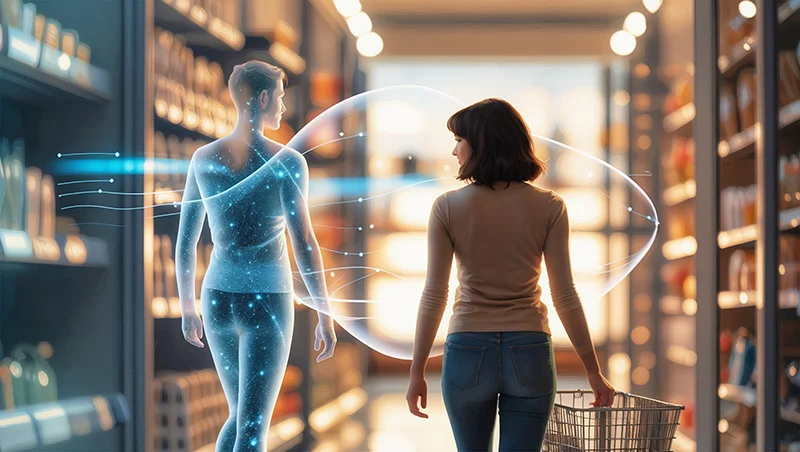
Queiroga pushes the vision further. She describes a future where every shopper has a digital twin — an AI-powered persona that knows their preferences, tracks their patterns, and anticipates what they need before they reach the shelf.
“Think about it like The Sims,” she says with a laugh. “You’re going to have the digital Juliana, with her shopping schedule and her profile. Your refrigerator already talks to your online account. AI agents are going to be personal shoppers. The physical store isn’t going away, but the physical and the digital are overlapping more and more every day.”
Silva sees the practical bridge. Robots are already operating in MC Sonae warehouses and select stores. Navigation systems help both employees and customers find what they need across 10,000-square-meter retail floors. Human-robot collaboration is the transition phase.
Full automation, he believes, is a matter of when, not if.
BUY LESS.
MOVE FASTER.
THINK BIGGER.
Silva recently represented MC Sonae at the European Industry Summit in Antwerp, sitting alongside EU heads of state and industrial leaders debating European competitiveness. The word that stuck with him: speed.
“The global order is changing fast. Historical allies are not allies anymore. Protectionism is rising. The status quo is different,” he says. “We do the right things, move fast, and strengthen our competitive edge. If not, we all grow poorer.”
Sustainability is woven into that urgency. Sonae’s current Chairman, Paulo Azevedo, famously told customers before Christmas to “buy less.”
The company now offers heavy discounts on products approaching expiration rather than letting them go to waste. It’s a bet that changing behavior is as important as changing technology.
“You have to figure out how the customer is going to hack your product. Because the customer is going to bring things you’re not even considering.” — Juliana Queiroga, CESAR Europe
Queiroga frames the partnership in geopolitical terms. Europe is recalibrating its partnerships. Brazil, and CESAR specifically, represents a new kind of partner for companies rethinking where innovation comes from.
“Former allies are not allies anymore. New partnerships are being developed and prioritized,” she says. “Companies in Europe have a real opportunity to reshape how they build digital sovereignty, to be less dependent on who they used to depend on, and to be open to new ways of finding solutions. That’s what innovation means right now.”
What Comes Next
The Test Beds program wraps in the coming months, but both sides are already planning what follows. Silva wants to expand the model to a European scale, tapping talent and technology beyond Portugal’s borders.
CESAR wants to deepen the relationship, bringing its government-designated Cybersecurity Competence Center (CISSA) in Brazil into the retail innovation conversation as both companies prepare for the quantum computing era and the security challenges it will create.
Asked what advice he’d give companies still hesitating, Silva recommends empathy.
“You need to understand what your partner’s objectives are and how you can contribute to those, while they help you achieve yours. It’s about finding a win-win. We proved with our test beds that it’s possible to do better. We’re already thinking about how to do it bigger.”
Queiroga gets the last word. “Being open to new partnerships, new possibilities, new ways of working. That’s the key factor. Otherwise, you risk being irrelevant a few years from today.”
Editorial Note: The images accompanying this article were generated using artificial intelligence by Chris Knight and are provided for illustrative purposes only. They are not photographs of real people or actual events.