By Tatiana Andronova
Banking apps are borrowing mechanics from games, fitness trackers, and food delivery platforms — changing how millions of people relate to their money.
What do The Sims, Duolingo, a fitness tracker, a food delivery app, and your banking app have in common? At first glance, not much. One is about building a virtual life, another helps people learn a language, another tracks workouts and daily activity, while a banking app is supposed to help users manage money. But if we look closer at how these products are designed, they often rely on the same logic: progress, rewards, challenges, streaks, goals, and emotional feedback.
Over the past several years, leading fintech products — from Revolut and Monzo to Robinhood — have increasingly borrowed ideas from gaming and consumer apps. What used to be common in entertainment products is now becoming normal in finance. This phenomenon is known as fintech gamification — and what looks playful on the surface is, in reality, driven by serious business goals: user activation, product adoption, and long-term loyalty.
This shift did not happen by accident. Everyday life has become overwhelmingly digital, and financial products now exist inside the same attention economy as marketplaces, delivery apps, social media platforms, fitness trackers, and mobile games.
This is why gamification has become more than a visual trend. This is why gamification has become more than a visual trend – it has become a powerful business tool and design approach.
I. Why banking apps started using gamification
For decades, banking products were built around functionality rather than emotion. People opened banking apps to complete practical tasks: transfer money, pay bills, check balances, review transactions, or solve financial problems. Unlike entertainment products, banking interfaces were never expected to create excitement. Their main purpose was to appear stable, reliable, and secure.
However, digital culture slowly changed user expectations. People became used to products that constantly respond to their behavior and reward attention as fitness apps congratulating users after workouts or language-learning platforms celebrating milestones.
Over time, these interaction patterns went beyond entertainment products and began shaping expectations for digital experiences in general, including finance. Younger audiences, especially Generation Z, grew up inside ecosystems built around instant feedback, personalization, progression systems, and visible achievements. As a result, many users now expect financial products to feel intuitive, interactive, and emotionally responsive rather than purely functional.
At the same time, banking itself became increasingly invisible. Physical branches, once associated with human interaction and personal communication, continue to disappear and many people manage their finances entirely through a smartphone. As banking moved onto screens, we needed new ways to maintain emotional connection inside purely digital environments.
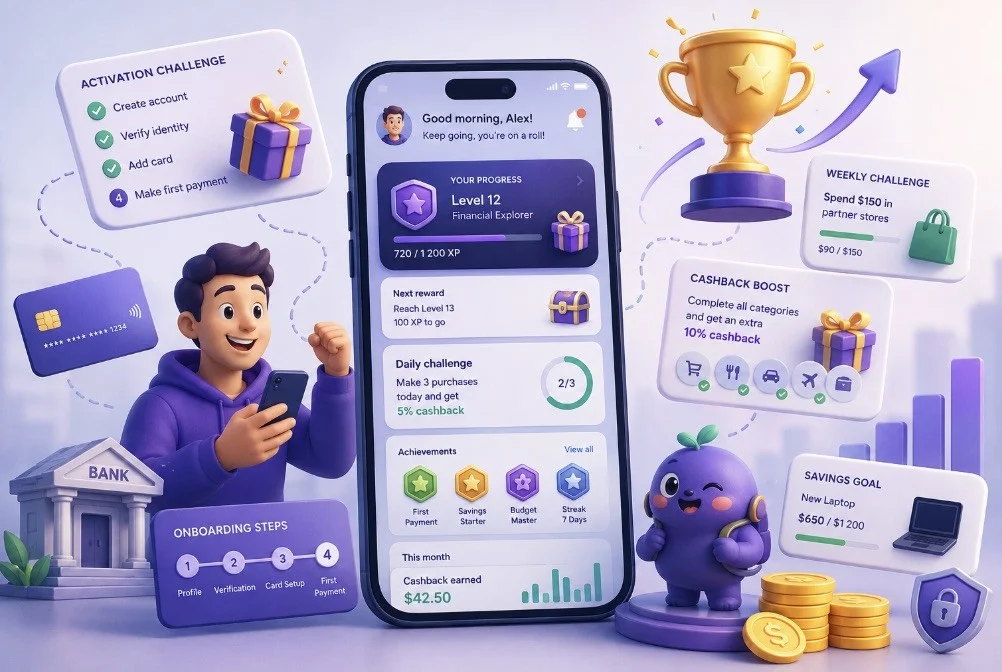
Gamification emerged as one of the most effective solutions. What started as small interface experiments — progress bars during onboarding, cashback rewards, savings goals, achievement badges — gradually evolved into a much larger design philosophy. Modern fintech products increasingly use game-like mechanics not simply because they look modern, but because they influence behavior. They encourage users to complete onboarding, activate cards, return to the app regularly, use additional products, and build habits around financial routines.
This shift is especially important because financial behavior itself is deeply emotional. People may think of money as rational, but financial decisions are often connected to stress, anxiety, security, freedom, status, and self-control. A savings goal no longer feels like just a number sitting inside an account when it is visualized as progress. Cashback becomes more emotionally engaging when it is framed as a challenge. Even completing identity verification feels easier when the interface shows visible momentum instead of endless paperwork.
Banking apps were once products people opened only when necessary. Today, many fintech companies are trying to turn them into products users interact with more routinely, sometimes even daily. Gamification became one of the central tools making that transformation possible.
II. Onboarding and activation challenges
One of the clearest examples of gamification in fintech appears during onboarding. Instead of presenting onboarding as one long and exhausting process, fintech apps divide it into smaller steps with visible progress and constant reassurance. A user no longer sees a giant registration form with endless fields. Instead, the process becomes structured as a journey with clear stages and visible movement forward.
This may sound like a small design detail, but psychologically it changes the experience significantly. A simple “Step 2 of 4” reduces uncertainty because users understand where they are and how much effort remains. Progress indicators, checkmarks, completion states, and subtle animations all create the feeling that the user is moving forward rather than getting stuck inside bureaucracy.
Fitness apps use similar mechanics very effectively. A running app does not simply tell users to “exercise more.” It breaks activity into goals, daily progress, streaks, and visible milestones. Language-learning platforms work the same way. They transform long-term effort into smaller achievable steps. Banking apps increasingly apply this logic to financial onboarding and activation.
While some fintech products also attach rewards to onboarding itself, the challenge, however, is balance. Banking apps still need to feel trustworthy and secure. If onboarding becomes too playful or visually aggressive, users may begin questioning the seriousness of the product itself.
III. Cashback, rewards, and behavioral motivation
Cashback is one of the oldest reward systems in finance, but over the past few years it has evolved into something much more behavioral and emotionally driven.
Traditionally, cashback worked quietly in the background. Users spent money and occasionally received a percentage back. It was useful, but emotionally passive. Most people barely paid attention to it beyond seeing small amounts returned to their account.
Modern fintech apps approach rewards very differently, many products now present rewards as active experiences built around challenges, milestones, urgency, and participation. A user may be encouraged to complete several purchases within a certain timeframe, unlock higher cashback categories, or participate in partner-store challenges.
This logic closely resembles systems already common in delivery apps, marketplaces, and mobile games, that create urgency through limited-time offers and progress-based discounts.
Banking apps increasingly apply this behavioral logic to financial actions. A user who sees they are “one purchase away” from unlocking a reward becomes emotionally invested in completing the cycle. The reward itself may not even be very large. What matters more is the feeling of anticipation, completion, and progress.
From a business perspective, these systems can increase card usage, transaction frequency, and partner engagement. But from a psychological perspective, they also change the relationship between users and financial products. Banking apps stop feeling like passive utilities operating in the background and begin behaving more like interactive ecosystems designed around habits and routines.
IV. Achievements, streaks, and emotional engagement
One of the more interesting developments in fintech design is the growing importance of emotional feedback. Traditionally, banking products focused almost entirely on clarity, stability, and efficiency. Emotional design was often considered unnecessary or even inappropriate within financial environments.
However, modern fintech products increasingly challenge that assumption.
Today, many banking apps celebrate user behavior through streaks, milestones, badges, achievements, and personalized progress systems. Users may receive recognition for completing their first investment, reaching a savings goal, paying on time consistently, or staying within budget for a certain period. At first glance, these mechanics may appear even childish, but they tap into something deeply human: people enjoy recognition and visible progress.
Financial products increasingly use achievement systems because financial progress is often psychologically difficult to sustain. Saving money rarely provides immediate emotional reward. Paying off debt can take years. Budgeting requires discipline and consistency. Without feedback, these actions can feel emotionally invisible.
Gamification introduces smaller moments of encouragement along the way. A savings goal becomes visible progress rather than an abstract number. A streak transforms consistency into achievement. A milestone creates a sense of movement even when the long-term financial outcome is still far away.
Some fintech products experiment even further with character progression, visual worlds, or virtual environments connected to financial behavior. A savings goal might grow a digital plant or unlock visual upgrades. While these systems may appear playful, their purpose is serious: they help transform abstract financial habits into emotionally understandable experiences.
V. Retention, habits, and routine engagement
One of the main reasons gamification became so important for fintech companies is that it creates reasons for users to return regularly.
Historically, banking apps existed in the background of everyday life. Users opened them when necessary, completed a task, and left immediately afterward. From the user’s perspective, this was efficient. From the company’s perspective, however, it limited opportunities to build stronger relationships with customers.
Other industries solved this problem long ago through routines and behavioral systems. Social media platforms encourage users to return constantly through notifications and personalized feeds. Fitness apps create habits through daily goals and streaks. Language-learning apps remind users not to break progress chains. Delivery apps create repeated interaction through offers, tracking systems, and recommendations.
Banking apps increasingly use similar strategies.
Weekly spending reports, savings goals, cashback missions, financial challenges, personalized insights, and reward systems all create ongoing reasons to return to the app. Over time, the banking experience shifts from purely transactional behavior toward routine engagement.
This transformation reflects a larger trend in digital culture. Modern apps increasingly compete not only for users, but for routines. Products that successfully become part of everyday habits gain enormous long-term advantages because routine interaction creates familiarity, trust, and emotional attachment.
For businesses, this affects customer loyalty, product adoption, and long-term engagement. For users, however, the experience can feel more practical when done correctly. Financial products that encourage users to check spending patterns, follow savings goals, or understand habits more clearly can genuinely help people become more aware of their financial behavior.
VI. The darker side of gamified finance
The biggest challenge with gamification in finance is that the same mechanics can be either helpful or harmful depending on how they are used.
A progress bar may help users complete a savings goal, but it can also pressure them into spending more to unlock a reward. A streak can encourage consistency, but it can also create anxiety around maintaining engagement. A challenge can motivate healthy financial habits, but it can also make risky behavior feel exciting.
This tension becomes especially visible in investment and trading platforms. Critics have increasingly compared certain fintech products to gambling systems because of their use of instant feedback, celebratory animations, emotional rewards, and highly stimulating interaction patterns. In some cases, financial risk begins to feel visually similar to entertainment.
The concern is not only about visual design. It is about behavioral influence.
Unlike games, financial decisions carry real-world consequences. Losing points in a game may be frustrating. Losing money inside a financial product can affect someone’s savings, debt, or future stability. This is why the line between motivation and manipulation becomes especially important in fintech.
Questions around ethical gamification are becoming increasingly relevant not only for designers, but also for regulators, lawyers, educators, and financial institutions themselves. Are users clearly informed about risk? Are reward systems transparent? Do challenges encourage responsible behavior or impulsive spending? Are emotionally vulnerable users protected from manipulative patterns?
These discussions will likely become even more important in the coming years as financial products continue adopting interaction systems originally developed for entertainment platforms.
The most responsible fintech products increasingly focus on encouraging healthy habits rather than maximizing engagement at any cost. Instead of rewarding excessive spending or risky behavior, they focus on budgeting, saving, financial education, and long-term planning. In these cases, gamification becomes less about entertainment and more about guidance and behavioral support.
VII. Conclusion
While gamification has become a profound pattern across digital products, in fintech it raises more serious questions. Banking apps deal with real money, debt, and financial risk – the stakes are fundamentally different from a language app or a fitness tracker.
Product leaders responsible for fintech experiences must think beyond business metrics. The real challenge is not how to maximise engagement, but how to motivate without manipulating – and how to help users make better financial decisions, not just more frequent ones.