
By Carsten Lund Pedersen and Thomas Ritter
Strategies, when executed to a perfect blend, can even end a World War. This is why organisations and corporations put considerable value on effective strategic planning whether it be conforming, deviant, or a mixture of both. In this article, the authors emphasise the essence of managing and synchronising two types of strategists in a company.
Strategic renewal is often fostered by internal tensions, rule breaking, and deviations from the formulated strategic plan.1 The strategic necessity of internal conflict is best illustrated by a classic story from Hewlett Packard. In the early 1980s, David Packard awarded a Medal of Defiance to one of his employees, Charles H. House, for “extraordinary contempt and defiance beyond the normal call of engineering duty.”2 Charles had persistently pursued a project on a large-screen electrostatic monitor that the management team had ordered him to abandon.3 Charles believed in the project and continued to work on it despite managerial orders to stop. In the end, the project “planted the seeds for a new market” and HP acknowledged the necessity of maverick behavior by praising Charles for his rule-breaking work, as his strategic defiance was needed to counteract complacency and bureaucracy. In so doing, HP allowed for the strategy to be challenged.4
HP is not alone. Stories of strategic renewal often reveal tense internal disagreements concerning the right strategic course. For instance, Intel witnessed virulent internal debates about its move into microprocessors, a gang of unlikely rebels woke IBM up in time to catch the internet wave, and Disney discussed digital animation long before it finally acquired Pixar.5 At the heart of most of these stories of corporate transformation is a struggle between those who support the current strategy, whom we call “strategy enforcers,” and those who reject the current strategy in favor of a new opportunity, whom we refer to as “strategy mavericks.” Your realised strategy is determined by the daily battle between these two types of people in your organisation.
Strategy enforcers provide the consistency and alignment needed to secure corporate profits, while strategy mavericks ensure renewal and counteract complacency. If one side wins, the company loses.
Building on our previous work on strategic renewal, employee types, and competitive dynamics, we argue that corporate performance thrives when there is a constant tug-of-war between strategy enforcers and strategy mavericks.6 Why is that the case? Strategy enforcers provide the consistency and alignment needed to secure corporate profits, while strategy mavericks ensure renewal and counteract complacency. If one side wins, the company loses. In other words, the checks and balances that the two employee types provide are lost if one side constantly wins. Hence, successful corporate transformations are comprised of tug-of-wars that never end. Therefore, your organisation has a winning strategy when both sides win sometimes. The following table illustrates the main differences between the two types.
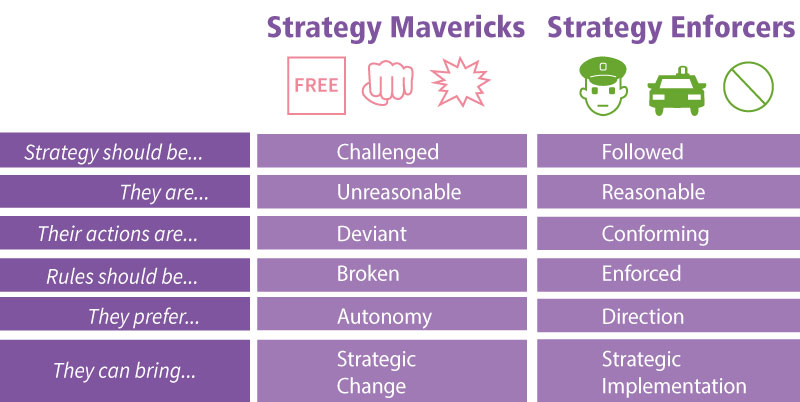
Strategy enforcers take the predefined strategy as a given, and focus their attention on enforcing and executing it. For them, a strategic course should be dictated and employees should continually comply with its trajectory. As such, they are often aligned with the C-suite and the strategy- or business-development function operating at central headquarters. Strategy mavericks may view enforcers as control-and-command leaders who are overly bureaucratic. However, as Jonathan Trevor and Barry Varcoe put it, alignment is critical for firm performance.7
In contrast, strategy mavericks see the predefined strategy as something that should be challenged. For them, a strategic course should be disrupted and employees should not be bound by the predefined trajectory if a more promising path emerges. Mavericks are what Julian Birkinshaw calls unreasonable people who, he suggests, “seek to adapt the world to their view, rather than learn to fit in.”8 They can originate anywhere in an organisation, but they can often be found on the front lines or in the operational core. Enforcers may view mavericks as troublemakers or as overly alarmist. However, as Amy Gallo states, “when faced with a strategy you think is wrong, you have an obligation to speak up.”9
The tug-of-war between enforcers and mavericks offers organisations one way to succeed at ambidexterity.10 In other words, it can help organisations excel at both exploitation and exploration. It is also consistent with advice found in studies on securing corporate longevity, as well as seminal research on how strategy actually unfolds.11 As such, this simple categorisation not only illustrates how strategy formation typically occurs, it also offers a suggestion for how to overcome the classic dilemma in strategy between persistence and renewal.12 Of course, whether you are an enforcer or a maverick depends on the context, and it can change over the course of a career. Therefore, it is more sensible to focus on maintaining organisational processes to ensure a tug-of-war than on emphasising the recruitment of certain individuals who fit the idealised archetypes.
Strategy mavericks see the predefined strategy as something that should be challenged. For them, a strategic course should be disrupted and employees should not be bound by the predefined trajectory if a more promising path emerges.
Orchestrating a tug-of-war between enforcers and mavericks is not easy. We therefore propose three steps to help you along the way.
Make sure that you have both enforcers and mavericks. Enforcers ensure internal consistency and strategic persistence. However, if you only have enforcers, you risk blind spots in terms of the existing strategy. Mavericks challenge the current path and ensure renewal. However, if you only have mavericks, you risk chaotic tendencies that can result in strategic burnout.
Make sure that enforcers and mavericks are engaged in a balanced tug-of-war. In order for enforcers and mavericks to take part in a balanced tug-of-war, they both need an official mandate to pursue their strategic paths. Moreover, they should have the necessary autonomy and resources, and be able to influence decision makers.
Make sure that enforcers and mavericks continuously challenge each other. When one side wins a strategic battle, you need to ensure that the power balance does not shift permanently. Enforcers and mavericks need to constantly challenge each other. Most organisations have some form of strategy process that promotes alignment, but few organisations have processes in place to incorporate information provided by mavericks.13