
By Adam Crouch and Dr Llewellyn D W Thomas
The traditional ESG playbook is failing. Smart executives are discovering that the most powerful path to societal impact lies in harnessing capitalism’s fundamental mechanisms.
Environmental, social, and governance (ESG) programs face an unprecedented crisis. Political backlash, skeptical corporate leadership, and declining investor interest have created a perfect storm challenging corporate sustainability initiatives. Yet for executives genuinely committed to creating positive change, this crisis presents an opportunity to fundamentally rethink how businesses can drive social impact.
The answer lies in a powerful but counterintuitive approach: impact externalities – products and services that inherently generate positive societal benefits while attracting customers through self-interest rather than altruism. These businesses catalyze industry transformation by making socially responsible products that win through traditional competitive advantages – quality, desirability, and price – rather than asking customers for self-sacrifice.
The False Choice in Current Approaches
A core problem with many ESG initiatives and corporate charity lies in their structural design. They typically function as cost centers, additional expenses that drain resources without directly contributing to competitive advantage.1 While they achieve some good, if they don’t generate competitive advantage, they act as a drag on the business, limiting their scope and sustainability. When economic pressures mount, these programs become easy targets for budget cuts because they exist outside the fundamental value creation engine of the business. For example, Shell halved its low-carbon investments as part of a “discipline drive” to prioritize shareholder returns.2
ESG initiatives typically function as cost centers, additional expenses that drain resources without directly contributing to competitive advantage.
Another core problem arises when the social and environmental impact embedded within a product’s value proposition asks customers to compromise on quality, desirability, or price to help others.3 This has yielded few breakthrough successes, with the most prominent leaders still relegated to niches; companies like Toms Shoes and Patagonia, while admirable, remain limited in scale and market impact.
What’s more, most consumers devote little attention to corporate charity and, for them, modest charitable activity has become a hygiene factor that may reduce criticism yet rarely generates incremental demand or durable preference, so competent but undifferentiated efforts are more likely to be met with indifference than with loyalty.
Equally, the real-world impact is modest relative to the scale of the problems at hand: corporate contributions are typically small, resources are fragmented across multiple causes, and dispersion dilutes outcomes as well as the credibility to claim material progress. While corporate charity can yield internal benefits by lifting employee morale, satisfying compliance expectations, and easing stakeholder conversations, it does not on its own constitute strategy.4
The Power of Impact Externalities
A more sustainable approach emerges when businesses create positive impact externalities, beneficial side effects that arise naturally from superior products or services. In these models, the greater the business’s success, the more societal good is produced. This alignment ensures that social impact scales with business growth rather than acting as a drag or even competing against it.
Consider Poshmark, a peer-to-peer marketplace for secondhand clothing. By bringing e-commerce to thrift shopping, it made secondhand clothing dramatically more popular. More than 90 percent of Millennial women in the US have a Poshmark account, and even fashion brands themselves now sell secondhand clothing. The environmental impact of catalyzing this shift from new to secondhand is significant. The fashion industry accounts for 8-10 percent of global CO2 emissions – more than aviation and maritime shipping combined.5 A single pair of jeans uses 3,800 liters of water and exposes workers to dangerous chemicals.6
The most durable path to social impact in consumer markets comes from products that embed impact externalities in the value proposition yet win adoption through customer self-interest rather than altruism, competing on the familiar vectors of quality, desirability, and price without asking buyers to accept sacrifice. When these offerings scale, they reset category reference points, realign customer expectations, and shift the basis of competition, thereby multiplying their societal impact through market dynamics rather than charitable intent.
Intrinsic Impact versus Altruistic Branding
Poshmark led a revolution in secondhand shopping, yet offering or promoting sustainability isn’t why it succeeded. When testing marketing messages, “Get [Brand] up to 70 percent off” always dramatically outperformed sustainability messaging. The environmental impact is no less real because it’s inherent to the product and business model. Poshmark attracted far more consumers by offering a broadly popular value proposition centered on value, selection, and uniqueness, rather than the narrow appeal of altruistic self-sacrifice.
Tesla became one of the world’s most influential advocates for sustainable transportation not through altruistic positioning, but by offering consumers high-performance, desirable electric vehicles. Its social impact, accelerating the shift away from fossil fuels and reshaping the global auto industry, emerges organically from its core business model rather than being imposed externally. In contrast, Prius asked consumers to altruistically forgo performance for reduced environmental impact and were nowhere near as impactful.
Consider also Toms Shoes, who pioneered the “buy one, give one” model. While this altruistic positioning created clear visibility for its social mission and enabled them to get early traction, they quickly hit a growth ceiling, as the altruistic customer market is limited and their model was easy to copy.
Thus, while successful, the altruistic approach has inherent limitations: there is lots of competition, and consumers must choose to make what they perceive as a moral sacrifice, thereby limiting market appeal and scale. They remain relegated to a niche, rather than changing consumer expectations and catalyzing change across the industry.

Historical Precedent for Market-Driven Solutions
This is leveraging capitalism as a solution to the problems that it has created. This cycle has repeated throughout history. Indeed, impact externalities represent how society has solved many of its most vexing problems. Whales were hunted to the brink of extinction for their oil to light homes. Kerosene outcompeted whale oil as a fundamentally better product, saving the whales while simultaneously creating Standard Oil, one of history’s most valuable companies.
Plastics were invented as a cheaper alternative to ivory for precisely shaped objects requiring hardness and durability, like combs or billiard balls, dramatically reducing elephant poaching. In the late 19th century, cities choked on air pollution as every home and factory burned coal for light, heat, and power. The light bulb, natural gas heating, and centralized power generation offered better, cheaper products that moved pollution out of city centers, improving millions of lives. Lead paint’s market share had declined dramatically by the time it was banned, due to competition from cheaper and better titanium dioxide paints.
Today, solar, wind, and natural gas are outcompeting coal with lower-cost generation, leading to astounding drops in per capita CO2 emissions across the developed world. While the Prius had niche success as an altruistic statement, Tesla’s positioning as a superior car transformed the automotive industry, resulting in a market valuation multiple times that of Toyota, the world’s largest manufacturer by volume.
A Framework for Implementation
Impact externalities from superior products ultimately surpass more overt efforts focused on altruism because consumers adopt them for their own benefit. This challenges current managerial advice about integrating societal impact into existing operations or asking customers to change behaviors or accept lesser-quality products. Three key principles guide the implementation of impact externalities:
- Build a great business without relying on altruism. The core value proposition must be compelling enough to succeed on its own merits. Social impact should enhance rather than substitute for fundamental business strengths.
- Address existing needs in demonstrably better ways. Look for solutions that can displace problematic alternatives through superior performance, convenience, or economics rather than moral persuasion.
- Embrace new technology as an enabler. Whether through deep tech innovations or simple applications that solve user friction, technology often provides the breakthrough that makes superior alternatives possible.
By fully embracing capitalism and using all its tools, you can lead to larger social impact than ESG initiatives or potentially even nonprofits.
In this way executives can focus on traditional competitive drivers – quality, desirability, price – so that product success itself drives societal impact. By fully embracing capitalism and using all its tools, you can lead to larger social impact than ESG initiatives or potentially even nonprofits. When you create a product and business model that is inherently sustainable yet better than incumbent solutions, existing consumer activity volume can flip from negative to positive societal impact.
Getting Started: Finding Your Wedge
The key to getting started is identifying the “wedge idea”, something that a more sustainable product can do uniquely well. There will usually be a small market segment that values that benefit so highly that they are willing to accept significant trade-offs to get it. Successful execution of an impact externality product strategy requires four steps:
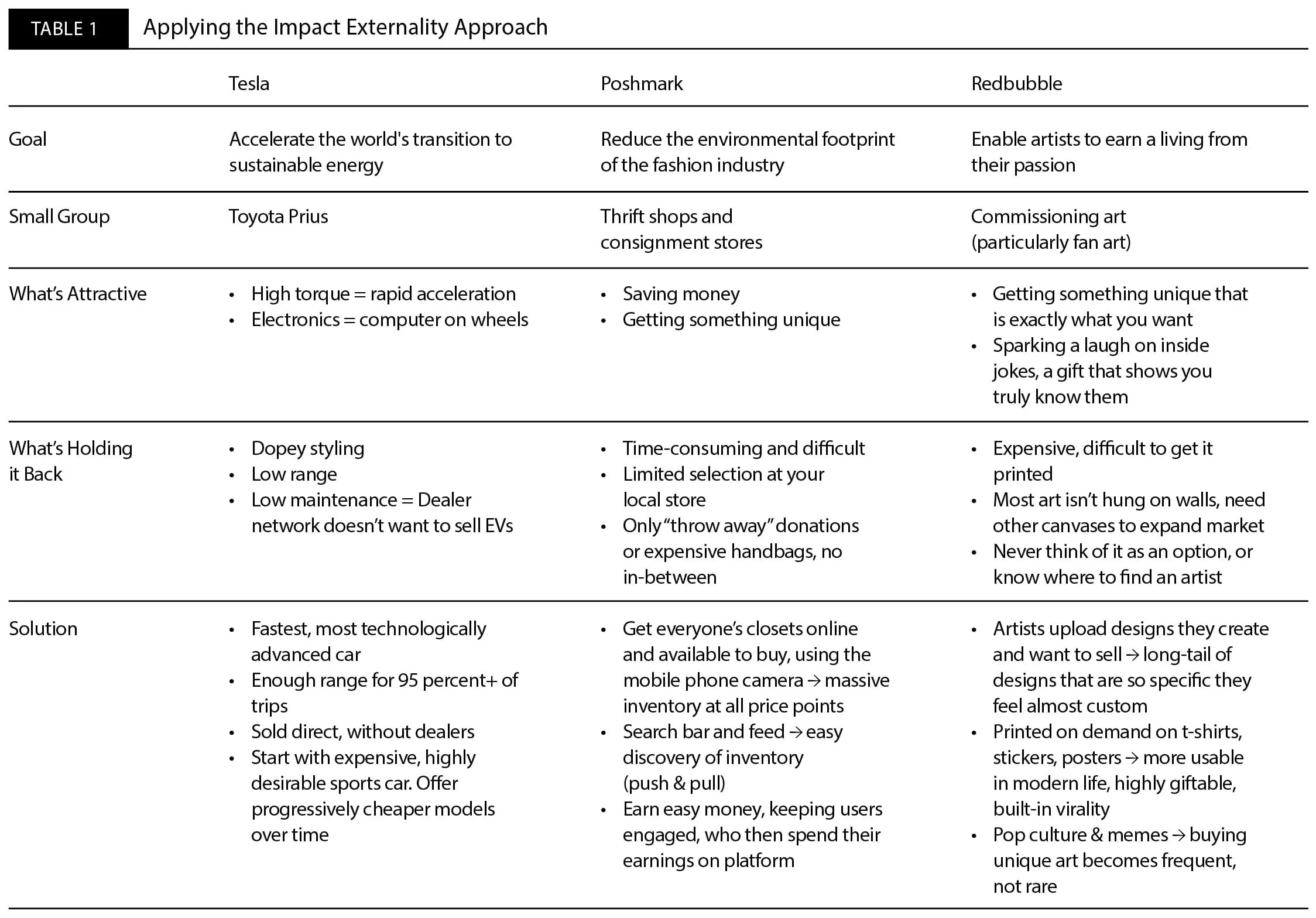
- Find a small group of customers already using the more sustainable approach. Who are they? What’s attractive about their sustainable approach? How does it work?
- Identify what unique strength it has that is attracting those people despite the trade-offs. How can you 10x that? How can you make the benefit both larger and more salient for customers?
- Identify what major issues are holding it back from mass adoption. How can you apply new technology to solve some of these? This can be everything from deep tech (higher-capacity batteries), lighter tech (use the mobile phone camera to make listing secondhand clothing easy), or non-tech (more-beautiful car design). You don’t need to solve all the issues, but you should find a way to radically solve at least one meaningful barrier.
- Solve at least one of the major issues, creating something that is dramatically better than the incumbent solution. Make sure you do this in a way they can’t copy, while solving some of the issues that have held people back before.
Thrift shopping existed before Poshmark, offering value and uniqueness, but with major limitations in convenience and selection. Electric vehicles existed before Tesla, offering low maintenance and high torque, but with severe compromises in range and appeal. Commissioned art existed before Redbubble, but it was expensive and was difficult to commission. Table 1 (next page) illustrates how three different impact externality businesses found their wedge.
The Leadership Imperative
As ESG loses favor, many socially-minded executives wonder “What’s next?” The compelling case for social and environmental impact hasn’t disappeared. Our message is empowering: the world’s most pressing problems are solvable by business leaders using skills they already possess – market positioning, growth, process optimization, and general business success.
The challenge is that incremental actions in current roles are unlikely to drive transformative change. You likely can’t do this in your current job. Impact externality businesses are classic disruptors, counter-positioning against incumbent solutions. Business leaders must boldly proclaim why their approach creates fundamentally better products than legacy companies can deliver.
The Path Forward
The future of business-driven social impact depends on aligning genuine market needs with broader societal benefits. This approach ensures sustainability, scalability, and profitability while positioning businesses to thrive by intrinsically contributing to social good. Moving beyond traditional ESG means embracing capitalism’s potential not as a burden to be managed, but as an unparalleled driver of transformative social change. For executives willing to think differently about the relationship between profit and purpose, the current ESG crisis represents not an ending, but a beginning.