


By Guilherme F. Frederico
Supply chain operations, having seen a sea change under Supply Chain 4.0, are now getting to grips with new kid on the block Supply Chain 5.0. But, in these days of perpetual motion, we shouldn’t be surprised that Supply Chain 6.0 is already being talked about.
In the last decade, the digital transformation also known as Supply Chain 4.0 has changed supply chains to a new level of development and performance. Soon after, Supply Chain 5.0 started to be discussed by leading voices in the field, bringing the proposal of a paradigm shift and new transformational elements over the Supply Chain 4.0 stage. These two supply chain revolutions are creating a scaffolding for the next, but still distant, generation of supply chains, Supply Chain 6.0. Hence, this article aims to discuss the evolution and characteristics of Supply Chain 4.0 and Supply Chain 5.0 and present what the next stage of supply chains might look like.
Supply Chain 4.0
Supply Chain 4.0 allowed a new level of productivity and performance for supply chains, improving aspects such as efficiency, flexibility, reliability, visibility, and transparency.
Industry 4.0’s technologies have brought significant improvements in terms of performance for today’s supply chains. Started in 2013, Industry 4.0 revolutionized processes by creating an interconnected environment between virtual and physical technologies. In this scenario, the Internet of Things (IoT) plays a crucial role in allowing cyber-physical systems across supply chains. Cyber-physical systems in supply chains mean that their main processes, like sourcing, manufacturing, and delivery, are self-controlled and self-executed by a perfect integration between virtual and physical technologies. Among these are big data analytics, artificial intelligence, cloud platforms, blockchain, augmented reality, digital twins, robotics, and 3D printing.
Supply Chain 4.0 allowed a new level of productivity and performance for supply chains, improving aspects such as efficiency, flexibility, reliability, visibility, and transparency, which enhanced collaboration and integration aspects in end-to-end supply chain flows.
Supply Chain 5.0
Years later, a provocative discussion began regarding a paradigm shift from a machine-centric approach to a more human-centric perspective. One main question that arose was whether this paradigm of a full machine-centric aim would really be more beneficial than a mixed approach, bringing together and valuing human skills (e.g. human intelligence, innovative capacity, and autonomy in decision-making) integrated with machines. This period also brought a consideration of, and demand for, greater focus on the need to meet sustainability requirements, as well as increasing resilience capabilities, especially in times when many disturbance events were occurring. More new technologies emerged, as well, especially those allowing more interaction with humans, like generative artificial intelligence and collaborative robotics (Cobots). So, all those elements, including all the developments from Supply Chain 4.0, shaped the pillars of Supply Chain 5.0.
Supply Chain 5.0 absorbs all the benefits from Supply Chain 4.0, especially those from the disruptive technologies, by valuing the human aspects and creating a more balanced approach between humans and machines. Supply Chain 5.0 also predicts that advanced technologies must contribute to a more sustainable and intelligent society, this principle originating from the Society 5.0 program, which was proposed by the Japanese government in 2016. The human perspective also goes beyond the organization’s boundaries, including a more personalized approach from the standpoint of customers, who need and desire more customization of products and services.
On the Path to Supply Chain 6.0
Although Supply Chain 6.0 is still hypothetical, it is more than likely that all knowledge and developments gathered from Supply Chain 4.0 and Supply Chain 5.0 will be the basis for it.
This new stage of supply chains will include technologies from Supply Chain 4.0 and Supply Chain 5.0, together with advancements on them and, potentially, new emerging technologies. The spectrum of performance is possibly going to be widened by including organizations, government, and society. The performance in this scenario will be jointly measured based on the impact over these external players, rather than only focusing on customer and shareholder expectations.
Supply Chain 6.0 is going to potentially contribute to a super-smart environment by offering intelligent, innovative, and personalized products and services, with the aim of generating a super-smart, sustainable, adaptable, and resilient society, capable of reacting to highly volatile and uncertain scenarios.
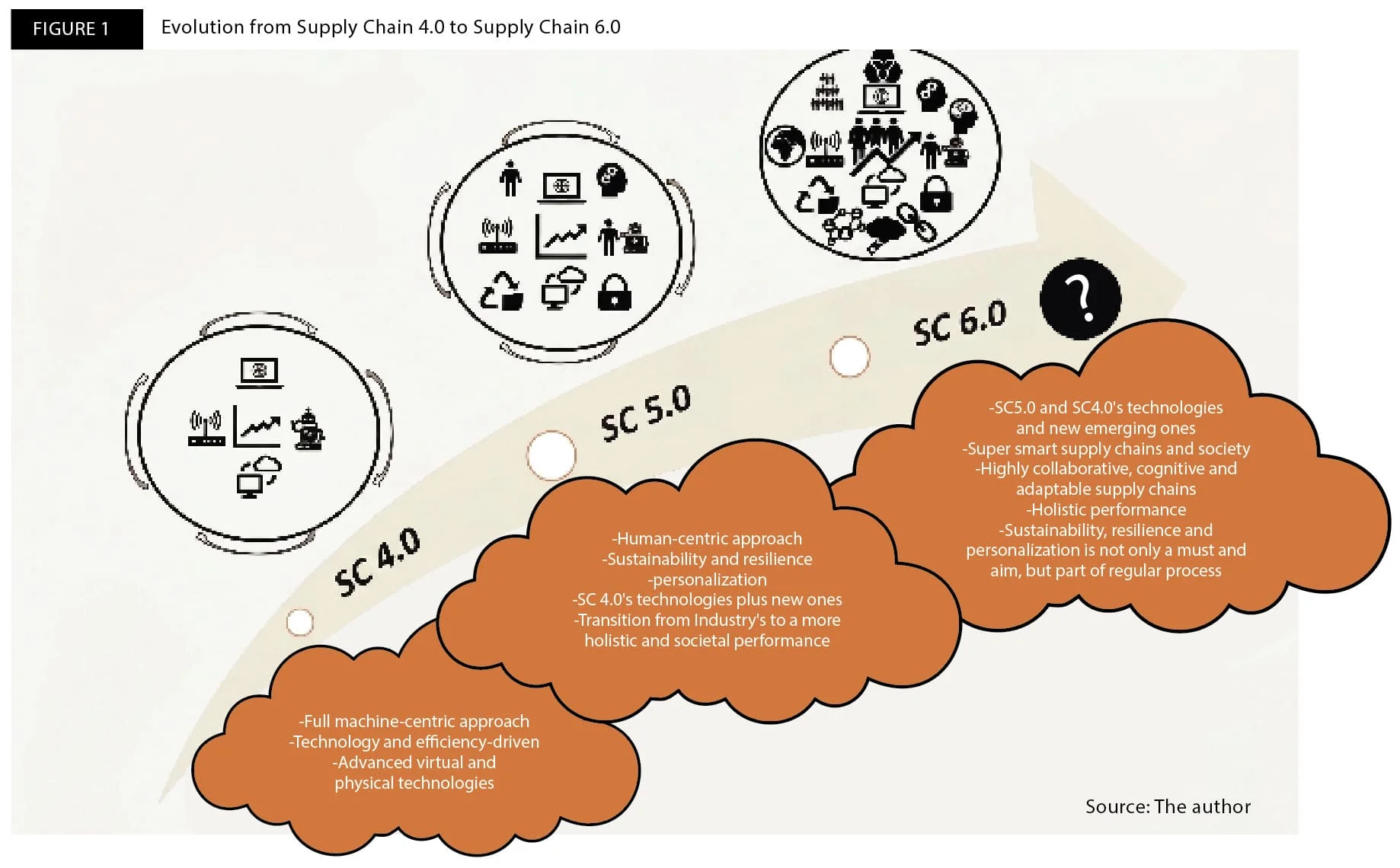
Another aspect is the possibility of highly collaborative and cognitive supply chains, allowed by advanced technologies, where not only will suppliers have real-time visibility and the ability to collaborate within the supply chain processes, but also customers may have the opportunity to participate in supply chain decision-making and customization, changing from a passive to an active part of the products and services generation.
This real-time collaboration also fosters sustainability processes and initiatives, especially those related to circular supply chains, which will become a normal and regular part of the flow, being subject to cooperation among all the supply chain members, rather than only through sporadic and project initiatives.
The complete order cycle is likely to be drastically changed by flowing directly from customers to suppliers, eliminating many intermediate steps and channels across the supply chain echelons. This will significantly increase responsiveness and resilience, making supply chains even more capable of responding rapidly to the impacts of a highly volatile and uncertain environment.


