

By Fernanda Arreola and Jean Giraux
As generative AI makes entrepreneurial knowledge widely accessible, competitive advantage increasingly depends on human judgment, contextual thinking, and strategic differentiation.
Generative AI is rapidly transforming entrepreneurship by making strategic analysis, business planning, and market intelligence more accessible than ever before. The article explores how this shift is changing the nature of competitive advantage. Fernanda Arreola and Jean Giraux examine why human judgment, contextual understanding, and critical thinking may become more valuable as AI-driven entrepreneurial intelligence becomes increasingly abundant.
The New Economics of Entrepreneurial Expertise
The rise of generative artificial intelligence is profoundly transforming entrepreneurship. Tasks that once required extensive market research, strategic reflection, or external consulting support can now be completed within minutes. Entrepreneurs can instantly generate business plans, draft business model canvases, conduct Porter’s analysis, produce competitor analyses, identify customer segments, create go-to-market strategies, or draft investor pitches using increasingly sophisticated AI systems.
For many founders, this represents a major acceleration in the entrepreneurial process. The barriers to accessing strategic knowledge are falling rapidly. What was once reserved for experienced consultants, incubators, or business schools is becoming widely available through conversational interfaces powered by large language models.
Yet this technological shift also introduces a paradox. As entrepreneurial intelligence becomes increasingly abundant, the real source of competitive advantage may no longer lie in the production of analysis itself, but in the ability to interpret, contextualize, and challenge it. In a world where AI can generate acceptable strategic recommendations at scale, entrepreneurial success may depend less on access to information and more on the quality of human judgment.
The Commoditization of Entrepreneurial Intelligence
According to the Stanford AI Index Report, advances in large language models have significantly improved the ability of AI systems to synthesize information, reason across domains, and generate business-oriented outputs. Simultaneously, firms such as OpenAI and Anthropic continue to accelerate the integration of generative AI into professional workflows and to work continuously on the reliability of the information.
As AI-generated entrepreneurial analysis becomes increasingly accessible, analytical production itself risks becoming commoditized.
For entrepreneurship, this democratization of strategic tools may lower barriers to entry and accelerate experimentation. Incoming Entrepreneurs with limited financial resources can now access forms of analytical support that were once available to entrepreneurs with larger teams and resources, breaking a frontier that made it difficult to access environments such as angel investors and venture capitalists.
However, as AI-generated entrepreneurial analysis becomes increasingly accessible, analytical production itself risks becoming commoditized. When every founder can generate a competent business plan or a convincing strategic presentation, analytical outputs lose part of their differentiating value. And we argue that they start looking alike.
This transformation echoes the observations of Herbert Simon, who argued that an abundance of information creates a scarcity of attention. Today, entrepreneurs are no longer constrained primarily by access to information, but by their ability to determine which information is meaningful, relevant, and strategically actionable. Furthermore, what information can lead them to generate valuable and distinctive business models?
The challenge is no longer producing entrepreneurial knowledge. It is interpreting it wisely.
Why Entrepreneurship Cannot Be Reduced to Prediction
Entrepreneurship has never been solely an analytical exercise. While strategic frameworks, business plans, and market analyses are very useful, entrepreneurial decision-making often depends on contextual understanding, intuition, timing, and the capacity to identify opportunities before they become obvious.
Generative AI systems operate through probabilistic prediction. They identify patterns from existing datasets and generate outputs that statistically resemble successful forms of reasoning. This makes them highly effective at producing causal entrepreneurial recommendations, based on previously available information. However, entrepreneurship rarely unfolds in stable or predictable conditions based on past data.
Entrepreneurs operate in environments characterized by uncertainty, ambiguity, emotional dynamics, evolving customer behaviors, and institutional complexity. They must frequently make decisions despite incomplete information and contradictory signals. Some of the most successful entrepreneurial opportunities emerge precisely because existing data fails to fully capture emerging social, technological, or cultural shifts. As Steve Jobs once said, “It’s not the customer’s job to know what they want.”
As a result, entrepreneurial expertise often relies on forms of tacit knowledge that remain difficult to codify.
The philosopher Michael Polanyi famously argued that individuals “know more than they can tell.” His concept of tacit knowledge is particularly relevant to entrepreneurship because much entrepreneurial judgment emerges from lived experience, field immersion, interpersonal interactions, experimentation, relationships, and intuition rather than explicit analytical rules.
Similarly, organizational theorist Karl Weick described organizations as systems engaged in continuous “sensemaking.” This distinction is critical because AI-generated entrepreneurial outputs may appear strategically coherent while overlooking subtle contextual factors and important emotional factors. A business opportunity identified by AI may ignore political tensions, cultural frictions, founder motivations, or weak signals detectable only through direct engagement with a market or ecosystem.
Consequently, the role of the entrepreneur increasingly shifts from generating information to interpreting and arbitrating it.
The Rise of Human-in-the-Loop Entrepreneurship
Interestingly, the AI industry itself already demonstrates the continuing importance of human expertise. A growing ecosystem of firms has emerged around the idea that AI systems require continuous human supervision, evaluation, and refinement. Companies such as Scale AI, Mercor, Surge AI, Invisible Technologies, and Prolific increasingly depend on networks of domain experts capable of evaluating nuance, contextual relevance, and strategic appropriateness.
These new organization of business models for AI systems, reveal a fundamental contradiction in many narratives surrounding AI automation. The most advanced AI systems still depend heavily on human discernment.
AI can accelerate analysis, but entrepreneurs remain responsible for framing problems, identifying opportunities, evaluating trade-offs, and making strategic commitments under uncertainty. Paradoxically, the more AI improves, the more valuable these uniquely human capabilities may become. Otherwise said, the more AI provides us with information, the deeper our own knowledge and analysis capacity should be.
The Red Queen Effect of AI
One of the most important yet underexplored consequences of generative AI for entrepreneurship may be the emergence of a new form of the “Red Queen Effect.” The Red Queen Effect describes situations in which organizations must constantly adapt and innovate simply to maintain their relative competitive position. Firms keep running faster, yet no one truly gains a durable advantage because competitors evolve simultaneously, and make decisions using the same information. Otherwise said, companies fail to create competitive value and differentiation, simply because their sourcing for information leads to similar strategic choices.
Historically, entrepreneurs developed competitive advantage partly through privileged access to information, unique market insights, or differentiated analytical capabilities. Market knowledge was unevenly distributed. Some founders possessed superior industry understanding, stronger networks, or more advanced strategic tools than others. These asymmetries created opportunities for differentiation.
Generative AI fundamentally alters this logic by democratizing access to entrepreneurial knowledge at an unprecedented scale. Today, thousands of entrepreneurs can ask nearly identical questions to similar AI systems and receive remarkably comparable answers. Today, founders risk generating strategies and analysis using the same underlying technological infrastructures.
As a result, AI does not merely accelerate entrepreneurial decision-making. It also risks standardizing it.
When firms rely on similar AI-generated analyses, they are increasingly exposed to the same strategic assumptions, the same market interpretations, and the same dominant patterns extracted from historical data. Over time, this may create a form of cognitive convergence in which entrepreneurs begin making similar decisions because they are trained, informed, and guided by similar machine-generated logic.
This is where the Red Queen dynamic becomes particularly important. As more companies adopt AI tools, firms are forced to use these systems simply to remain competitive in terms of speed, efficiency, and analytical capability. However, because competitors are using similar systems, the advantage rapidly erodes. Everyone runs faster, but everyone also runs in the same direction.
The danger is not only competitive acceleration. It is strategic homogenization.
If entrepreneurial ecosystems increasingly depend on the same predictive infrastructures, firms may unknowingly reproduce similar visions of opportunity, prioritize comparable markets, imitate dominant business models, and converge toward equivalent strategic responses. AI systems trained on existing success patterns naturally tend to reinforce prevailing market logic rather than radically challenge it.
The paradox of entrepreneurial AI is therefore striking. The more accessible strategic intelligence becomes, the greater the risk that entrepreneurial thinking itself becomes standardized. In such a world, sustainable competitive advantage may depend less on access to AI tools and more on the ability to escape the cognitive convergence those tools can produce.
This is why contextual judgment, strategic imagination, and human sensemaking become increasingly important in the AI era. Entrepreneurs capable of questioning AI-generated assumptions, interpreting weak signals, understanding local context, and imagining possibilities beyond dominant data patterns may become the true sources of differentiation.
Rethinking Entrepreneurial Education in the AI Era
The rise of generative AI also raises important questions for entrepreneurship education and incubation systems. For decades, entrepreneurship programs have emphasized business plans, market studies, financial projections, and strategic frameworks as central learning tools. However, if AI can increasingly automate these outputs, educational institutions may need to reconsider what entrepreneurial expertise truly means and what can be taught in the classroom.
The challenge is no longer simply teaching entrepreneurs how to produce analysis. It is teaching them how to interpret complexity, navigate uncertainty, challenge machine-generated assumptions, and exercise judgment in ambiguous environments. It is also how to create prototypes, ask questions to real-world actors, and explore the outside world.
Future entrepreneurial education may therefore place greater emphasis on critical thinking, contextual intelligence, creativity, ethical reasoning, adaptability, contact with the external environment, networking, and sensemaking capabilities. Rather than replacing entrepreneurial learning, AI may force educational institutions to focus more deeply on the uniquely human dimensions of entrepreneurship.
Conclusion: Judgment as the New Entrepreneurial Scarcity
If AI can increasingly automate these outputs, educational institutions may need to reconsider what entrepreneurial expertise truly means
Generative AI is transforming entrepreneurship by democratizing access to strategic and analytical capabilities. Entrepreneurial knowledge that was once scarce is becoming increasingly accessible and automated. Yet this abundance of analytical intelligence does not eliminate uncertainty. Nor does it replace the contextual understanding required to navigate complex entrepreneurial environments.
On the contrary, as AI-generated competence becomes widespread, the value of human discernment may increase significantly. The entrepreneurs who succeed in the coming years may not necessarily be those who generate the most sophisticated analyses, but those who best understand the limitations of those analyses.
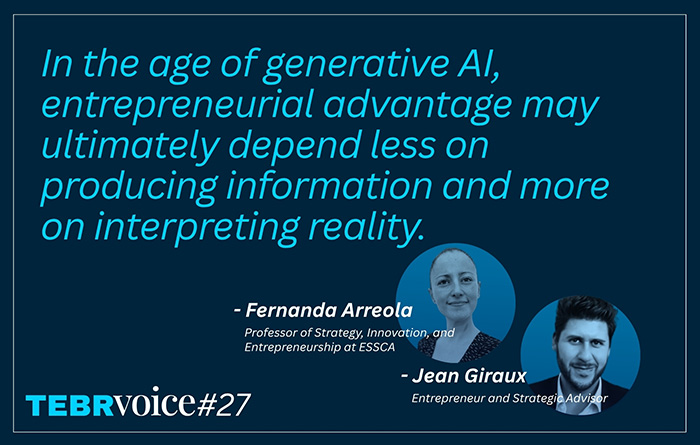
In the age of generative AI, entrepreneurial advantage may ultimately depend less on producing information and more on interpreting reality. In the long term, the entrepreneurs who create the greatest value may not be those who use AI most efficiently, but those who remain capable of thinking differently while everyone else is being guided by increasingly similar machines.
This may be key to success and value creation may be critical judgment!
 Fernanda Arreola
 Jean Giraux