

By Nick Hudson
Most procurement leaders are buying AI tools to speed up cycle times, but the evidence suggests the sequence is backwards.
Procurement leaders are under growing pressure to show visible AI progress, and many are buying tools before fixing how work actually moves. That sequence is backwards. AI does not fix procurement on its own. It accelerates whatever process already exists, broken or not. Across dozens of transformation conversations, the same pattern keeps surfacing: AI-tooling budgets are growing faster than the ways of working they are meant to support, and cycle times are barely moving.
Why Isn’t AI Moving the Needle on Procurement Cycle Times?
Procurement functions have spent heavily on AI over the past two years: spend-analytics platforms, contract-review copilots, supplier-risk scoring, RFP drafting assistants. Vendor demonstrations are compelling. Yet when procurement leaders are asked how much their average sourcing cycle time has actually fallen since adopting these tools, the honest answer is usually “not much,” or “we haven’t measured it.”
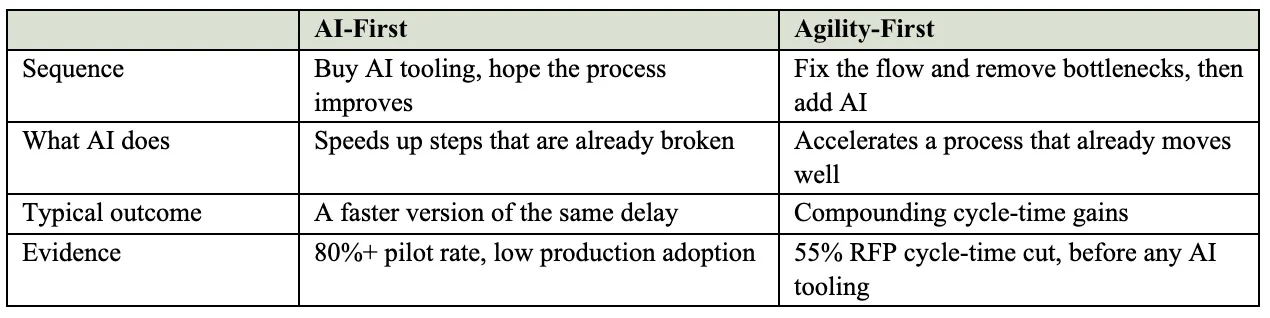
This isn’t a technology failure. The tools generally do what they claim. Nor is it a lack of appetite: industry research puts generative-AI pilot rates in enterprise procurement above 80%, yet only a small single-digit fraction reach mature, production-stage adoption. The problem is sequencing. AI is a multiplier, not a fix. If a sourcing process routes every RFP through six approval layers, a slow legal review, and a habit of re-litigating scope after supplier selection has begun, AI can summarise documents and draft clauses faster, but the process still has all of that in place. You get a faster version of a slow process; the bottleneck just becomes easier to see.
What Happens When You Fix Flow Before Adding AI?
We saw this directly working with a major telecoms group’s strategic sourcing function. Before any AI tooling was introduced, the team restructured how sourcing work actually flowed: smaller cross-functional teams, parallel rather than sequential review, decisions pushed to the people closest to the work instead of escalated upward by default. RFP cycle time fell by 55%, with no new software purchased. The gain came from removing structural friction, the same friction an AI tool would otherwise have simply helped people navigate a little faster.
This is not an argument against AI in procurement. It is an argument about order of operations. A sourcing function that fixes its flow first and adds AI second gets a compounding benefit: every unit of speed the tool provides lands on a process that can use it. A function that reaches for AI first is, in effect, paying to make its bottlenecks marginally less painful to sit inside.
What Happens When You Automate a Broken Process?
There is a well-worn line in operations circles: automating a bad process just lets you make mistakes faster. Procurement is proving it again with AI. A spend-analytics tool that surfaces savings opportunities is only useful if someone owns the decision to act on them within days, not the next quarterly review. A contract-drafting copilot only compresses turnaround if legal review isn’t queued behind four unrelated priorities.
The underlying constraint in each case isn’t information or drafting speed. It’s how decisions move through the organisation, who is authorised to make them, and how much handoff the process demands by habit rather than necessity. AI addresses the first constraint well; it does almost nothing for the second. A 2026 BCG supply chain study found procurement has the lowest AI adoption rate of any business function surveyed, with most initiatives stuck at a basic co-pilot stage delivering only marginal returns. In most functions we’ve examined, that organisational constraint, not the tooling, is what actually sets the pace.
What Does “Agility First” Actually Look Like in Procurement?
“Agility” gets used loosely enough in enterprise contexts that it is worth being concrete. In practice, applying agile, lean ways of working to procurement means a handful of specific, unglamorous changes:
- Smaller, empowered sourcing teams rather than large committees
- Visible, shared work queues instead of email-chain status chasing
- Decisions made at the point of most information rather than escalated by default
- Short, regular cycles of review rather than a single high-stakes sign-off at the end
None of this requires new software. It requires re-examining who needs to approve what, how many handoffs a typical RFP passes through, and where work sits waiting rather than moving. Most procurement functions have never mapped this: they know their average cycle time in aggregate, but not where the time actually goes, which is why the instinct is to buy a tool rather than fix a flow. Breaking a sourcing cycle into its component stages (specification, approval to go to market, evaluation, negotiation, sign-off) usually surfaces one or two stages responsible for most of the elapsed time, often approval and evaluation rather than the sourcing work itself. That is the stage to fix first, before any tooling conversation begins.
How Can Procurement Leaders Sequence AI Adoption Correctly?
The practical implication isn’t “don’t invest in AI.” It’s: map the process first, remove the bottlenecks you find, and only then layer AI on top of a process capable of moving fast. Done in that order, AI compounds a real gain instead of multiplying a hidden constraint.
A useful test before investing: can you show, in hard numbers, where cycle time actually goes, and has anyone tried removing steps rather than adding a tool around them? If not, that diagnostic work is the higher-value first move, and it costs far less than most AI platform licences.
The organisations seeing genuine cycle-time gains aren’t the ones with the newest AI stack. They’re the ones that fixed how work flows first, and are now using AI to accelerate a process that was already fast. Sequence matters more than spend.
Conclusion
The pressure on procurement leaders to show visible AI adoption is real, and it isn’t going away. But adopting AI onto a slow, over-approved process mostly produces a faster version of the same delay, dressed up as progress. The leaders who see genuine cycle-time gains are the ones willing to do the less glamorous work first: mapping how decisions actually move, removing unnecessary handoffs, and only then reaching for AI to accelerate what’s left. Sequence, not spend, is the differentiator.
 Nick Hudson