
By Pedro Hidalgo Insua
The engineering and construction sector faces a striking paradox: digital tools are proven to boost performance, yet adoption remains low. In this article, Pedro Hidalgo Insua explores how forward-thinking EPCs can turn this gap into an advantage, using AI, integrated data ecosystems, and modern commissioning tools to outperform slow-digitalizing competitors and strengthen long-term project success.
A report published at the end of 2024 by the Royal Institution of Chartered Surveyors highlights a paradox in which the engineering and construction industry finds itself – globally, particularly in Europe.
Here’s the paradox: most professionals agree that digital tools improve project delivery. When asked which areas would benefit most from digitalization, 63% identify cost estimation, prediction, planning and control; 57% cite developing an asset lifecycle or “whole-of-life” perspective and 55% pointed to better progress monitoring. In each case, almost all agree upon the benefits of digitalization.
Yet actual adoption remains stubbornly low. In fact, the share of firms not using any digital technologies on projects increases each year, rising from 40 to 43% between 2021 and 2023. European firms believe in the value of digitalization but are now the least likely to use them in comparison to companies in the Americas, the Middle East or APAC.
Putting Value on a Paradox
So, how much does this contradiction between this belief and the lack of progress in practice cost European firms?
When trying to answer this question, one can focus on project performance. The Boston Consulting Group found that the use of digital technologies by E&C firms tended to reduce construction time by 15%-30% and cut lifetime costs by 20%.
But that’s only part of the equation. With several countries such as the UK, Germany, France and Spain mandating the use of BIM or digital twins in public-sector tenders, low digital adoption also represents loss of revenue. Lack of digital capabilities for project selection or project controls can also lead teams to avoid valuable projects by excess of pessimism or conservatism, or to submit uncompetitive bids because of poor cost or risk estimates and lack of benchmark data.
So how can forward-looking EPCs turn this situation to their advantage? The following are four concrete digital strategies that not only address the common barriers to adoption but also build a clear competitive edge over slow adopters.
#1 Leveraging AI to Strengthen Project Controls and Progress Measurement
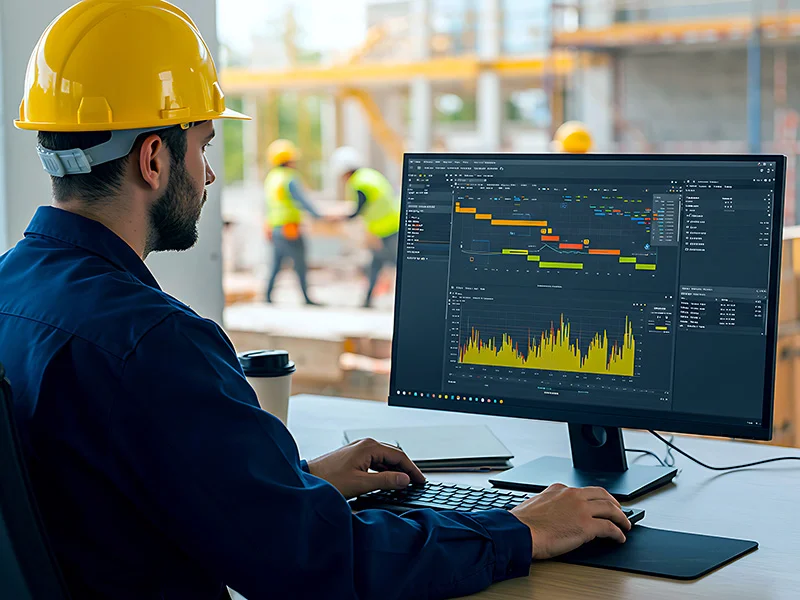
When surveying large engineering and construction firms (for example, as part of our research into high-performing projects), one consistent finding is that firms fall into one of three groups. Roughly a third deliver on their time and budget commitments in 80% of their projects or more. Another third does so between 50-80% of the time.
This disparity highlights a profound challenge in project controls. Major projects across multiple sectors suffer massive financial losses due to inefficiencies, often stemming from inadequate control mechanisms. A 2021 study by KPMG revealed that major projects, on average, experienced $100 million USD in losses due to waste, with inadequate controls identified as the leading cause. This waste is often rooted in a reliance on manual data entry, subjective status reports and siloed spreadsheets, which collectively create poor visibility into true progress until it is too late to course-correct.
To address this pain point, leading EPCs are automating data capture and shifting toward approaches like Enterprise Project Performance (EPP) that can now be enriched with Artificial Intelligence. This shift replaces traditional subjective measurements, which often suffer from optimism bias and inconsistency, with objective data. For example, construction schedules are now being directly linked with real-time indicators such as quantities installed (via barcode or RFID scans) or actual work completed. AI and Machine Learning then analyze these patterns to predict potential outcomes, which allows for proactive intervention; for example, by flagging that a project is likely to slip a key milestone or suggesting more efficient resource allocation.
Platforms like Hexagon’s EcoSys™ exemplify this modern approach. As a leading EPP solution, EcoSys addresses poor progress visibility by integrating all key project functions, including scheduling, cost control and resource management, as well as connecting to diverse data sources like ERP systems and field applications. This integration establishes a single source of truth for project performance, injecting the necessary objectivity and consistency into decision-making.
It should be noted, however, that the shift requires more than just the software. True performance uplift is dependent on foundational organizational changes, including process standardization, robust data governance frameworks and a profound cultural shift toward data-driven decision-making across the organization.
When these systems are properly implemented, the impact on success rates is significant. According to a 2022 survey by Logikal, while only 5% of projects fully automate their project controls data, those projects report a 79% success rate in meeting targets.
#2 Collecting, Structuring and Contextualizing Project Data Within a Single Interface
Slow adopters tend to treat project data in a fragmentary way— each phase and department generates its own trove of emails, documents and spreadsheets that often vanish into archives after project close-out.
Three numbers demonstrate how doomed this strategy is: the World Economic Forum found that, on average, a single large infrastructure project today could produce 130 million emails, 55 million document and 12 million work orders. Keeping this volume of information buried in individual inboxes or disparate systems means thousands of hours wasted searching for information. It also leads workers to rely on memory or intuition rather than data.
Leading EPCs address this through integrated data ecosystems—a shift that requires both technological infrastructure and cultural change. These ecosystems are structured around platforms like digital thread or a project/asset digital twin. They spread information across traditionally separate domains (design, procurement, construction, operations).
For example, engineering models and tags can be linked to procurement statuses, which link to construction progress and then feed into an asset management system for operations. The result is greater speed and efficiency across the chain: for instance, when an engineering change occurs, an integrated system automatically notifies affected procurement orders, updates construction schedules and flags potential impacts on commissioning process that would take days or weeks within fragmented systems.
Contextualizing data like this means at any point in the lifecycle, the right people can access trusted, up-to-date information. This lifecycle approach also enables powerful analytics: AI can be applied to the unified dataset to find patterns (e.g. which contractors consistently perform better) or to forecast outcomes across the project portfolio.
Importantly, data connectivity needs to accompany the mere addition of tools. Without integration, adding more digital tools can ironically create extra work as teams jump between systems. It’s no surprise that 73% of EPC executives say lack of data integration has a “strong or severe” negative impact on their operations.
The high-performing EPCs avoid this trap by investing in platforms that speak to each other, often via standards like CFIHOS (Capital Facilities Information Handover Specification) for handover data and by enforcing data governance practices. The results are tangible: less time spent cobbling together reports and more time using information to make decisions.
#3 Avoiding Project Derailment at Commissioning and Handover

Another high-impact area where conventional practices fall short is completions, commissioning and handover to the owner/operator.
Traditionally, preparing turnover dossiers while ensuring every test, inspection and punch-list item is complete typically involves coordinating hundreds of documents across multiple contractors—a process prone to documentation gaps, version control issues and coordination failures between multiple stakeholders. These practices are also highly inefficient: as the Construction Industry Institute notes, “Commissioning failures are too common in frequency and extremely costly in impact. The business case for action is clear”.
So, what does this action look like? Modern completions management systems like Intergraph Smart® Completions turn this into a digital process. All asset information, checklists and test results are captured in a centralized database, with automated tracking Smart Completions of outstanding tasks. The payoff can be significant: on one Australian LNG megaproject, adoption cut the compilation and delivery time of commissioning dossiers by 98%.
Such tools also benefit the EPC in two important ways. First, commissioning is embedded in the design and construction processes rather than treated as an afterthought, which reduces rework, delays and other unforeseen issues during final testing. Second, they drive standardization, repeatability and continuous improvement rather than handling each project as one of a kind.
This emphasis on standardization is crucial: consistently delivering projects on time and on budget requires repeatable processes, not heroic efforts on each project. This consistency requires the effective use of data, from project selection to handover, to reduce risk and guesswork and increase margins.
The tools and methodologies exist and with digitalization adoption still lagging across much of the industry, early movers can establish a significant competitive advantage before digital maturity becomes a baseline expectation, rather than a differentiator.
Discover how Hexagon’s solutions, including project twins and EcoSys, our Enterprise Project Performance platform, can help you digitalize processes and achieve greater project performance here.