By Jacques Bughin and Patrick Hermann
Ten facts every European executive and investor should know — and why the biggest opportunity may be to make existing physical capital earn more, not simply to replace labor.
For the past several years, the economic consequences of artificial intelligence have largely been discussed as a digital phenomenon. Generative AI writes, codes, analyses and creates. Agentic AI goes further: it plans, uses tools and takes digital actions. The next frontier is increasingly physical.
NVIDIA has popularised the term “Physical AI” for artificial intelligence that perceives, reasons and acts through robots, vehicles, machines and industrial systems. Google DeepMind is connecting multimodal reasoning with robot action. Amazon is using foundation models to coordinate one of the world’s largest robotic fleets. BMW and other manufacturers are taking humanoids out of the laboratory and into selected production tasks.
The shortest route to economic impact may therefore be to add perception, intelligence, coordination and learning to the installed base rather than to replace it.
The resulting forecasts are enormous — and extraordinarily dispersed. Morgan Stanley sees a humanoid ecosystem exceeding $5 trillion by 2050. J.P. Morgan’s broader robotics scenarios range from roughly $0.5 trillion to $8 trillion of annual revenue by 2035. Goldman Sachs is much more conservative about humanoids specifically, with a roughly $38 billion 2035 estimate. This forecast dispersion is not a nuisance. It is evidence that the market is still moving from functionality toward reliable economics.
For management, the more useful question is therefore not whether there will be one hundred million or one billion humanoids. It is what is already economically real, what still has to improve, and which layer of the emerging stack can capture value if machines become progressively more intelligent.
Fact 1: Robots are not a future market. Millions are already working.
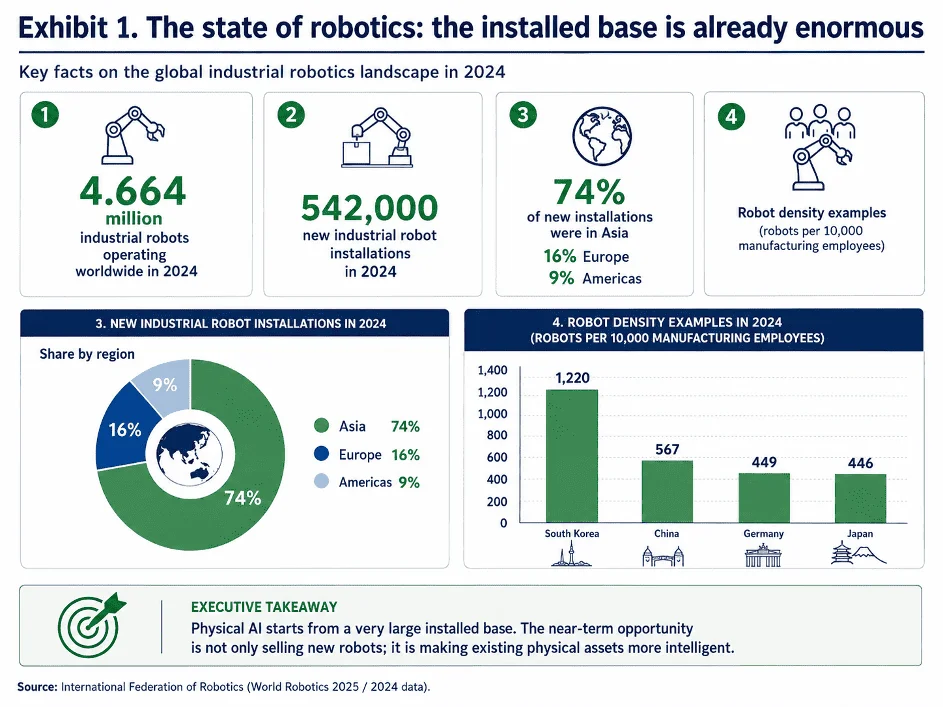
The starting point is easy to miss because so much of the current discussion focuses on humanoid prototypes. Industrial robotics is already a very large installed technology base. The International Federation of Robotics reports 4.664 million industrial robots operating worldwide in 2024, up 8.9% in a year. A further 542,000 robots were installed during 2024 — more than twice the annual number a decade earlier — and annual installations have exceeded half a million for four consecutive years (IFR, 2025).
This matters because Physical AI is not entering an empty market. It is arriving on top of millions of robots, machines, conveyors, workstations and industrial control systems that companies already own. The shortest route to economic impact may therefore be to add perception, intelligence, coordination and learning to the installed base rather than to replace it.
Fact 2: The robotics center of gravity has shifted toward Asia. Europe needs a different way to win.
Asia accounted for 74% of new industrial-robot deployments in 2024, compared with 16% for Europe and 9% for the Americas. China alone installed about 295,000 robots — 54% of the global total — and its operational stock exceeded two million units. Europe installed about 85,000 robots, down 8% year on year, although that remained the second-highest number in its history (IFR, 2025).
Robot density reinforces the message. Korea leads the world with 1,220 robots per 10,000 manufacturing workers; China is at 567; Germany at 449; Japan at 446; and the global average at 177. Europe remains highly automated and retains deep strengths in industrial engineering, factory software, machine tools and process know-how. But it is unlikely to outscale China simply by manufacturing more robot bodies.
The more attractive European position may be the intelligence layer around the industrial installed base: robot learning, industrial perception, operational data, vertical simulation, safety, process control and orchestration. This is the point at which Europe’s installed capital and domain expertise can become an advantage rather than a legacy burden. Exhibit 1 summarizes the scale and geography of the installed base.
Fact 3: What is genuinely new is not the robot body. It is reprogrammability.
Traditional industrial automation is extremely productive when products, layouts and tasks are stable. Its economic weakness is rigidity. New variants can require reprogramming, dedicated fixtures, engineering work and line changes. This makes conventional automation attractive for high-volume repetition but less compelling in higher-mix environments.
Robot foundation models attack that friction. Open X-Embodiment pooled experience from 22 robot embodiments, 21 institutions and hundreds of skills, providing evidence that heterogeneous robot experience can produce positive transfer. OpenVLA subsequently trained a seven-billion-parameter vision-language-action model on roughly 970,000 real-world robot demonstrations and reported materially higher task success than RT-2-X across its evaluated tasks and embodiments (Open X-Embodiment Collaboration, 2024; Kim et al., 2024).
The economically interesting derivative is not a benchmark score. It is whether experience from robot or task j increases capability on robot or task i. If that transfer becomes robust, the cost of automating the next task can fall because previous deployments have already generated data, representations and reusable skills.
Fact 4: Synthetic data can change the economics of the robot “brain”.
Digital AI benefited from an enormous historical gift: the internet had already generated vast amounts of text, images, software and video. Robotics has no comparable natural corpus of aligned instructions, trajectories, actuator states, forces, tactile information, interventions and outcomes. Real physical experience is expensive to collect, slow to diversify and constrained by safety.
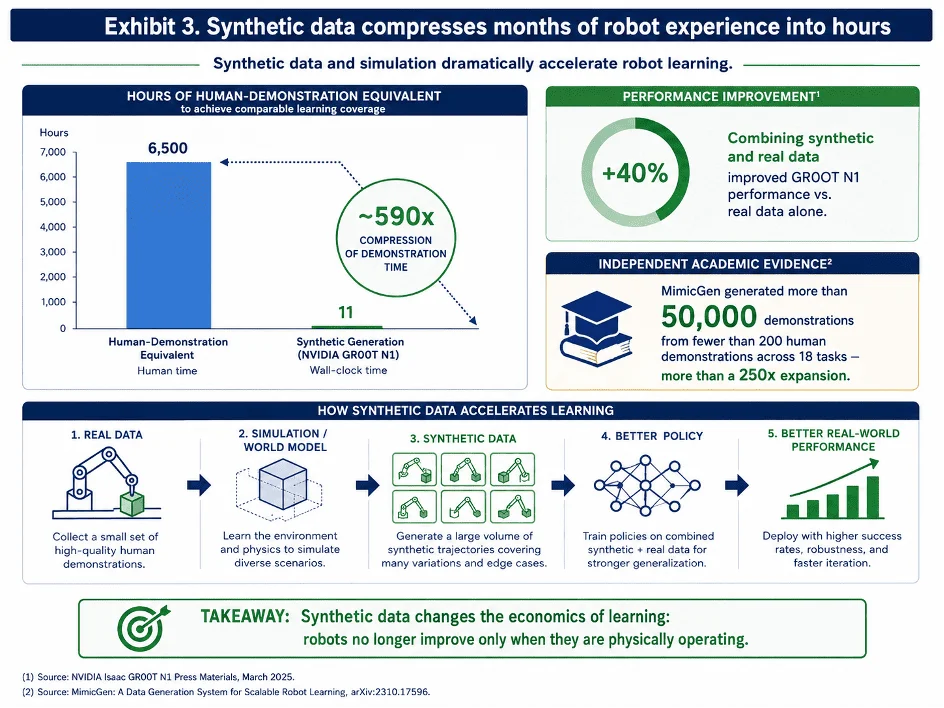
Synthetic data attacks this bottleneck. In 2025, NVIDIA reported generating 780,000 synthetic robot trajectories in 11 hours using its Isaac GR00T workflow — the equivalent of 6,500 hours, or roughly nine continuous months, of human demonstration data. When NVIDIA combined the synthetic data with real data, it reported a 40% improvement in GR00T N1 performance versus using real data alone (NVIDIA, 2025). The arithmetic implies roughly 591 times compression of demonstration time. That should not be confused with a 591-times reduction in fully loaded cost, but it illustrates the potential scale effect.
Independent academic work points in the same direction. MimicGen generated more than 50,000 demonstrations across 18 tasks from roughly 200 human demonstrations — more than a 250-times expansion — and found that generated data could compare favorably with gathering additional human demonstrations (Mandlekar et al., 2023).
This changes the economics because a physical asset no longer has to learn only while occupying the factory floor. A digital twin or simulation can expose the policy to rare events, alternative layouts, new objects and failure modes without interrupting production or risking equipment. Real experience becomes the seed for much larger synthetic experience. Exhibit 3 shows why synthetic data can bend the learning curve.
Fact 5: The robot brain is improving faster than the robot body.
The counterweight to the synthetic-data story is embodiment. Modern models increasingly understand what a task means. That does not mean the machine can reliably perform it. Physical work contains hidden states — friction, pressure, slip, deformation, contact stability and whether a component is truly seated — that vision alone may not reveal.
TouchWorld, one of the recent tactile-foundation-model systems, reports 65% success across six contact-rich tasks in clean conditions and 53.7% under human perturbation. That is meaningful research progress, but it is far from the reliability expected from a production asset. The ORCA work similarly demonstrates how rapidly lower-cost tactile hands are improving, while also showing that laboratory durability tests are a long way from multi-shift industrial life.
The managerial lesson is that semantic competence, dexterity, robustness, and safe autonomy are separate variables. The final few percentage points of reliability often carry much more economic value than the first spectacular demonstration. A robot that is 95% successful on one action can be deeply unreliable across a long sequence because errors compound.
Fact 6: Amazon shows that robots can increase the productivity of space and capital, not just labor.
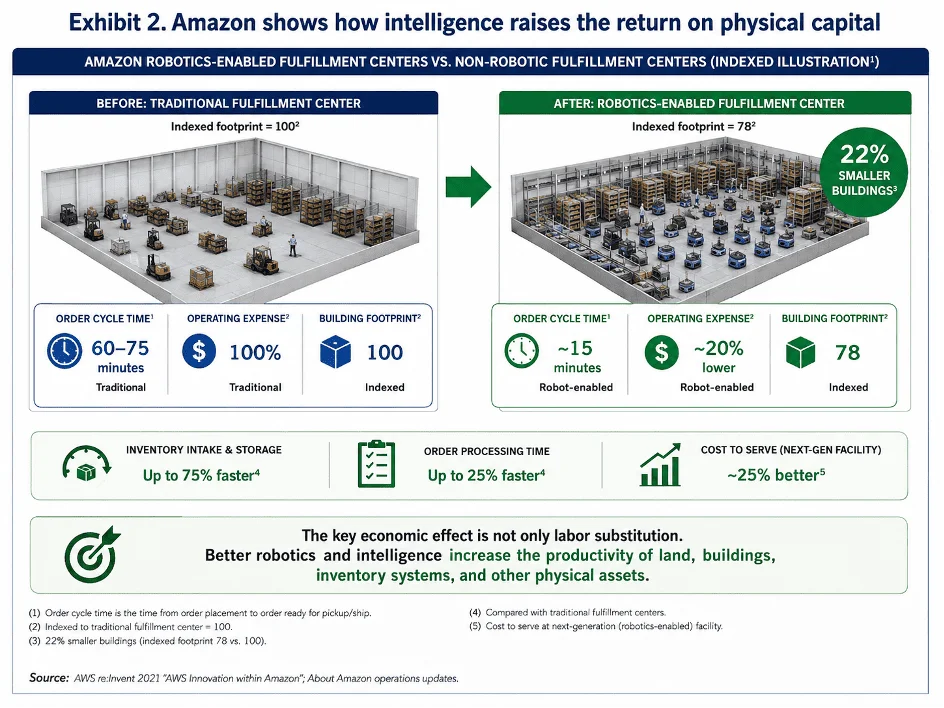
Amazon may be the most important near-term Physical-AI case precisely because its economic impact does not depend on humanoids. An official Amazon Web Services presentation comparing robotics-enabled and non-robotic fulfillment centers reported 22% smaller buildings, roughly 20% lower operating expenses and order-cycle times falling from 60–75 minutes to around 15 minutes (AWS, 2021).
Newer systems reinforce the pattern. Amazon says Sequoia can identify and store inbound inventory up to 75% faster and reduce order-processing time by up to 25%. Its next-generation Shreveport facility targets roughly a 25% improvement in cost to serve. DeepFleet, a foundation model used to coordinate Amazon’s large robotic fleet, is expected to improve robot travel efficiency by roughly 10% (Amazon, 2023–2025).
This is a much larger story than labor replacement. If a robotic architecture needs 22% less building area for a given activity, it improves the productivity of real estate and infrastructure. If a 10% efficiency gain releases enough capacity to postpone the next warehouse or production module, a small operating improvement can defer a large and lumpy capital investment. Exhibit 2 makes the capital-productivity effect visible.
Fact 7: Humanoids have crossed from demonstration to selected factory work — but not general labor.
Humanoids should therefore neither be dismissed nor overinterpreted. BMW provides one of the clearest public factory cases. During a roughly ten-month pilot in Spartanburg, Figure 02 supported production associated with more than 30,000 BMW X3 vehicles, moved more than 90,000 components, took around 1.2 million steps and accumulated approximately 1,250 operating hours. The task was bounded: retrieving and positioning sheet-metal components for welding (BMW Group, 2026).
The case matters because it moves humanoids beyond a staged video. But it does not demonstrate a general factory worker capable of discovering and executing arbitrary tasks. The likely near-term path is task-family expansion: increasingly useful behavior in controlled and semi-controlled environments, with human intervention handling exceptions.
Humanoid morphology does have a unique economic advantage. The industrial world has been built around human bodies: stairs, aisles, workstations, shelves, tools and machine interfaces. A specialized robot may be mechanically superior at a particular activity but require the factory to be redesigned around it. A more flexible human-compatible machine may occasionally win at the system level even if its unit hardware cost is higher.
Fact 8: Robot price is the wrong metric. The right metric is cost per successful autonomous task.
The most common economic comparison is robot purchase price versus worker wage. That is too narrow. A useful Physical-AI cost needs to include annualized hardware, integration, maintenance, inference and software, energy, human supervision, downtime, rework and expected failure losses. The denominator then needs to include scheduled hours, technical uptime, autonomous-success probability and quality-adjusted throughput.
In simplified form: fully loaded task cost = total system cost divided by successful, quality-adjusted autonomous output. This explains why a cheap robot can be expensive and why an expensive robot can be economic. The denominator often matters more than the sticker price.
It also explains why the cost curve can fall faster than the hardware price. Hardware cost can decline at the same time that uptime rises, task success improves and one human can supervise more machines. Physical AI therefore potentially has two interacting learning curves: learning by making lowers hardware cost; learning by operating improves intelligence, transfer and autonomy.
Fact 9: Polysense illustrates Physical AI without buying a new factory.
The most attractive Physical-AI systems may not look like robots at all. Polysense, a Belgian company backed by Fortino Ventures and others, applies AI-native machine vision and process control to food manufacturing. Cameras inspect products continuously at production speed; the system turns visual variation into quality data; and AutoControl can use those data to adjust process parameters such as peeling, cutting or sorting in real time (Polysense, 2026).
The capital logic is important. Polysense states that it installs on existing production lines with minimal hardware changes and integrates with the existing control layer through industrial protocols. Its 2026 financing announcement also describes the use of real-time imaging and synthetic-data models. In other words, the customer does not need to replace an expensive line in order to make the line more intelligent.
This is arguably a cleaner expression of Physical AI than a humanoid. The sequence is sense, measure, learn, decide, act and measure again — all on top of an existing physical asset. The result can appear in yield, waste, consistency, quality, uptime and cost per unit. The intelligence layer is economically small relative to the capital it can influence.
For Europe, this model is particularly important. The region’s comparative advantage may lie less in building the cheapest general-purpose robot and more in embedding AI into complex, high-value physical processes where industrial data, domain physics, quality standards and integration knowledge matter. Exhibit 4 shows the resulting closed-loop architecture.
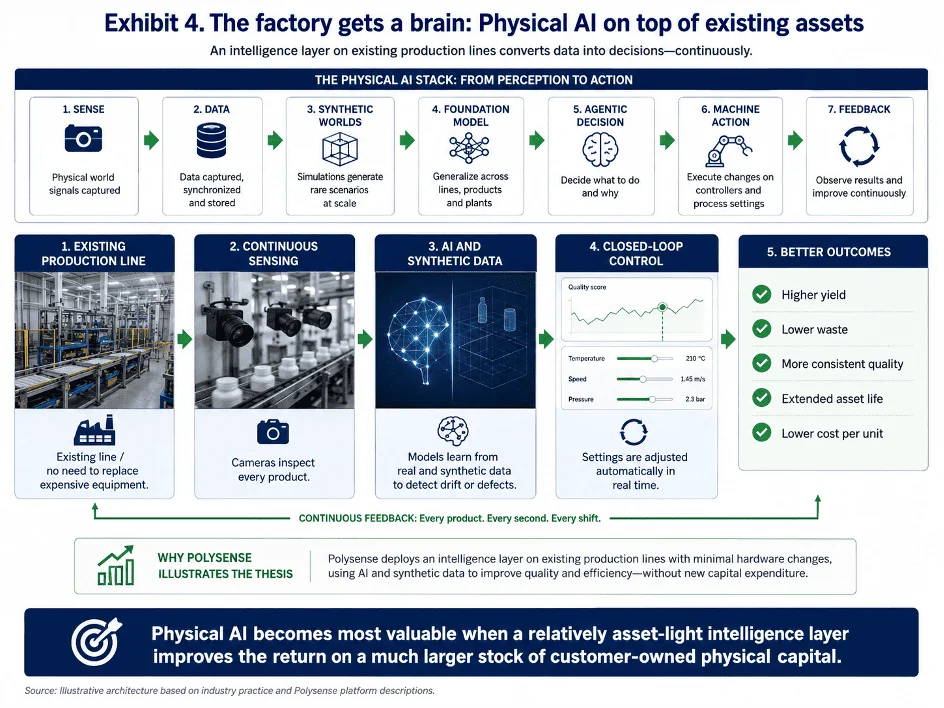
Fact 10: The biggest opportunity is higher return on physical capital. That is why the intelligence layer can have venture economics.
The conventional robotics story begins with labor. The larger investment thesis begins with the balance sheet. European companies have already sunk enormous amounts of capital into buildings, production lines, tooling, storage systems, machines, conveyors and automation. Much of that infrastructure was designed around a particular product and a particular division of labor.
Physical AI can create value by making that installed capital more productive and more flexible. It can reduce downtime, improve yield, increase throughput, shorten changeovers, defer line modifications and extend asset life. In some cases it can reduce the amount of new dedicated capital needed when products change. The economic value is therefore better represented as labor savings plus quality, throughput, safety, avoided capex, asset-life extension, flexibility and learning.
Consider a deliberately simple illustration. A €500 million plant that improves its economic return by only one percentage point creates €5 million of annual value. If a technology provider captures 10% of that value, a €500,000 annual contract can be economically rational for the customer. One hundred such customers would produce €50 million of annual recurring revenue while the platform influences perhaps €20 billion of customer-owned physical capital.
That is the key to venture-scale economics. The startup does not have to finance €20 billion of factories. It owns the intelligence layer applied to them. If every deployment also makes the next deployment faster or better through reusable models, data and task libraries, then revenue can scale faster than the vendor’s physical-capital requirement. The business begins to look much more like enterprise software built on industrial assets than like an equipment manufacturer funded with expensive venture equity.
What European executives should do now
The current moment calls for neither robotics exuberance nor passivity. The useful starting point is not the robot catalogue. It is the physical asset base and the frictions preventing it from earning more.
- Identify where valuable assets are underutilized because labor, changeovers, quality drift or exceptions constrain throughput.
- Find product changes that trigger disproportionate retooling or fixture costs; these are natural targets for flexible automation.
- Measure the fully loaded cost per successful autonomous task, not list price or powered-on hours.
- Track intervention minutes per robot-hour and the number of machines one human can supervise.
- Treat every pilot as a data and learning investment: does deployment n make deployment n+1 cheaper, faster or more reliable?
- Own or contractually secure access to physical operating data, failure traces and derived skill libraries.
- Look for intelligence that can improve existing lines and machines before assuming the business case requires replacement capex.
- Preserve options. The uncertainty around humanoids is large; the opportunity in industrial intelligence does not depend on resolving it today.
The bottom line
The defining question for the next decade may therefore be less “How many robots will we build?” and more “How much more productive can intelligence make the physical capital already around us?”
The most visible symbol of Physical AI is the humanoid robot. The economically important shift is broader. Millions of industrial robots already exist. Amazon is making an installed fleet smarter with foundation models. Synthetic data is compressing months of demonstration experience into hours. Polysense is adding intelligence and closed-loop control to existing food-production lines. BMW is demonstrating that humanoids can perform selected industrial tasks outside the laboratory.
At the same time, the negative evidence matters. Robustness, dexterity and safety remain far behind the most spectacular demonstrations. General-purpose physical intelligence has not yet proven scalable economics.
Companies do not need to wait for that end state. If intelligence can raise the productivity, flexibility and useful life of physical assets that firms already own, the opportunity is already substantial. The defining question for the next decade may therefore be less “How many robots will we build?” and more “How much more productive can intelligence make the physical capital already around us?”
For Europe, that is not merely a robotics question. It is a capital-productivity strategy — and potentially one of the most important applications of AI to the real economy.
About the Authors
 Jacques Bughin is the CEO of Machaon Advisory and a former professor of Management. He retired from McKinsey as a senior partner and director of the McKinsey Global Institute. He advises Antler and Fortino Capital, two major VC /PE firms, and serves on the board of several companies.
 Patrick Hermann is a partner at Fortino Capital.
References
Amazon Web Services (2021). “Automation at Scale: Amazon Robotics.” AWS re:Invent, MFG203. Reports 22% smaller buildings, ~20% lower operating expenses, and order-cycle time reduced from 60–75 minutes to ~15 minutes versus non-robotic fulfillment centers. https://d1.awsstatic.com/events/reinvent/2021/AWS_innovation_within_Amazon_MFG203.pdf
Amazon (2023). “Amazon announces new fulfillment center robots, Sequoia and Digit.” Sequoia identifies and stores inventory up to 75% faster and reduces order-processing time by up to 25%. https://www.aboutamazon.com/news/operations/amazon-introduces-new-robotics-solutions
Amazon (2024). “See 18 photos of Amazon’s newest fulfillment center powered by AI and robotics.” Reports up to 25% lower fulfillment processing time and a target 25% improvement in cost to serve at the Shreveport next-generation facility. https://www.aboutamazon.com/news/operations/amazon-fulfillment-center-robotics-ai
Amazon (2025). “Amazon deploys over 1 million robots and launches new AI foundation model.” DeepFleet is reported to reduce robot travel time by 10%. https://www.aboutamazon.com/news/operations/amazon-million-robots-ai-foundation-model
BMW Group (2026). “First humanoid robot introduced in Plant Leipzig.” Includes operating evidence from the Figure 02 Spartanburg pilot. https://www.bmwgroup.com/en/news/general/2026/humanoid-robot-in-leipzig.html
International Federation of Robotics (2025). World Robotics 2025: Industrial Robots. 542,000 new industrial robots installed in 2024; 4.664 million operational stock; Asia 74% of new deployments; Europe 16%; China 54%. https://ifr.org/worldrobotics/report-2025
International Federation of Robotics (2025). “Automation is a Cornerstone of Modern Manufacturing.” Robot density: Korea 1,220; Singapore 818; China 567; Germany 449; Japan 446; global 177 robots per 10,000 manufacturing workers. https://ifr.org/post/automation-is-a-cornerstone-of-modern-manufacturing
Kim, M. J., et al. (2024). “OpenVLA: An Open-Source Vision-Language-Action Model.” Conference on Robot Learning / arXiv:2406.09246.
Mandlekar, A., Nasiriany, S., Wen, B., Akinola, I., Narang, Y., Fan, L., Zhu, Y., & Fox, D. (2023). “MimicGen: A Data Generation System for Scalable Robot Learning using Human Demonstrations.” Proceedings of the 7th Conference on Robot Learning, PMLR 229, 1820–1864. arXiv:2310.17596.
Morgan Stanley Research (2025). “Humanoids: A $5 Trillion Market.” https://www.morganstanley.com/insights/articles/humanoid-robot-market-5-trillion-by-2050
NVIDIA (2025). “NVIDIA Announces Isaac GR00T N1 — the World’s First Open Humanoid Robot Foundation Model — and Simulation Frameworks to Speed Robot Development.” Reports 780,000 synthetic trajectories generated in 11 hours, equivalent to 6,500 human-demonstration hours, and a 40% performance improvement from combining synthetic and real data. https://investor.nvidia.com/news/press-release-details/2025/NVIDIA-Announces-Isaac-GR00T-N1–the-Worlds-First-Open-Humanoid-Robot-Foundation-Model–and-Simulation-Frameworks-to-Speed-Robot-Development/default.aspx
Open X-Embodiment Collaboration (2024). “Open X-Embodiment: Robotic Learning Datasets and RT-X Models.” IEEE International Conference on Robotics and Automation (ICRA), 6892–6903. arXiv:2310.08864.
Polysense (2026). “Polysense Intelligence” and “Polysense AutoControl.” Existing-line integration, continuous inline inspection and closed-loop process adjustment. https://www.polysense.ai/ ; https://www.polysense.ai/platform/polysense-autocontrol
Polysense (2026). “Polysense raises $10.7 million to shape the food factory of the future with AI and computer vision.” Describes real-time imaging data and synthetic-data models. https://www.polysense.ai/blog/polysense-raises-107-million-seed-round-food-manufacturing
VerWey, J. (2026). Physical AI: A Primer for Policymakers on AI-Robotics Convergence. Center for Security and Emerging Technology, Georgetown University. https://doi.org/10.51593/20250023
Zhou, J., et al. (2026). “TouchWorld: A Predictive and Reactive Tactile Foundation Model for Dexterous Manipulation.” arXiv:2607.07287.