
By Jacques Bughin
Software is the canary in the AI coal mine. After only a few quarters, commercial AI is already associated with a widening growth frontier — suggesting that ubiquitous access to intelligence may concentrate, rather than democratize, its economic returns.
For much of the past two years, executives and investors have oscillated between two extreme interpretations of artificial intelligence. One holds that enterprise AI remains substantially overhyped: companies are spending heavily, releasing copilots and agents, and announcing partnerships without demonstrating that those investments materially affect financial performance. The other predicts a “SaaSpocalypse,” in which increasingly capable models and autonomous agents undermine the economics of software itself by reproducing features, reducing the importance of user interfaces, and allowing enterprises to automate workflows that previously required multiple applications and human users.
The evidence emerging from the public software market during the first half of 2026 points toward a different outcome. AI is neither economically invisible nor indiscriminately destroying software. Instead, commercial AI activity is becoming associated with company revenue growth remarkably early in the technology’s diffusion, while that growth is being distributed very unevenly across companies. The result is a software market that remains healthy in aggregate but is beginning to display a much steeper performance hierarchy. We reached this conclusion by reviewing public software companies and reconstructing their Q1 and Q2 2026 disclosures concerning AI products, customers, annual recurring revenue, bookings, consumption, transactions, agents, deployments, and other measurable indications of commercial AI activity. We then constructed a consistent analytical panel for the companies for which AI and financial variables could be compared systematically across the period. This distinction matters because the analysis did not begin with a handpicked collection of conspicuous AI winners; the analytical sample emerged from a broader review of public software disclosures.
Why software is the canary in the AI coal mine
Software is an unusually demanding early test of AI economics. It is among the sectors most capable of deploying AI quickly because its products, workflows, and customer interactions are already digital. Software companies also sell AI, so they experience the technology simultaneously as a production tool, a product innovation, and a potential substitute for their existing products.
It suggests not simply that AI is becoming commercially relevant, but that the economic consequences are appearing in realized company revenue growth and are becoming disproportionately concentrated near the AI frontier.
That last exposure matters. Generative AI lowers the cost of producing software functionality, while agentic AI can bypass some user interfaces and perform workflows directly. At the same time, a business model built around human seats faces a basic tension: if AI lets customers accomplish more work with fewer employees, a vendor can create more customer value while selling fewer seats. If AI is economically real, SaaS should therefore reveal its effects early; if AI is mostly hype, the commercial evidence should be difficult to find even here.
What makes the first half of 2026 noteworthy is therefore not simply that software companies are talking about AI. Within only a few reporting quarters, some are already able to measure deployment, price AI activity, report AI ARR or consumption, and convert that activity into material commercial momentum. The short observation window remains a limitation for causal inference, but the speed with which separation has appeared is itself strategically significant.
Across the consistent panel, annual revenue growth averages approximately 19.7%. Companies reporting a measurable commercial AI indicator grow approximately 22.3%. Among companies in the upper half of the AI-momentum distribution, average growth reaches approximately 24.2%, while companies in the top quintile grow approximately 34.5%. The progression from 19.7% to 22.3%, 24.2%, and ultimately 34.5% is the central fact of our analysis. It suggests not simply that AI is becoming commercially relevant, but that the economic consequences are appearing in realized company revenue growth and are becoming disproportionately concentrated near the AI frontier.
Exhibit 1. The AI frontier is already separating. Palantir and C3.ai are excluded from the visual only to keep the vertical scale readable; both remain in the econometric analysis.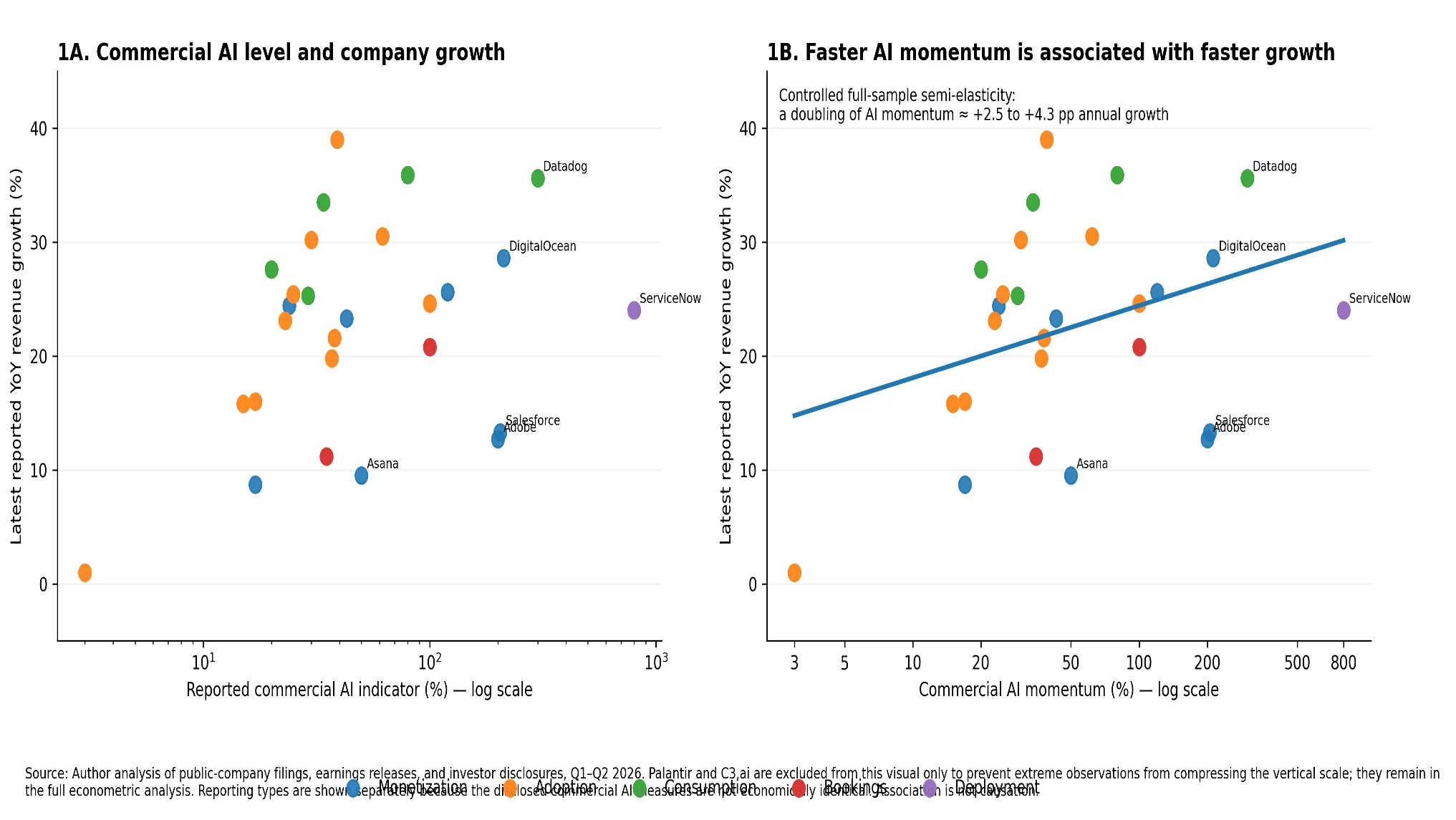
The AI debate is moving from whether to who
The first implication is that the debate about whether AI can produce measurable economic value is becoming less useful. Our outcome variable is not the number of AI announcements a company makes, the frequency with which management mentions AI on an earnings call, venture capital investment, product releases, or movements in stock valuations. It is company revenue growth. Across several specifications, companies exhibiting greater commercial AI momentum also exhibit higher annual revenue growth.
Depending on how differences in the AI measures and company architectures are treated, a doubling of commercial AI momentum is associated with approximately 2.5 to 4.3 percentage points of additional annual revenue growth. These estimates should not be interpreted as a causal elasticity: doubling an AI metric does not mechanically add four points to revenue growth, and successful companies may be better positioned both to grow and to commercialize AI. Nevertheless, the consistency of the relationship across specifications makes the proposition that AI remains financially immaterial increasingly difficult to reconcile with what is occurring in the software market.
The timing is also consequential. Our AI evidence covers essentially the first two quarters of 2026, while the performance variable on which companies are separating is year-over-year revenue growth. This does not mean that six months of AI caused a full year of growth. Part of the relationship almost certainly runs in the opposite direction: companies with superior products, distribution, management capabilities, or financial resources may have been able to commercialize AI more rapidly. But it suggests that AI is interacting with existing differences among software companies quickly enough to become associated with material differences in their growth trajectories.
AI is moving from deployment to dollars
The aggregate pattern becomes easier to understand when we examine the companies occupying the frontier. They do not all sell the same kind of software, nor do they rely on the same AI business model. What they share is an ability to connect AI activity to an existing source of economic leverage.
Palantir provides perhaps the most extreme illustration. Its recent growth is not principally the result of adding a conversational assistant to an established application. The company’s AI proposition sits on top of Foundry, Gotham, and an ontology that connects models to the data, objects, permissions, and operational logic of an organization. As enterprises move from experimenting with models to allowing AI to participate in consequential workflows, this contextual layer becomes more valuable. Palantir provides the most extreme illustration in the current data: Q2 2026 revenue grew 93% year over year and U.S. commercial revenue grew 149%. Its AI proposition is not simply a conversational layer on an application; it sits on top of Foundry, Gotham, and an ontology connecting models to enterprise data, objects, permissions, and operational logic. The magnitude of the acceleration illustrates what can happen when AI amplifies an already differentiated execution architecture rather than merely adding another feature.
ServiceNow offers a related but organizationally different case. The company already occupies a privileged position inside enterprise workflows. Its opportunity is therefore not simply to sell an AI assistant but to turn the Now platform into a control layer through which digital work can be routed, governed, and audited. In Q2 2026, ServiceNow reported 24% total revenue growth, said its AI business had crossed $1 billion in annual contract value, and reported that agentic deployments had increased ninefold in nine months. The combination illustrates how an incumbent system of workflow can turn installed-base access, enterprise context, and governance into an AI distribution advantage.
Salesforce illustrates a third route. Agentforce moved rapidly from product launch to a material recurring-revenue business. Salesforce reported $800 million of Agentforce ARR on Feb. 25, 2026, up 169% year over year, and $1.2 billion on May 27, up 205%; the latter reporting period also showed 13% year-over-year company revenue growth. These are sequential company reporting points rather than two calendar-quarter observations, so we use them as evidence of rapid commercialization rather than as a strict Q1-to-Q2 panel measure. Salesforce possesses enormous distribution and an extensive store of customer and commercial context, but the important strategic shift is that it is attempting to transform those assets from databases used by employees into context on which autonomous agents can act.
DigitalOcean provides one of the cleanest calendar Q1-to-Q2 comparisons in our data. AI Customer ARR increased from $170 million in Q1 to $234 million in Q2, while year-over-year company revenue growth accelerated from 22% to 29%. Because DigitalOcean operates closer to the infrastructure layer, it benefits when AI-native companies and developers consume more infrastructure, inference, and related services. Datadog represents another version of the same phenomenon. Revenue growth accelerated from 32% in Q1 to 36% in Q2, while its Q1 earnings call reported that Datadog MCP Server tool calls had quadrupled quarter over quarter and spans sent to its LLM Observability product had nearly tripled. Autonomous software does not eliminate infrastructure activity; it creates more calls, traces, logs, and events to observe.
AI appears to amplify architecture rather than replace it
The frontier companies suggest that AI does not operate independently of the assets surrounding it. Foundation models are diffusing rapidly, but that diffusion may increase the value of complementary positions rather than eliminate competitive differences.
For systems of record, the complement is enterprise context. For vertical operational platforms, it may be proprietary information generated by fleets, technicians, equipment, or regulated workflows. For cybersecurity and identity providers, it is the expanding population of machine identities and autonomous actions that require authentication, authorization, monitoring, and governance. For infrastructure and observability companies, it is the explosion of machine-generated activity created whenever autonomous systems interact.
AI can therefore commoditize generic software functionality while making differentiated complementary assets more economically important. Writing a conventional feature becomes easier, but owning the context required to execute a consequential enterprise process can become more valuable. User interfaces can become thinner while the infrastructure underneath them becomes busier. Some human software interactions may disappear while the number of machine interactions grows dramatically.
Small today can become material quickly
Directly identifiable AI is still a minority of revenue at many incumbents, which makes the early growth signal more—not less—interesting. Salesforce, for example, reported $1.2 billion of Agentforce ARR in May 2026 against a company revenue base above $40 billion annualized; Agentforce alone was therefore still only a low-single-digit share of company scale. DigitalOcean was much further along: AI Customer ARR reached $234 million against $1.125 billion of total ARR, or roughly one-fifth of the business.
AI can therefore commoditize generic software functionality while making differentiated complementary assets more economically important.
The arithmetic of a small fast-growing business is powerful. If AI begins at only 3% of company revenue, the rest of the company grows 15% annually, and AI revenue grows 50% annually, AI rises to roughly 11% of company revenue after five years. At 75% AI growth, the share approaches one-quarter. At 100%, it approaches one-half. These are mechanical scenarios, not forecasts; today’s triple-digit frontier growth rates cannot persist indefinitely. But that is precisely the point: AI either becomes a material share of software revenue, cannibalizes and replaces existing revenue, or its growth decelerates sharply. None of those outcomes is consistent with AI remaining merely a feature story.
A large annual growth gap can matter quickly
The difference between 19.7% average annual growth across the analytical panel and 34.5% among the highest-AI-momentum quintile is approximately 14.8 percentage points. Annual growth differentials of that size compound rapidly even when they persist for relatively short periods.
If two businesses began with the same revenue base and one grew at 19.7% annually for three years, its revenue index would increase from 100 to approximately 172. At 34.5%, the same starting revenue would increase to approximately 243. This is not a forecast that either rate will persist. It illustrates why the appearance of a large annual growth differential after only two quarters of observable AI momentum deserves management attention: even temporary differences of this magnitude can materially alter relative scale, investment capacity, and competitive position.
Exhibit 2. Revenue growth is concentrating at the AI frontier. The compounding panel is illustrative, not a forecast.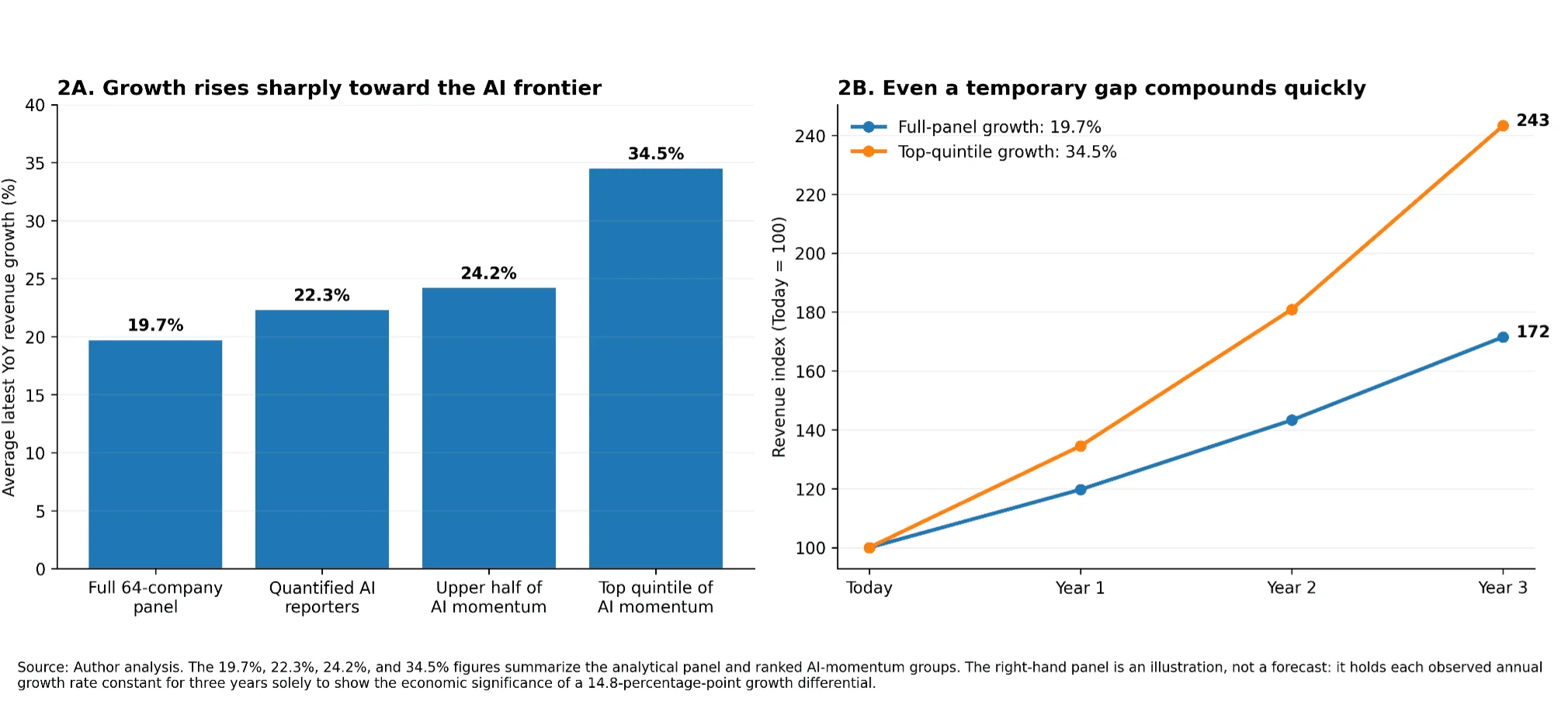
Concentration is not yet cumulative advantage
There is an important line we should not cross. The evidence currently demonstrates concentration; it does not yet establish a self-reinforcing superstar process. If today’s AI leaders simply moved earlier, competitors may catch them as models diffuse, implementation expertise spreads, and customers become more sophisticated.
A more consequential possibility is that today’s advantage creates resources that strengthen tomorrow’s advantage. Higher AI usage can generate more proprietary interaction data and implementation knowledge. Higher AI revenue can finance further development. Greater deployment can deepen workflow integration and customer switching costs. Larger scale can improve inference economics. Distribution can make subsequent AI products easier to sell.
We tested for the first signs of this mechanism using the smaller set of companies for which sufficiently comparable AI indicators are available across sequential reporting periods. The result does not yet support a strong claim of cumulative advantage. Companies beginning with greater AI momentum do not systematically demonstrate greater subsequent AI acceleration in the limited panel currently available. Individual cases such as DigitalOcean and Salesforce are consistent with reinforcement, but the overall longitudinal evidence remains too limited and heterogeneous to establish it.
Exhibit 3. Concentration is visible; cumulative advantage is not yet established. Sequential evidence is deliberately limited to comparable disclosures.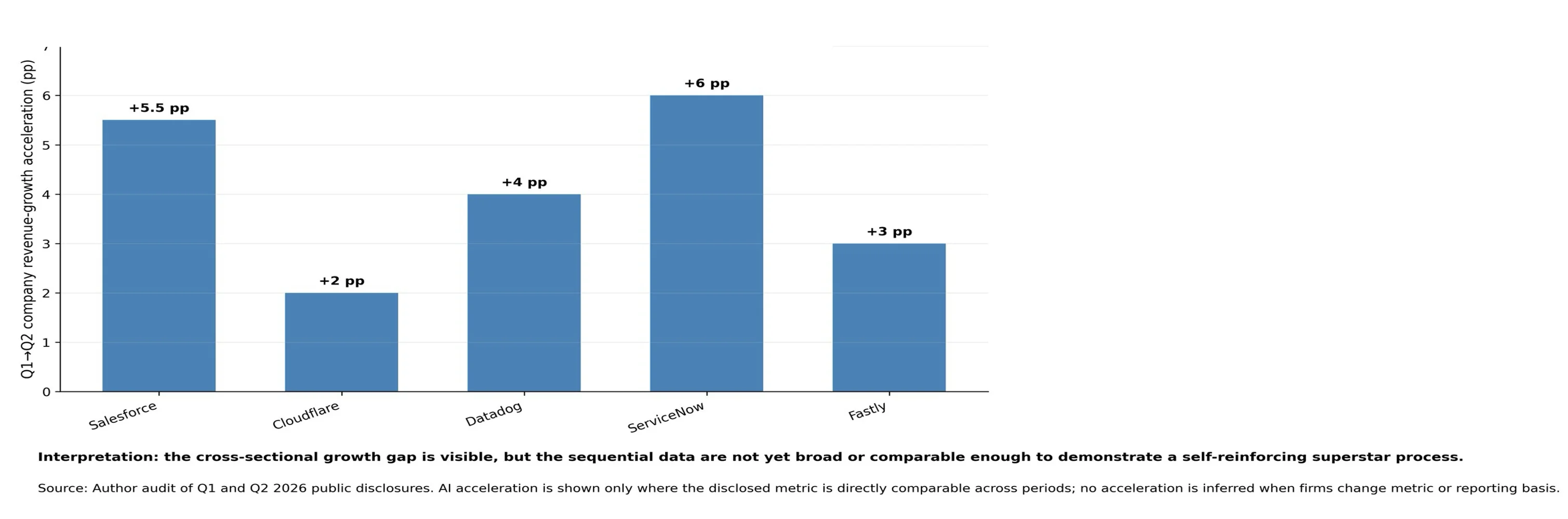
What executives should do now
Software may be the first place where this pattern is visible, but the managerial implication extends well beyond SaaS. If increasingly capable AI models become widely available, access to AI itself will become a weaker source of differentiation. The strategic question is therefore not how much AI a company deploys, but whether AI increases the value of something the company controls and competitors cannot easily reproduce.
Executives should begin by identifying the scarce complement before choosing the AI use case. Instead of asking “Where can we use AI?”, ask what proprietary asset AI could amplify. In software, that asset may be workflow authority, enterprise context, distribution, telemetry, or trust. In banking, it might be transaction history and risk knowledge; in industrial companies, installed equipment and operating data; in health care, clinical workflows and trusted patient relationships; in professional services, accumulated expertise and client context. AI initiatives that strengthen such assets are strategically different from initiatives that merely automate activities competitors can automate equally easily.
Second, move the measurement system from adoption to commercial conversion. Counting licenses, pilots, copilots, or employees using AI is increasingly insufficient. Management should follow the progression from deployment to usage, from usage to customer or operating value, and from value to an economic unit that can be measured. Depending on the business, that unit might be AI-generated revenue, transactions resolved, autonomous workflows completed, cost per outcome, customer retention, or incremental margin. A company that cannot measure the economic unit of its AI activity may not yet have an AI business — it may simply have AI usage.
Third, reinvest early AI gains into the complement rather than only into more AI. If AI commercialization begins to produce superior growth or productivity, the strategically important question is where those gains go next. Reinvesting them only in additional model capacity may create little durable advantage as model capabilities diffuse. Reinvesting them in proprietary data, deeper workflow integration, distribution, customer relationships, security, governance, or other scarce complements can make the next generation of AI more valuable inside the company than outside it. This is the mechanism through which today’s concentration could eventually become cumulative advantage.
Finally, watch the gap, not the adoption rate. Executives should benchmark themselves against the companies converting AI into economic outcomes fastest, not against the percentage of competitors that have adopted AI. The relevant warning signal is a persistent gap in commercial AI momentum, revenue growth, productivity, or another industry-specific outcome. If that gap begins to widen, waiting for the technology to mature may be particularly costly because the leaders may simultaneously be strengthening the complementary assets that make subsequent AI deployment more productive.
The lesson from software is therefore not that every industry will experience a SaaSpocalypse. It is that widespread access to the same underlying intelligence does not imply widespread access to the same economic returns. For executives in any industry, the objective should be to make AI compound something scarce, rather than merely automate something common.
Watch the gap
The most useful indicator for executives and investors during the next several quarters may therefore be neither total software growth nor the number of AI products being launched. It will be the distance between companies at the AI frontier and the rest of the market.
If the gap narrows, the first half of 2026 will look retrospectively like a classic early-adopter period in which a few companies temporarily captured disproportionate gains before capabilities diffused across the industry. If the gap remains large, AI will have produced a persistent redistribution of software growth even without creating a true superstar dynamic. If the gap widens, and particularly if today’s commercial AI leaders systematically become tomorrow’s fastest AI accelerators, we would be observing the emergence of cumulative advantage.
The deeper paradox is that AI can democratize access to intelligence while concentrating its economic returns.
After only two quarters, it is too early to know which of these paths the industry will follow. It is not too early to see the initial separation. The public software market remains a substantial growth market, but companies at the top of the AI-momentum distribution are already growing far faster than the market overall. That makes it increasingly difficult to maintain that AI has yet to show up economically, while simultaneously making it misleading to describe AI as a rising tide from which software companies will benefit equally.
The question that dominated the beginning of 2026 was whether AI would cause the SaaSpocalypse. The evidence from the first half of the year suggests a more consequential question for management: If AI is already concentrating revenue growth this quickly, what will determine whether today’s gap disappears — or becomes the defining competitive divide of the software industry?
The deeper paradox is that AI can democratize access to intelligence while concentrating its economic returns. Models diffuse quickly; proprietary context, workflow authority, distribution, telemetry, trust, and governance do not.For managers, that leads to a more demanding question than “What is our AI strategy?” If your competitors can increasingly access the same intelligence you can, what does your company own that AI makes more valuable? If the answer is a genuinely scarce complement, AI may compound the advantage. If the answer is simply “our software,” AI may be commoditizing it.
About the research
We began with a broad review of publicly traded software companies rather than a predetermined list of AI leaders. We examined Q1 and Q2 2026 company disclosures, earnings materials, and measurable indicators of commercial AI activity, including AI revenue and ARR, bookings, customer adoption, consumption, transactions, and agent or deployment metrics. Software is intentionally the setting: it is a front-runner in AI deployment and commercialization, while AI simultaneously challenges software functionality and seat-based monetization, making the sector an unusually early laboratory for value creation and value capture.
A consistent analytical panel of 64 companies could be assembled with the operating and AI variables required for the principal analysis. Thirty-seven disclosed identifiable evidence of commercial AI activity, and 29 provided sufficiently quantitative AI indicators to support continuous AI-momentum analysis. Those 29 observations are heterogeneous by construction: monetization, adoption, consumption, bookings, and deployment are different economic quantities with different means and ranges. We therefore show reporting categories separately and include reporting-type controls rather than assuming that a percentage increase in AI ARR, consumption, customers, or deployments is economically identical.
The principal outcome is the latest reported year-over-year company revenue growth rate observed during the Q1–Q2 2026 reporting window; it is not quarter-over-quarter revenue growth. Because quantified AI indicators are skewed, continuous specifications use the logarithm of the reported AI measure. The resulting semi-elasticity can be translated into the revenue-growth difference associated with a doubling of commercial AI momentum. Across alternative specifications, that association is approximately 2.5 to 4.3 percentage points of additional annual revenue growth. Quantitative AI disclosure is selective: faster-growing and higher-gross-margin companies are more likely to disclose measurable AI indicators. Selection-corrected estimates remain economically positive but are less statistically precise, so the regression evidence is interpreted as associational rather than causal.
Sequential Q1–Q2 observations for the smaller subset of companies with sufficiently comparable AI measures do not yet establish that firms starting with greater AI momentum systematically accelerate their subsequent AI lead. The evidence therefore supports rapidly emerging growth concentration associated with commercial AI momentum, while cumulative advantage remains a hypothesis for future quarters. Other limitations include voluntary disclosure, reverse causality, heterogeneous measurement, omitted differences in management quality and market position, and the exceptionally short observation window. The short window is nevertheless strategically informative: measurable deployment, monetization, and growth separation are appearing within only a few reporting quarters.
 Jacques Bughin