

By Dr. Gregory C. Unruh
A framework for engaging AI as a reasoning partner, not a machine.
Better AI results come from managing large language models through contextual, iterative conversations—not treating them as machines that simply execute prompts.
Prompt engineering was heralded as AI’s new superpower. At the peak of the hype, Anthropic advertised a “Prompt Engineer and Librarian” role with compensation reaching $335,000. But despite the hope in better prompts, users are still frustrated. A study of ChatGPT interactions found that the common irritation wasn’t hallucinations or technical failure. It was an inability to understand what the user wanted.
In executive education programs and my Digital Literacy course, I find students thinking of AI like a vending machine. Type in your selection, pull the handle, and out pops your soda or chewing gum. This mechanical mindset makes sense given the predictable search engines and fixed-rule spreadsheets we are used to interacting with. But it is the wrong mindset if you want to get more out of LLMs.
AI isn’t mechanical. It’s relational. AI is better engaged as a reasoning agent than operated as a mechanism, and it needs to be managed accordingly. The good news is that we already know how to manage relational systems like AI. Executives do so every day. It’s just that the systems they manage usually reside in their colleagues’ heads. When a manager delegates a task, they don’t “engineer a prompt.” They engage in a relational conversation that considers not only the request, but the preexisting context surrounding the task.
Why? Because humans, like large language models, don’t mechanically execute requests. We interpret them based on knowledge and previous experience. Getting the best out of a team member requires more than clear instructions. It requires a context of relationship, mutual understanding, and iterative clarification. This is the mindset we need to get better results from AI.
The Conversation Is the New Command
In retrospect, the mechanical mindset of my students was partly a product of how I was teaching them. I introduced the proliferating prompting frameworks, assuming better syntax would mean better results. But while students could cut and paste from a prompt library, they rarely had a clear understanding of what they were doing or why. The shift occurred when they began thinking of prompting conversationally instead of mechanically.
Most people use conversational language descriptively, reporting on what happened or answering questions like, “How was the meeting?” Leaders, in contrast, also use language purposefully to create desired outcomes. Linguists and philosophers call these “speech acts”: language that doesn’t merely describe reality but helps change it.
Philosopher Fernando Flores built on this tradition to elaborate the “Conversations for Action” framework. Action in organizations arises through structured conversational exchanges that include offers, requests, and promises. They are not simply top-down commands. This framework maps remarkably well to AI and, importantly, leverages conversational skills managers already have.
The Five Cs of AI Effectiveness
A conversational framework for engaging AI as a reasoning partner, not a machine.
Just as managers want to get the best out of an employee’s knowledge, creativity, and judgment, they also want to unlock the full value of a large language model’s capabilities. These systems can draw on vastly more information than any one human, but they still require guidance, framing, and calibration to deliver a desired outcome. And like a talented teammate, they perform better when managed through collaborative conversations rather than one-shot commands.
The Conversations for Action model reminds us that productive action begins not with commands, but with conversations. All conversations are contextual. At the very least, they require a context of shared language that allows us to frame requests as well as interpret and respond to them. Applied to AI, this becomes a five-part conversation: Connect, Content, Context, Clarify, and Calibrate. These are the Five Cs of AI Effectiveness, illustrated in Figure 1.
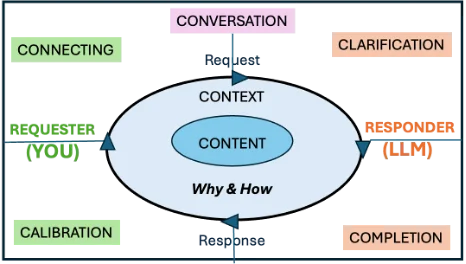
The first step is to connect by establishing the roles in the conversation. When you meet a new team member, introductions matter. AI chatbots don’t know who you are unless you tell them. More importantly, they don’t know who they are unless to tell them. They need to be given a role from which to respond. Effective engagement with an LLM therefore begins by establishing both who you are and who the AI is.
You’d think introducing yourself is easy, but in practice you have many selves. You may be acting as a manager, a teacher, a customer, a sibling, or something else entirely. The role you are playing frames the conversation because it changes what you are trying to achieve. Your role is different when sending a birthday message to your grandmother than when disputing a charge with your bank. Establishing your role with the chatbot is therefore a first step.
Second, define the AI’s role. Is it an executive assistant, a branding expert, a travel adviser, or something else? The role you assign influences the perspective, expertise, and form of the response it produces.
Once the roles are set, you can move to the content of your request, that is what you want to achieve, whether that is a proposal draft, a slide outline, or a customer response. This is what the LLM will be acting on, so the same clarity you’d expect when assigning a task to a team member applies here. Be specific, but don’t conflate detail with micromanagement. You’re guiding an agent that can reason, so your task is to activate that reasoning, not replace it.
Of course, no effective request exists in a vacuum. With employees, shared context is often implicit. You both know the organization’s values, mission, culture, and history. LLMs don’t automatically share that context, so you have to supply what matters. The box below lays out the two most important elements.
Creating Context – The “Why?” and “How?”
When you assign a task to a colleague, you explain what’s needed, why it matters, and how it should be delivered. This context is what turns a request into productive action. The same applies when working with AI.
There are two key elements of context:
- Why sets the purpose. It aligns the task with a meaningful goal, whether that’s to reassure, persuade, inform, or explore. Purpose invites creativity and helps the AI reason through tone, structure, and content. It’s the difference between mechanical output and meaningful engagement.
- How defines the conditions of satisfaction. It channels the response into a format you can use – a summary, list, paragraph, or draft – delivered in the right tone, style, and length. While why inspires, how
Together, why and how promote both creativity and utility.
Just as a skilled employee brings their best when they know what’s at stake, AI can reason more effectively when it understands the full picture.
In managerial conversations, we clarify that we have mutual understanding. We naturally pause to ask, “Any questions?” or “Is that clear?” With AI, that dynamic is not automatic. LLMs do not reliably surface ambiguity or ask the clarifying questions you need unless invited to do so. It is therefore useful to explicitly invite questions, refinements, or alternative interpretations before moving ahead.
Once the AI delivers a response, the conversation isn’t over if the result is unsatisfactory. Instead, we calibrate. We review what worked, identify what missed the mark, and continue until the response meets the conditions of satisfaction. This process is iterative, not repetitive. You’re correcting the output while deepening shared understanding. That’s how higher-quality responses emerge through relational refinement.
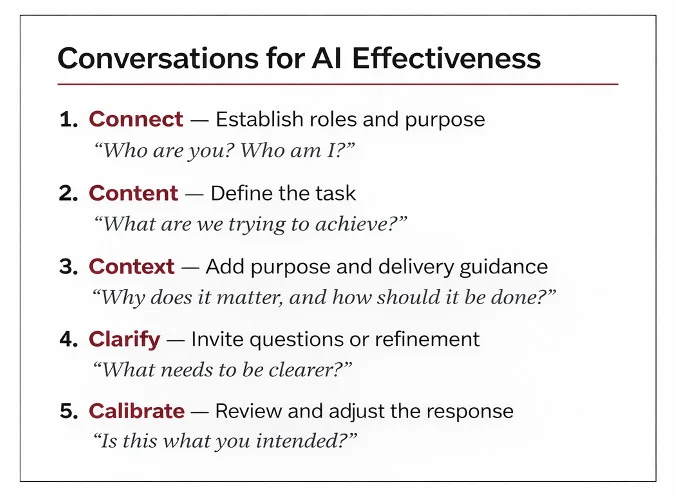
The Five Cs of AI Effectiveness
- Connect – Establish roles and purpose
“Who are you? Who am I?” - Content – Define the task
“What are we trying to achieve?” - Context – Add purpose and delivery guidance
“Why does it matter, and how should it be done?” - Clarify – Invite questions or refinement
“What needs to be clearer?” - Calibrate – Review and adjust the response
“Is this what you intended?”
Invest in Your Colleague
No manager wants to onboard the same employee over and over again. Once expectations are clear and working relationships are established, we build on that foundation. The same principle applies to AI.
While one-off prompting can produce decent results, true leverage comes from establishing persistent context so the system can work from your goals, style, preferences, and needs from the start.
Companies are already investing in this shift. Foxconn, for example, developed FoxBrain for internal uses including data analysis, decision support, document collaboration, reasoning, problem solving, and code generation. Cohere offers customizable enterprise AI designed around proprietary data, workflows, and industry use cases, including financial services and healthcare. Individuals are moving in the same direction. LinkedIn co-founder Reid Hoffman created REID AI, a digital twin built on a custom chatbot drawing from more than 20 years of his books, speeches, podcasts, and other content. These examples point at a future in which AI agents are trained and trusted more like deputies than queried like vending machines.
And you don’t need a massive budget to begin. Platforms like ChatGPT and Claude allow users to preserve useful context across interactions. I teach my students to create a personal workspace, upload relevant contextual information, and begin cultivating an AI assistant that understands their goals and grows more useful over time. This is sometimes called “cloning” or creating a digital twin, but that language can be misleading. You’re not replicating yourself. You’re onboarding and training an assistant that may work with you for years. To get more out of AI, stop treating it like a tool to be operated and start managing it like a high-potential colleague you are developing.
 Dr. Gregory C. Unruh