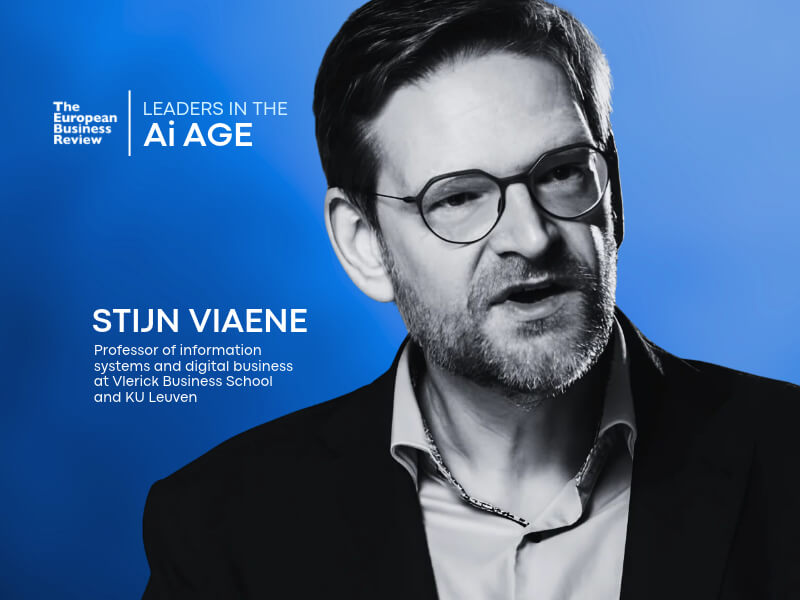
Professor of Digital Transformation Stijn Viaene sits down with TEBR to discuss digital leadership, how AI is putting it to the test, and turning technology into organisational value.
Stijn Viaene is a leading voice in digital transformation. And for good reason – the professor of digital transformation at Vlerick Business School has steadfastly kept one foot in academia and one planted in the real-world challenges of putting transformation into practice. Which means his work manages to push boundaries while remaining practical and relevant to forward-looking businesses.
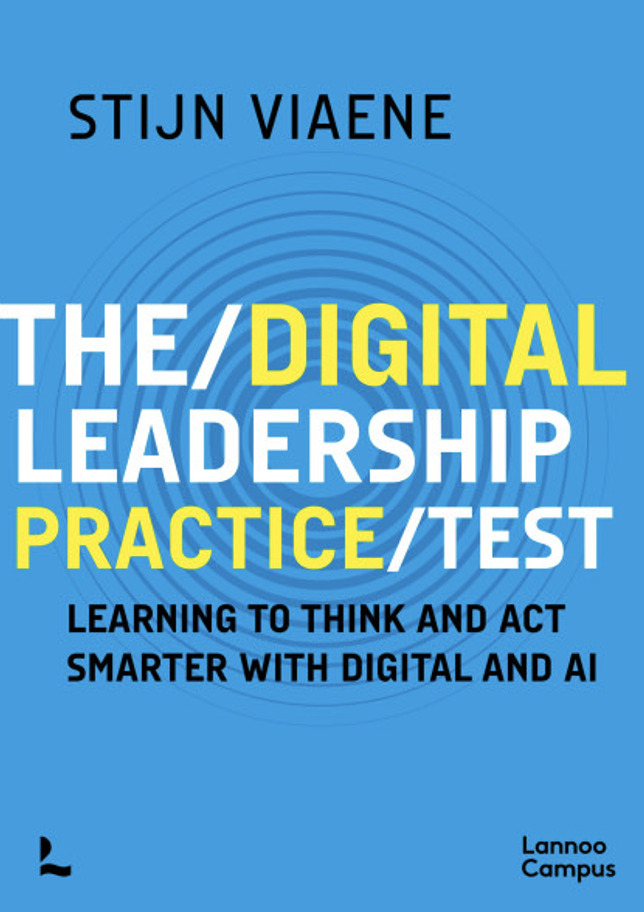
His 4V model of digital transformation leadership – which first appeared on the cover of this magazine in 2017 – remains a perfect example of this approach. And now, he’s built on this work even further, as set out in his new book The Digital Leadership Practice Test.
We caught up with him and asked what has changed in the last decade, what hasn’t – and how AI is making transformation even more complex…
Does AI change what we mean by digital transformation?
In some ways, AI simply makes something clearer that has always been true about digital transformation.
Digital transformation isn’t about adopting more technology, or completing a series of technology projects. It’s about continually assessing what technological change means for your organisation: where new opportunities fit your strategy, which are worth pursuing and how you turn them into value.
Digital transformation isn’t about adopting more technology, or completing a series of technology projects. It’s about continually assessing what technological change means for your organisation.
AI brings that challenge into particularly sharp focus because of the pace and breadth of change. New capabilities and possibilities are emerging all the time, and they won’t all be relevant or valuable to every organisation. Standing still isn’t an option – but neither is adopting technology for technology’s sake.
That is the thinking behind the 4Vs. Organisations need to be vigilant about what is changing, willing to voyage into new possibilities, able to develop a clear vision of where technology can create value, and capable of turning that vision into reality.
We’ve been through major technology waves before: the web, social media, mobile and cloud, as well as technologies such as the metaverse that generated enormous enthusiasm but proved less transformative than many expected. We should build on what we’ve learned rather than reset the intellectual clock every time something new arrives.
AI is the latest major wave. But it won’t be the last.
What makes AI different from those earlier waves?
First, you have to consider the pace of change, combined with the scale of access.
Generative AI reached mass markets while the technology was still in its infancy. Millions of people could suddenly experiment with it directly, while organisations quickly began making AI tools available across their workforces.
This means adoption, experimentation and technological development are all happening at the same time. New AI capabilities are emerging with remarkable speed and finding their way almost immediately into tools and devices that millions of people are already using.
And there’s another dimension to this. AI isn’t simply a new technology that people are experimenting with. It can become an active part of experimentation itself – helping people to generate ideas, explore possibilities and reimagine how work gets done. So while the technology is evolving, our understanding of what we might be able to do with it is growing too.
This creates enormous exploratory energy, but also a difficult leadership challenge. Organisations are, whether they realise it or not, experimenting extensively with a technology that is itself changing at speed. And because access is so widespread, experimentation doesn’t necessarily wait for a centrally managed transformation programme. Instead, it can emerge wherever people see opportunities in AI.
So how do you make sense of what is happening? What deserves attention and what is noise? What should you try? Where should you make bigger commitments? And what do you scale when both the technology and your understanding of its possibilities keep changing?
This is what makes AI such a formidable test of digital transformation leadership.
You’ve been studying digital transformation for more than a decade. What has surprised you?
What has surprised me most is how durable the leadership challenge has proved to be. The technologies changed enormously, and organisations became far more digitally experienced. Yet, every new wave brings back remarkably familiar questions. What deserves our attention? What should we explore? Where do we commit? How do we turn what works into value?
Underneath them, the same two tensions keep resurfacing. Exploration and exploitation. Thinking and acting.
The technology keeps changing faster than the underlying leadership challenge does. Which is one reason I no longer think of digital transformation as a journey you complete. The real challenge is building the capacity to keep transforming.
And that’s where the four Vs come in?
Exactly. In fact, that observation was at the heart of the 2017 article.
The framework starts with two tensions that organisations constantly have to navigate. They need to explore new possibilities while continuing to exploit what already works. And they need to balance thinking – making sense of what is changing and deciding where they want to go – with acting, so that they learn, deliver and create value rather than endlessly analysing possibilities.
Put those two tensions together and you get four different but connected types of leadership work. Vigilant is about looking beyond an organisation’s current focus, seeing what is changing and working out what might matter. Voyager is about exploring possibilities and learning through action, fast and frequently. Visionary is about making bold choices about what the organisation is to become, where to play and how to win. And Vested is about turning what works into sustained performance and value at scale.
The power of the 4Vs comes from using them together. Vigilance without exploration remains observation. Exploration without choices can become endless experimentation. Vision without execution remains ambition. And scaling what already works without continuing to look outwards risks leaving the organisation behind.
So organisations need all four capabilities working together. They need to continually scan what’s changing, explore what it could mean for them, make choices about where to focus – and turn these choices into value. And they need to keep doing it as new technological opportunities and challenges emerge.
And AI puts pressure on all four Vs?
Very much so, and often all at once.
People are experimenting. Functions are launching initiatives. Management wants an AI strategy. New opportunities keep appearing. Then somebody asks where the value is.
The temptation is to reach for a single answer. “We need more experimentation.” Or the opposite, which is kind of a default when the economy gets tougher: “Enough experimenting. Show me the ROI.”
But the 4Vs encourage you to look more closely. Perhaps you do need more exploration. Perhaps you’re experimenting extensively but not learning enough from it. Perhaps you haven’t made clear choices about where AI really matters to your organisation. Or perhaps promising ideas are getting stuck before they can become part of everyday operations and create value at scale. Often, several of these things can be true at once.
That is why I think AI is such a powerful stress test. It exposes how good an organisation really is at doing these different kinds of transformation leadership work, and at connecting them.
The goal isn’t to eliminate the tensions between them. The challenge is to become better at recognising and working with these tensions as they emerge.
AI didn’t create this challenge – but it’s made it much harder to ignore.
How big a leap is your new book from that 2017 model?
A substantial one.
The two tensions and four leadership contexts we identified in 2017 still sit at the heart of the framework. But we’ve spent much of the decade since then exploring what they mean in the reality of organisations that are working through transformation in practice.
Working with organisations across different industries and contexts has allowed us to see the framework in action – and to learn from what happens when organisations put these ideas into practice. In parallel, our academic work has continued to deepen and develop the thinking.
The result is a much richer framework, grounded in almost a decade of research and real-world experience. The book brings this learning together, explaining the 4Vs and exploring what helps organisations to become increasingly capable of transforming as the world around them becomes more turbulent.
So what does a digital transformation leader actually do?
For me, the answer has become quite clear over the years. Digital transformation leaders – or digital leaders for short – are people who are effective at driving the collaborative learning of new digital-agile practices across an organisation.
There is quite a lot packed into that definition.
By digital-agile practices, I mean ways of working that make an organisation better at transforming. How do we spot meaningful change earlier? How do we explore possibilities and learn from them? How do we make choices about where we want to go? How do we turn what works into value at scale? These are practices through which organisations build their capacity to keep transforming.
Digital transformation leaders – or digital leaders for short – are people who are effective at driving the collaborative learning of new digital-agile practices across an organisation.
And the digital part of digital-agile really matters. Technology has a dual role in digital transformation. Technological progress keeps changing the world around the organisation, whether you like it or not, creating new opportunities and challenges. But digital technologies can also become part of how the organisation responds – helping people understand change, explore possibilities, learn, collaborate and turn ideas into action. The technologies driving change can therefore also help organisations become better at navigating it.
My use of the term collaborative learning is also deliberate. There is no perfect set of transformation practices that you can design up front and simply roll out across an organisation. You have to experiment with new ways of working, learn what works in your particular context – and then adapt and scale this learning. And no single leader can do all this in an organisation. The learning has to happen collectively.
But why call that leadership?
Because transformation doesn’t happen by itself. It requires people to step forward and make it happen.
Think about how transformation actually happens. Something changes, big or small, and people help others see why it matters. A possibility emerges, and someone creates space to explore it. An experiment produces an insight, and someone helps others learn from it. A promising new way of working is adapted, strengthened and scaled. These are all acts of leadership – and they rarely belong to one person. Transformation does not happen by simply dumping a method or a tool on an organisation. Or from someone ordering it from the top.
This is where leadership becomes an open invitation. People across the organisation can choose to step into leadership work. But accepting the invitation to lead comes with accountability. You have to be willing to step forward, take responsibility for your contribution and be held to it. Anyone willing to pick up that gauntlet, I’d be happy to call a leader.
This doesn’t make formal leadership any less important. Senior leaders have particular power to set priorities, commit resources, create space and remove barriers. But a crucial part of their role is also to create the conditions in which leadership can flourish throughout the organisation.
So instead of only asking, “Who are our digital leaders?” ask: “What leadership mindset and behaviours does our transformation require – and how do we create an environment that encourages them?”
Executives still love best practices. Why won’t you give them any?
I don’t think there is one right way to do this.
I have nothing against learning from other organisations. I do it constantly in my research and teaching. What I’m wary of is copying somebody else’s answer without understanding why it works.
Take an innovation lab, an agile team, an AI centre of excellence, or a chief AI officer. You can copy the structure, meetings and terminology and still completely miss what made the transformation practice effective in its original setting.
The more useful question is: what is this practice helping the organisation to achieve? What problem does it solve? What makes it effective? Once you understand that, you can start experimenting with ways to achieve the same kind of progress in your own context – learning what works, adapting it and building on it.
This principle shaped the book too. I didn’t want to give readers a framework and then a catalogue of answers. I want them to encounter different situations, form their own view, use the framework to challenge or deepen their thinking – and then look again.
The book asks readers to practise the same kind of learning that it argues organisations need to become good at.
If transformation leadership is spread across the organisation, how do you stop it becoming fragmented?
That is the catch. Distributed leadership is not automatically coherent leadership.
Part of the operating model is to bring people together around the four contexts of the 4V model in what we call V-leadership communities. These communities experiment with transformation practices for their particular context and learn from what happens.
But learning within these communities isn’t enough. You also need orchestration across them.
One part of an organisation may be pushing to explore an emergent wave of technology, while another is asking for standardisation, reliability and returns. Neither is necessarily wrong. They are responding to different demands. Digital transformation is full of tensions like that.
Orchestration is about bringing those perspectives into conversation, working through the tensions and allowing learning to travel across the organisation. It isn’t about centralising everything again. The more you distribute leadership, the more important it becomes to connect the thinking and learning happening across the organisation through productive conversation.
So what are organisations ultimately trying to get good at?
Organisational agility.
And I don’t mean speed for the sake of speed. Or distributed autonomy, as in anything goes. I mean the capacity, as an organisation, to systematically explore and exploit the opportunities digital technologies create – and do it faster than your competitors.
You cannot simply install that capability. You have to learn your way into it.
You develop digital-agile transformation practices. You learn together from what happens. You adapt.
Practices that prove valuable get strengthened and shared. Those that don’t are changed or dropped.
It’s a process that never really ends. New technological opportunities, challenges and waves keep emerging, testing the transformation practices you’ve developed – and creating new things to learn.
Organisational agility comes from becoming increasingly good at this process of learning and adaptation.
And is that why you call the book a “practice test”?
Exactly. There is no final exam where somebody hands you the right answers.
The test isn’t whether you’ve mastered AI. Nobody has. And it isn’t whether you’ve found the perfect transformation playbook. You haven’t. The real test is whether your organisation is getting better at transforming as technology keeps moving.
And that brings us back to leadership. Good digital transformation leaders don’t pretend to know where all of this is going. They help their organisations become better at finding their own way – learning together, making choices, adapting what they do and building their capacity to keep transforming.
That’s the practice. And the test never really ends.
Stijn Viaeneis a professor of information systems and digital business at Vlerick Business School and KU Leuven. He is the academic lead behind the 4V framework of digital transformation leadership, grounded in research that draws on leadership-as-practice and paradox management theory to study how organisations adapt and learn under digital turbulence. His latest book is The Digital Leadership Practice Test: Learning to Think and Act Smarter with Digital and AI (Lannoo Campus, 2026).
Book Reference
Viaene, S. (2026). The Digital Leadership Practice Test: Learning to Think and Act Smarter with Digital and AI. Leuven, Belgium: Lannoo Campus.
The European Business Review uses cookies to improve site functionality, provide you with a better browsing experience, and to enable our partners to advertise to you. Detailed information on the use of cookies on this Site, and how you can decline them, is provided in our Privacy Policy and Terms and Conditions. By clicking on the accept button and using this Site, you consent to our Privacy Policy and Terms and Conditions. ACCEPT Reject
Privacy & Cookies Policy
Privacy Overview
This website uses cookies to improve your experience while you navigate through the website. Out of these cookies, the cookies that are categorized as necessary are stored on your browser as they are essential for the working of basic functionalities of the website. We also use third-party cookies that help us analyze and understand how you use this website. These cookies will be stored in your browser only with your consent. You also have the option to opt-out of these cookies. But opting out of some of these cookies may have an effect on your browsing experience.
Necessary cookies are absolutely essential for the website to function properly. This category only includes cookies that ensures basic functionalities and security features of the website. These cookies do not store any personal information.
Any cookies that may not be particularly necessary for the website to function and is used specifically to collect user personal data via analytics, ads, other embedded contents are termed as non-necessary cookies. It is mandatory to procure user consent prior to running these cookies on your website.