

By Mariana Pinheiro
As consumers become more comfortable delegating financial tasks to AI, financial institutions face a parallel challenge: building the trust infrastructure to support them.
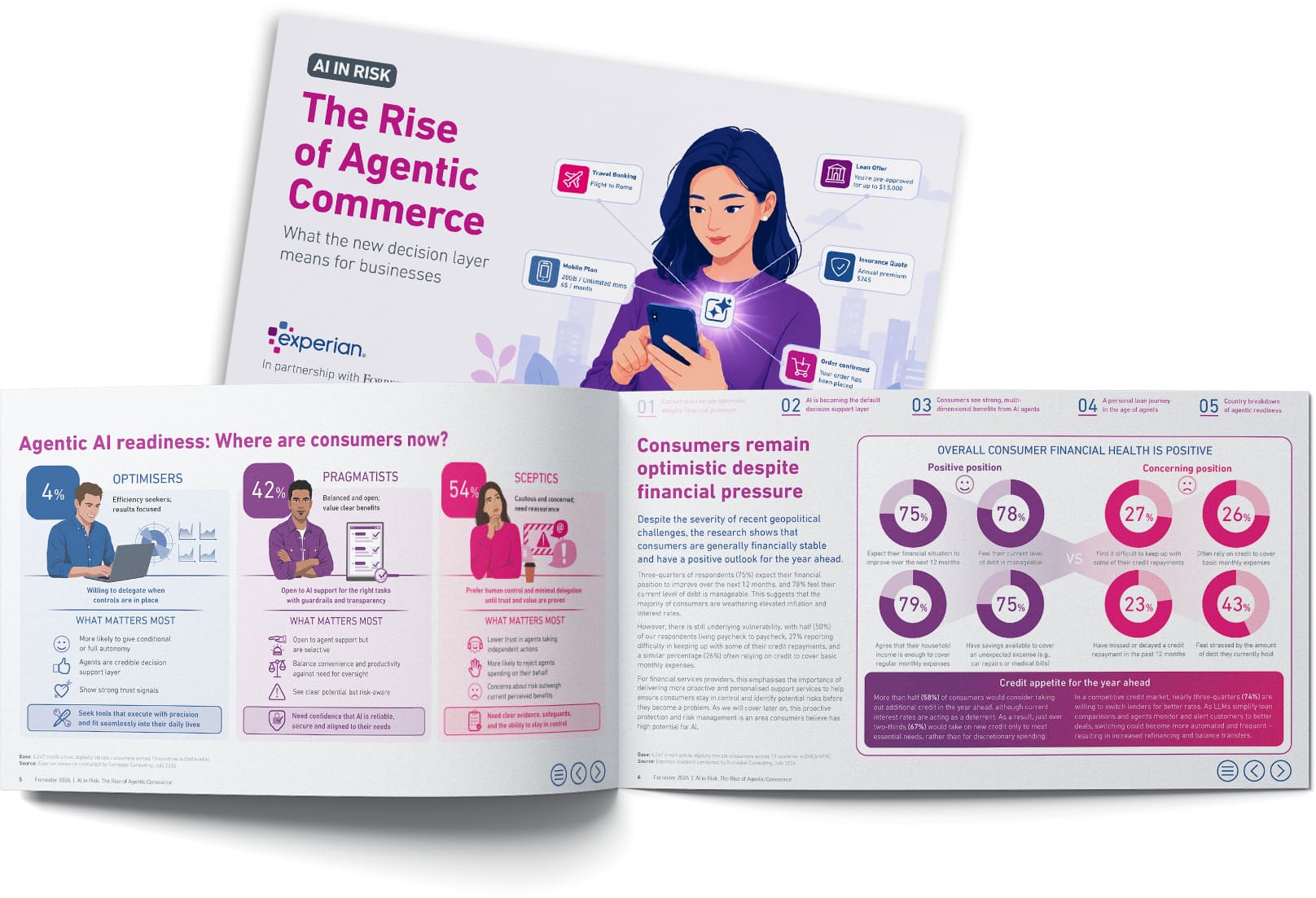
Consumer use of AI is evolving rapidly. Large language models (LLMs) are moving beyond answering questions towards taking action on users’ behalf through AI agents. Research conducted by Forrester Consulting, commissioned by Experian, among more than 6,000 credit-active consumers across 13 EMEA and Asia Pacific countries, suggests that transition may happen sooner than many expect.

Is consumer comfort with AI running ahead of use?
In the old model, we would ask an LLM to explain something, find information or compare. The AI provides the answer and we decide what to do next.
With the emergence of AI agents, these tools can move beyond taking action on our behalf. This is a giant leap forward.
When AI moves from answering questions to taking action, the question is no longer whether we trust the information it gives us. It becomes a question of whether we trust it with the authority to make decisions for us.
One of the most interesting findings is the gap between how consumers use AI today and what they already trust it to do.
In our research, 85% said agents could help them compare far more options than they could manually. 84% said they could help them find better prices or rates, and 83% saw value in agents helping them avoid missing important details, such as hidden fees or contract terms.
However, only 29% of respondents admitted they have used an LLM to compare loan options in the previous year, yet 82% said they would trust one to perform that task.
This gap suggests consumer behaviour could shift rapidly as AI-enabled services become more widely available and AI is expected to become a decision-support layer between consumers and businesses, with AI agents extending that role from information and guidance to execution.
How much control are consumers willing to delegate?
While much of the discussion around AI focuses on increasing autonomy, our findings suggest the future may be more nuanced.
More than half of consumers surveyed (54%) said they would be comfortable with an AI agent applying for a loan or credit card on their behalf. But willingness to delegate varies significantly depending on what the agent is being asked to do.
In a potential personal-loan journey, for example, 84% were comfortable with an agent searching and comparing offers and 81% with it negotiating a better deal. However, comfort levels decline as the agent moves into more consequential stages involving personal information, identity checks and accepting an offer.
In short, research suggests consumers are comfortable delegating tasks, provided they remain in control of key decisions and the parameters within which agents operate.
What does trust mean when AI starts taking action?
Most businesses have traditionally thought about trust as a relationship centred on brand perception. Customers trust a bank, retailer or payment provider because of their own previous experiences and their confidence in its reputation.
Those things will remain important. But agentic commerce requires a new form of trust: one that is embedded in the infrastructure behind interactions.
If an AI agent is going to act on your behalf, businesses need to be able to establish who or what they are interacting with and consumers need confidence that the agent is operating within the authority they granted it.
Both sides need clarity over what information can be shared, how decisions are reached, what happens when something goes wrong and who is accountable.
Our research highlights just how important consumers consider these safeguards to be. More than 80% recognise that their trust in agent is based on six factors: identity verification and liability; transparency and explainability; payment infrastructure; privacy controls; approval and reversibility; and financial controls.
75% said they would feel more comfortable using an LLM connected to a financial institution they already trust.
That challenges the assumption that using AI agents could weaken the relationship between established businesses and their customers. In this new world where LLMs and AI agents act as intermediaries, established trust may become more valuable, not less.
The ability to combine innovation with trusted identity, secure data use, transparency and clear accountability could well become the biggest competitive advantage.
Trust, in other words, increasingly needs to operate at two levels: through the confidence consumers place in an organisation and through the infrastructure behind interaction. This is familiar territory for Experian. We have long operated in environments where decisions carry significant consequences and where data quality, fraud prevention and accountability matter.
As AI takes on a greater role in those decisions and interactions, that experience becomes increasingly relevant. Our capabilities across identity, fraud prevention, data, analytics and decisioning help organisations assess whether an interaction is legitimate, authorised and taking place within the established controls.
What happens behind the interface
If consumer readiness is one side of the equation, business readiness is the other. Another recent piece of Experian research into the application of AI across credit and fraud shows that organisations are investing significantly in AI, but scaling it remains difficult.
Close to 7 out of 10 (68%) of financial institutions surveyed remain at an early or emerging stage of AI adoption, while only 11% have extended AI into core environments at scale.
As AI assumes greater responsibility, trusted execution depends on more than the model itself. It requires high-quality, appropriately governed data, connected systems, clear decision authority, explainability, and controls that operate within workflows rather than being performed afterwards.
Consumers are effectively saying: I will give AI greater authority when I understand and trust the boundaries within which it operates.
Financial institutions face their own version of that question: Where can AI act, based on which information, within what parameters, with what oversight?
In both cases, the challenge is establishing the conditions under which autonomy can safely increase.
This is also beginning to shape how Experian is developing its own technology. Our Agent Operating System, within the Experian Ascend Platform, is designed to provide a governed environment in which AI agents can work across data, analytics and decisioning, with appropriate controls and oversight.
How fast will the agentic age unfold?
We are still very much in the early phase of this transition, and adoption will not move at the same speed everywhere.
Our research reveals meaningful differences between markets. For example, 81% of surveyed consumers in India trust the accuracy of information provided by LLMs, compared with 59% in Italy. That does not mean one market is necessarily ahead of another, but it does show that consumers are starting from different levels of confidence in these technologies.
Those differences suggest agentic experiences are unlikely to develop at the same pace or in the same way everywhere.
But the broader direction is becoming clearer.
For financial institutions, the opportunity is to prepare for a world in which consumers increasingly expect AI to help them understand, compare and eventually act, while also using AI to make their own products, decisions and processes more effective.
That requires more investment in AI models, trusted data, identity verification, fraud prevention, explainability and governance, but also the ability to connect intelligence more directly to decisions and action.
As AI becomes more capable, those strengths can help enable more useful automation and better experiences while maintaining the trust and controls that financial decisions require.