

By Tomoaki Takei, MD, PhD
As artificial intelligence accelerates the automation of traditional office roles, a powerful new class of hybrid leaders is emerging. These professionals combine irreplaceable physical expertise with autonomous management systems to redefine the future of organizational agility.
The rapid advancement of artificial intelligence is fundamentally dismantling the historical prestige associated with traditional white-collar professions. Concurrently, hands-on, essential sectors are facing unprecedented labor shortages, effectively shifting economic leverage toward specialized technical fields. In this disrupted economic landscape, a formidable hybrid professional is emerging: the “Gray-Collar” leader. By successfully fusing deep, non-substitutable domain expertise with AI-optimized business management, these individuals are not merely adapting to change—they are actively redefining organizational efficiency and the future architecture of work.
The Illusion of White-Collar Superiority
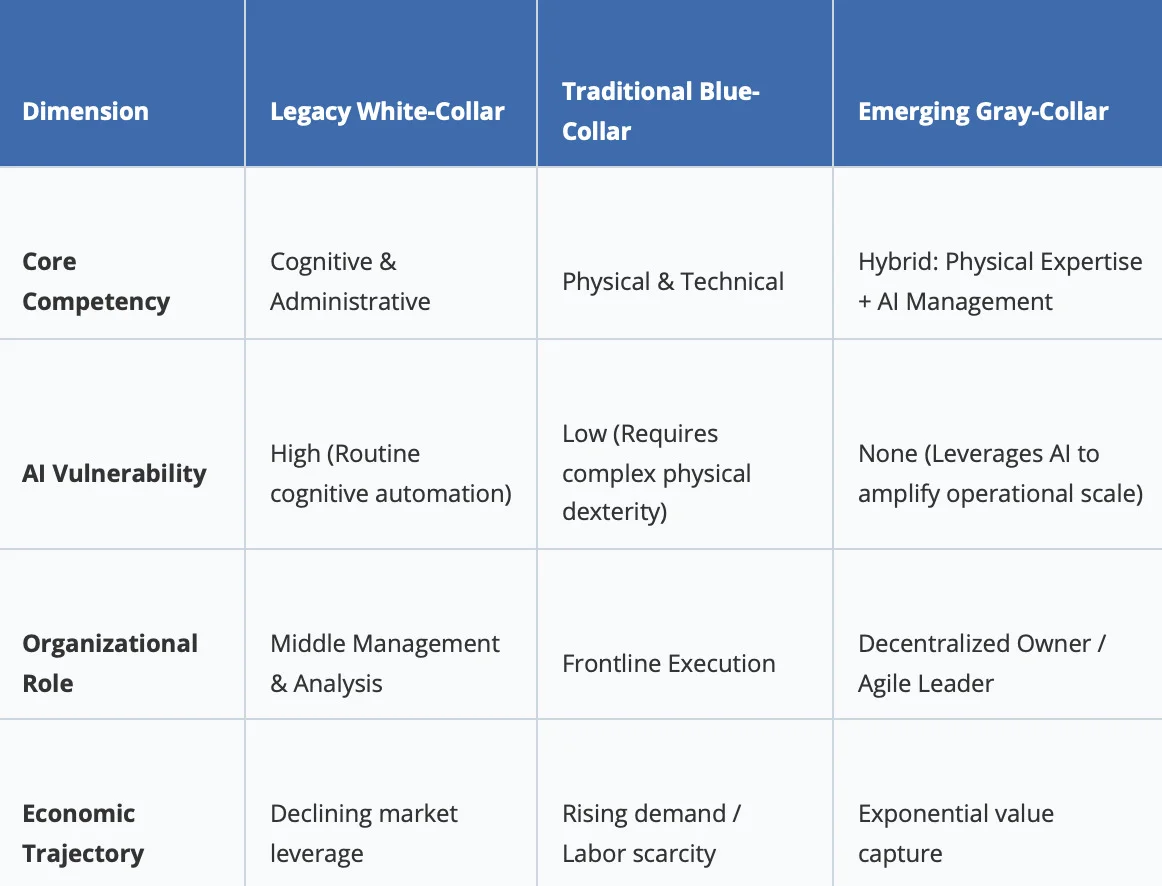
For decades, global labor economies have maintained a rigid and predictable hierarchy. White-collar corporate roles commanded high social status, outsized financial rewards, and career stability, while blue-collar technical vocations were frequently undervalued in the broader corporate discourse. However, the proliferation of generative artificial intelligence has exposed the underlying structural vulnerability of traditional office work. Tasks historically viewed as the exclusive domain of university-educated professionals—such as middle-management coordination, complex data synthesis, routine legal drafting, and basic financial accounting—are increasingly executed instantaneously by sophisticated algorithmic platforms.
Consequently, the relative market value of pure administrative labor is depreciating at an accelerated rate. Conversely, physical, high-skill industries such as advanced infrastructure, customized construction, and clinical healthcare remain remarkably resilient against the threat of automation. This profound shift is a manifestation of Moravec’s paradox, which posits that high-level reasoning requires very little computation, but low-level sensorimotor skills require enormous computational resources. The tangible world possesses an inherent complexity and unpredictability that digital systems cannot easily replicate or replace.
The Leadership Bottleneck in Essential Industries
Despite the rising economic value of essential, hands-on expertise, technical professionals frequently encounter an operational ceiling. In complex sectors like healthcare, brilliant practitioners often find themselves struggling under the burdensome weight of human resources management, intricate labor compliance, and financial engineering. Traditionally, independent clinics and technical firms attempted to resolve this bottleneck by hiring external business managers or specialized administrators. However, this classic division of labor frequently introduces significant organizational friction, misaligned incentives, and bloated bureaucratic overhead.
Generic business managers rarely possess an intrinsic understanding of the nuanced realities, emotional intelligence requirements, and daily frictions experienced by frontline practitioners. This fundamental disconnect inevitably leads to inefficient workflows, rigid protocols, and disengaged staff. True organizational transformation requires a seamless synthesis—a single leader who can fluently navigate both the intricate vocabulary of frontline operations and the strategic language of corporate governance.
Defining the Gray-Collar Leader
The Gray-Collar professional represents the ultimate synthesis of physical mastery and digital administrative autonomy. This paradigm does not merely describe an intermediate skill level between traditional collar designations; rather, it defines a highly leveraged hybrid strategy. Gray-Collar leaders possess deep, non-substitutable operational skills that demand years of physical training, rigorous certification, and honed human intuition. Simultaneously, they adeptly leverage advanced cloud architectures and generative AI tools to execute complex back-office functions—such as payroll, accounting, and recruitment—with minimal administrative overhead.
By effectively utilizing autonomous technology, a single practitioner can operate a highly lean, scalable organization without the necessity of a bloated middle-management layer. For instance, an advanced technical leader can now deploy AI-driven dictation systems to manage legal compliance, utilize automated software suites to oversee multi-tiered supply chains, and leverage predictive data analytics to optimize capital allocation. The traditional corporate bureaucracy is systematically replaced by a streamlined, technology-enabled individual.
Case Study: Decentralized Healthcare Scaling
This hybrid dynamic is particularly visible in modern healthcare entrepreneurship. Consider a dual-certified medical specialist operating a successful primary clinic. Historically, expanding operations to establish secondary facilities required the recruitment of substantial administrative staff to handle human resources, medical billing, and regional regulatory compliance. This traditional expansion model drastically increased fixed operational costs and often diluted the quality of patient care due to administrative distraction.
Under the Gray-Collar framework, the physician-entrepreneur utilizes specialized medical AI tools to automate clinical documentation, coding, and compliance tracking. Simultaneously, they deploy integrated cloud-based human resource platforms to autonomously manage physician scheduling, labor law adherence, and financial reporting across multiple regional sites. Because the founder possesses a deep, empathetic understanding of frontline clinical pressures, the digital administrative architecture remains uniquely supportive of the medical staff. The ultimate result is a highly profitable, agile network built entirely without the burden of traditional management layers.
Structural Implications for Lean Organizations
The emergence of the Gray-Collar professional fundamentally challenges traditional corporate architecture. Modern enterprises are frequently hindered by specialized, siloed departments that inadvertently create communication barriers and impede swift decision-making. Gray-Collar leaders eliminate these intermediate layers entirely, fostering exceptionally flat, hyper-efficient organizational structures where strategic vision and practical execution coexist fluidly within a single individual.
Furthermore, this evolution significantly shifts the distribution of economic value within industries. When administrative overhead is aggressively minimized through intelligent automation, surplus revenue can be reinvested directly into securing premium frontline talent and procuring cutting-edge operational equipment. This exceptionally lean approach creates a formidable business model that can easily outmaneuver legacy organizations still burdened by heavy administrative costs.
Exhibit 1: The Evolution of Professional Value in the AI Era
 Conclusion
The traditional dichotomy between white-collar strategic planning and blue-collar physical execution is rapidly becoming obsolete. As we navigate the complexities of the modern economy, the future unequivocally belongs to the Gray-Collar leader. These hybrid practitioners, who firmly anchor their authority in irreplaceable physical expertise while commanding advanced autonomous systems to manage their business operations, represent a new pinnacle of professional capability. As corporate structures continue to flatten globally, it is these multi-disciplinary professionals who will establish the new benchmarks for institutional agility, operational resilience, and sustained competitive advantage in an AI-driven world.
 Tomoaki Takei, MD, PhD