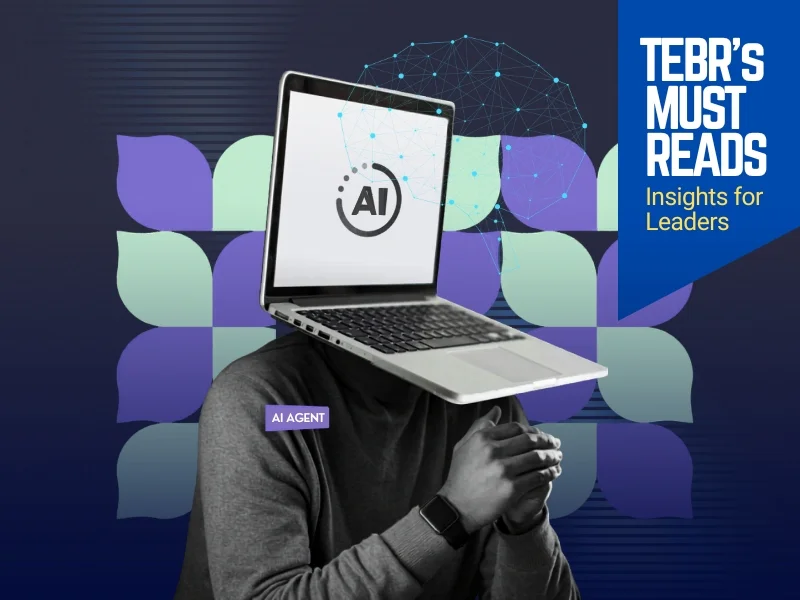
Artificial intelligence is no longer confined to isolated tools or experimental pilots. From infrastructure and software economics to human capital and customer trust, it is reshaping how organizations operate at every level.
At the center of this transformation is the rise of AI agents: systems capable of acting autonomously, executing workflows, and augmenting human decision-making. Together, these advances are giving rise to a new model—the AI agent workforce—where humans and intelligent systems collaborate as co-workers rather than tools.
To help leaders navigate this shift, The European Business Review has curated five essential articles that explore how agentic AI is redefining enterprise strategy, global innovation ecosystems, customer relationships, software models, and workforce management.
1. How Agentic AI is Reshaping Enterprise Infrastructure, Strategy, and Leadership
By Petr Malyukov of dTelecom
This examines the shift from traditional AI tools to agentic systems capable of planning, acting, and adapting independently. It highlights how enterprises must rethink their technology foundations, moving toward AI-native infrastructure built on real-time data and orchestration layers.
Beyond technology, the piece emphasizes a profound leadership shift. Executives are increasingly orchestrating hybrid systems of humans and AI agents, requiring new approaches to governance, accountability, and strategy.
Read More
2. How Policy, Infrastructure, and Collaboration are Shaping Global AI Innovation
By Wendy Chow of Invest Hong Kong
AI innovation is being shaped by a dynamic interplay of public policy, digital infrastructure, and international collaboration. This article explores how governments and organizations are building competitive advantage through national AI strategies, investments in compute and data ecosystems, and cross-sector partnerships.
For leaders, the key takeaway is that AI success depends not only on internal capabilities but also on the external ecosystem. Navigating regulation, aligning with standards, and participating in collaborative networks are now critical to staying competitive.
Read More
3. Understanding and Influencing Today’s Financial Consumer: How AI is Rewriting Insight, Visibility, and Trust
By Hakan Yurdakal of Bolt Insight
This article explores how AI is transforming customer engagement by enabling deeper insights and more personalized interactions. Organizations now have unprecedented visibility into customer behavior, allowing for more targeted and responsive strategies.
However, this increased capability brings new challenges around trust and transparency. Yurkadal argues that trust is becoming a central strategic concern, requiring organizations to balance data-driven personalization with ethical responsibility and clear communication.
Read More
4. Beyond SaaS-Pocalypse: How Agentic AI is Reinventing Software Economics
By Jacques Bughin of MachaonAdvisory
The traditional SaaS model is being disrupted by agentic AI, which shifts value from static software tools to autonomous, outcome-driven systems. This article explains how AI agents are transforming software from a passive product into an active participant in delivering business results.
As a result, pricing models, competitive dynamics, and value creation are all evolving. Organizations must rethink how they build, buy, and monetize software in a world where execution capability—not just functionality—defines value.
Read More
5. Empowering People with AI: Revolutionizing the Management of Human Resources for a Brighter Future
By Dr. Simon L. Dolan, Dr. Pedro Cesar Martínez Moran, and Dr. Dave Ulrich
Focusing on the human side of transformation, this article explores how AI is reshaping human resource management. From talent acquisition to workforce planning and employee development, AI is enabling more data-driven and adaptive HR practices.
Rather than replacing workers, the article highlights AI’s potential to augment human capabilities, freeing employees to focus on higher-value tasks. It also underscores the importance of reskilling and cultural change in building effective hybrid workforces.
Read More
Across these articles, a clear pattern emerges: AI is evolving from a supporting technology into a core component of the workforce. The rise of the AI agent workforce signals a fundamental transformation in business. Organizations that succeed will be those that move beyond adoption and instead reimagine their systems, strategies, and cultures around human–AI collaboration.
The future of work is not about replacing humans, but amplifying them through intelligent systems operating at scale.