The podcast and the article are brought to you by The Better Boards Podcast Series.
New research suggests the biggest leadership risk right now may not be bad leaders — it’s “good” ones. In fact, good leaders are both the problem and the solution: they already have the fundamentals, but they haven’t adapted to what employees need from leaders today.
A study of 2,206 U.S. employees, conducted by The Grossman Group with The Harris Poll, found that 54% rated their senior leader as “good.” Yet those same employees report three consistent gaps: they don’t feel valued as individuals, they don’t feel heard, and they don’t believe their leaders help them reach their full potential.
“Good” leadership was built for stable times. But we don’t live in stable times. Today’s uncertainties—economic volatility, AI disruptions, geopolitical conflicts, and constant organisational change—create relentless instability. These pressures are widening the gap between “exceptional” and “good” leaders and what employees now expect in the workplace. This means your “good” leaders are your most dangerous blind spot, putting the whole company at risk. If you fail to move leaders from “good” to “exceptional,” employees will disengage. You will steadily lose trust, talent, and relevance. You will fall behind your more adaptive competitors.
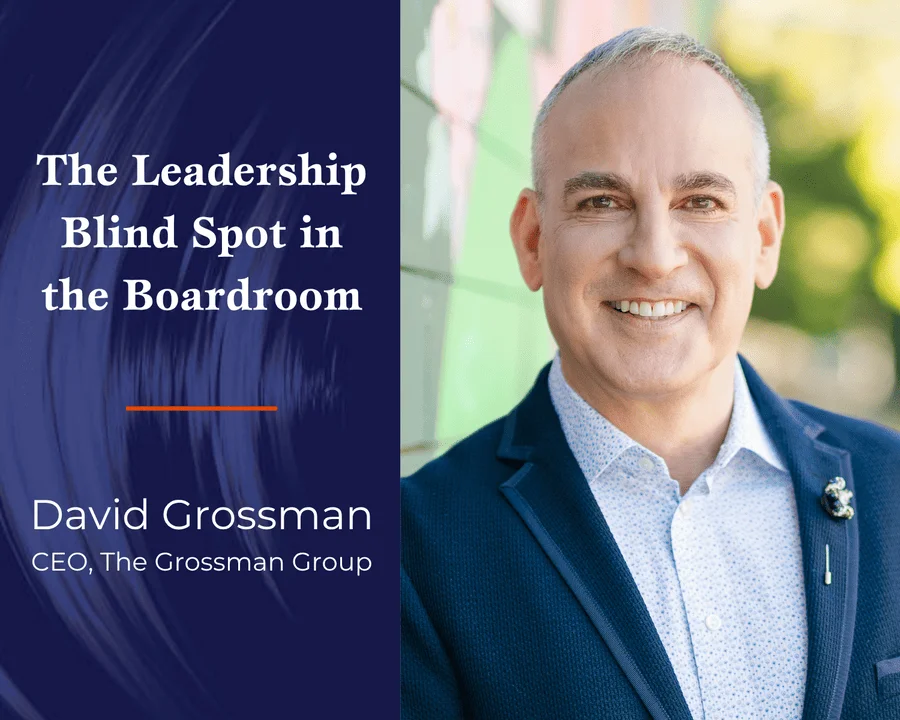
In this podcast, Dr Sabine Dembkowski, Founder and Managing Partner of Better Boards, is joined by David Grossman. David is the Founder and CEO of The Grossman Group, which helps Fortune 500 companies lead with heart to align business and communication strategy, strengthen workplace culture, and improve employee engagement and performance, particularly during periods of uncertainty and organizational change.
Boards are happy with leaders who get results. Indeed, some 54 percent of employees rate their leaders as good. Unfortunately, boards that accept “good” results miss the potential for exceptional outcomes.
David notes most good leaders were trained for stable times. That’s not the present environment. Their employees note that good leaders appreciate results, answer questions, and solve problems. It’s operationally good, but voluntary turnover rates and innovation speeds indicate a big underlying gap.
“The blind spot is all about appreciating those who work for you.”
In David’s experience, the difference is in how a leader treats and inspires workers. Good leaders see results; great leaders see people. Yet research reveals just 16% feel their leaders value them as people, only 19% feel heard, and a mere 14% say they are reaching their full potential at work. Under good leaders, people will report feeling invisible as human beings. Under great leaders, the metrics for being valued, heard, and seen will be double or more.
“The discipline is knowing which are crystal balls, the ones you cannot drop without permanent damage, and which are rubber balls, the ones that bounce back.”
David compares leadership structures to different types of balls. Crystal balls are what most organisations have – fragile leadership structures that collapse in a crisis. The goal is rubber balls – resilient, adaptable leaders who inspire their teams to excellence in all situations.
To make the shift, David recommends boards move from a performance vs. underperformance view to a three-tier lens of what’s exceptional, good, or outdated. This captures inspirational ability as well as goal performance.
“The most important thing boards can measure, based on what I’ve actually seen move the needle, is how well their leaders address the three blind spots.”
Leaders who make their people feel seen, heard, and valued make the difference. Good leaders routinely overestimate how comfortable their teams are with speaking up on issues. David notes independent perspectives, from skip-level reviews to third-party surveys, can uncover this gap.
Another vital investment is in heart-focused attributes. Out of the top 10 qualities of exceptional leaders, nine are heart-based skills. These include creating a positive work culture, focusing on building trust, and communicating transparently. All are trainable skills, including gratitude, the number one differentiator of exceptional leaders.
The three top takeaways from our conversation for effective boards are:
- Good leaders are both the problem today and the solution.
- The gap between good and exceptional is a training gap and belongs on the risk register.
- Put leadership quality on the standing agenda.
Don’t forget to subscribe never to miss an episode of the Better Boards Podcast Series. Available on their website, Apple, Spotify or Google.