The podcast and the article are brought to you by The Better Boards Podcast Series.
While we often think in terms of large, listed corporations, family firms account for some 70% of global GDP and 60% of global employment. They are key drivers of innovation, entrepreneurship, and long-term value creation, and effective governance of family firms warrants serious attention
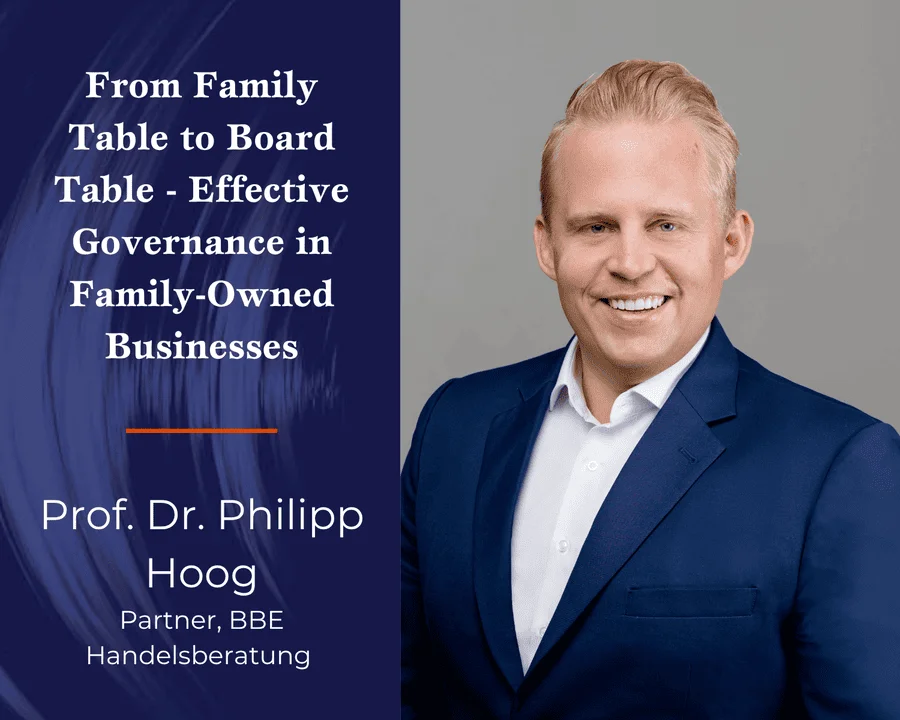
In this podcast, Dr Sabine Dembkowski, Founder and Managing Partner, is joined by Prof. Dr. Philipp Hoog. Philipp is a Partner at BBE Handelsberatung, a leading German consultancy specialising in the retail sector, and Honorary Professor of Strategic Management at CBS International Business School in Cologne. He advises family-owned and founder-led businesses and investors on strategy, governance, transformation, and succession, with a particular focus on the role of advisory and supervisory boards in navigating disruption in retail. Philipp combines academic insight with hands-on experience from numerous board-related mandates and projects. He also serves as President of the EBS Alumni Association, representing graduates of EBS Universität für Wirtschaft und Recht.
“In family business, it’s not just the business sitting at the table, but also the family and the ownership, often embodied in the same people.“
Philipp notes that many of the world’s most successful companies are family-owned. Mars, Walmart, Aldi, Lidl, Peters Sports, and Samsung, to name a few. This makes governance more complex and personal, since any strategic advice must also consider family dynamics and generational concerns.
“The role of an advisory board in family businesses is something like a balancing act.”
For Philipp, advisory boards need to provide advice and control while considering the family interests. This can mean serving as a sparring partner, driving succession conversations, or diffusing emotional conflicts. At times, this requires a greater time commitment and investment in understanding the relationships than you would see at a non-family firm, to give appropriate advice and remain mindful of the dynamics.
“Boards, especially in family businesses, work well when there are three things in place.”
In Philipp’s experience, family boards need three things. The first is clear role separation, so family members understand when they are acting as shareholders vs family members or external stakeholders. The second is timely professional information about the business, ideally through structured reporting. The third is regularly scheduled, well-structured board meetings. To Philipp, three to four quality meetings per year, plus a strategy retreat, is ideal.
“A good advisory board doesn’t restrict entrepreneurial freedom; it expands it.”
Philipp sees boards operating under two distinct models in family businesses. One is as an early warning system and strategic challenger. Another model is a board that oversees the company and monitors overall governance issues.
A critical question is whether the company is playing to win or playing not to lose. Family-owned businesses can be reluctant to share authority and control, but a good board offers structure and support. Indeed, since family businesses often think in generations rather than quarters, partnering with board members who share the entrepreneurial DNA and bring a governance structure can be the key to more stable long-term growth.
The three top takeaways from our conversation for effective boards are:
- Governance is not a luxury. It is a success factor, especially for family businesses.
- Family ownership and business must be clearly separated in roles, in bodies, and in decisions. This creates professional governance.
- The right board makes the difference.
Don’t forget to subscribe never to miss an episode of the Better Boards Podcast Series. Available on their website, Apple, Spotify or Google.