

By Dr. Deborah Bayntun-Lees
Leaders often struggle to balance compassion with accountability, fearing that one undermines the other. The Compassion-Accountability Matrix offers a practical framework to navigate this tension, helping leaders recognise when care drifts into enabling, when accountability becomes punitive, and how to restore dynamic balance in real time.
In leadership discourse, compassion and accountability are often presented as complementary virtues. In practice, however, they can feel like opposing forces. Lean too far towards compassion and you risk enabling underperformance or avoiding hard decisions. Lean too far towards accountability and you risk eroding trust, psychological safety, and morale. This is the Compassion-Accountability Paradox, and it is one of the most persistent challenges facing leaders today.
The Origins of the Matrix
The Compassion-Accountability Matrix emerged from my research with leaders working in complex, emotionally charged environments, including trauma-informed organisations, healthcare settings, and purpose-driven businesses. In these contexts, leaders navigate high-stakes decisions daily: supporting struggling team members while maintaining standards; holding space for personal difficulties while ensuring collective performance; demonstrating care without inadvertently rescuing people from the consequences of their choices.
What became clear through this research is that the most effective leaders do not choose between compassion and accountability. Instead, they achieve dynamic balance, holding care and rigour together, making context-sensitive judgements that protect relationships while safeguarding the mission.
This is not simply about being a ‘kind but firm’ leader. It requires deliberate, moment-by-moment calibration. To support this, I developed the Compassion-Accountability Matrix: a practical tool that helps leaders diagnose where they, and their organisations, currently sit, and make intentional adjustments.
The Four Quadrants
The matrix plots compassion on one axis and accountability on the other, creating four distinct leadership zones:
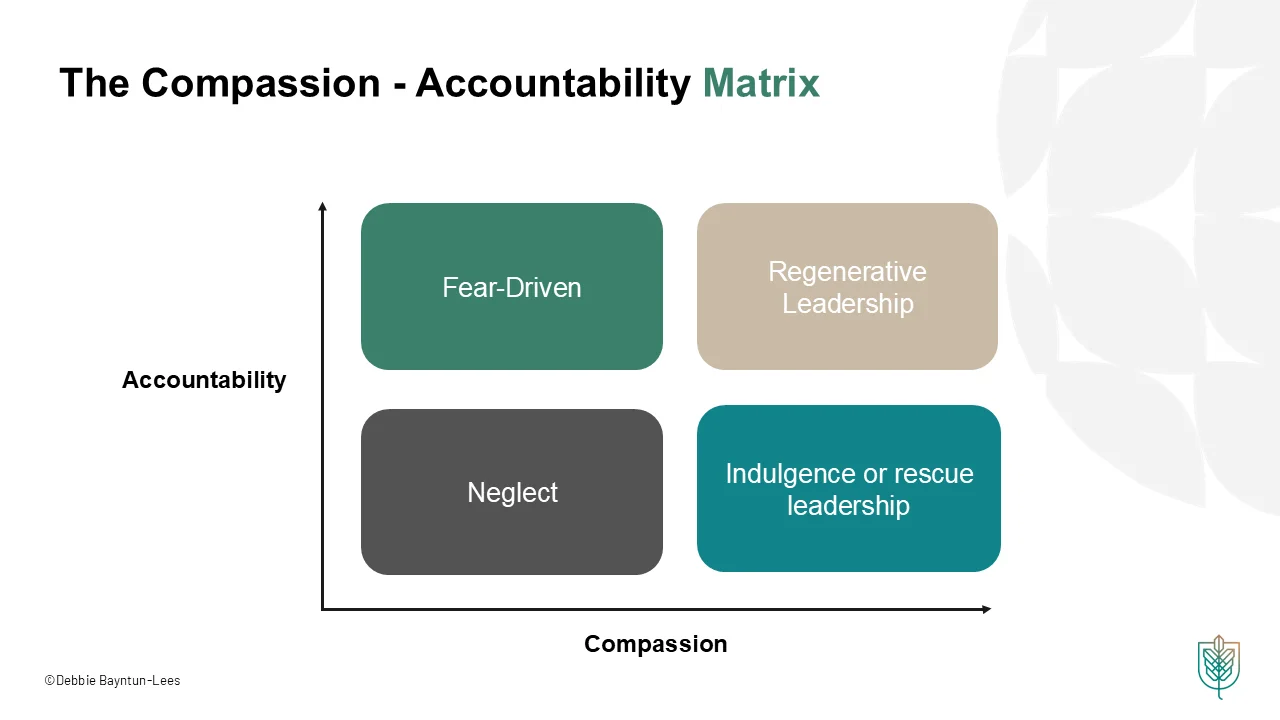
1. Neglect (Low Compassion, Low Accountability)
When both compassion and accountability are absent, neglect takes hold. Leaders in this quadrant may be disengaged, overwhelmed, or simply unaware of their impact. Team members feel unseen and unsupported, while standards drift without consequence. This is leadership by absence, and it erodes both trust and performance over time.
2. Fear-Driven Leadership (Low Compassion, High Accountability)
Here, accountability dominates without the humanising influence of compassion. Expectations are clear and consequences are enforced, but people feel like cogs in a machine. Mistakes are punished rather than learned from. Psychological safety erodes, innovation stalls, and talented people leave. This quadrant often emerges under pressure, when leaders default to control as a coping mechanism.
3. Indulgence or Rescue Leadership (High Compassion, Low Accountability)
This is the quadrant where well-meaning leaders often find themselves stuck. Compassion is abundant, flexibility is offered, allowances are made, and empathy flows freely. But without accountability, care can drift into enabling. Underperformance is tolerated. Difficult conversations are avoided. The leader may unconsciously ‘rescue’ team members from challenges they need to face. Over time, this damages both the individual (who doesn’t grow) and the team (who carries the burden).
4. Regenerative Leadership (High Compassion, High Accountability)
The upper-right quadrant represents the integration of both forces. Here, leaders demonstrate genuine care for their people while maintaining clear expectations and honest feedback. Boundaries are understood not as the opposite of compassion but as one of its deepest expressions. Support is offered alongside challenge. This is regenerative leadership, it renews energy and capacity rather than depleting it, creating cultures that are both humane and high-performing.
Using the Matrix in Practice
The matrix is most powerful when used as a reflective and diagnostic tool. Leaders can apply it in three ways:
1. Self-Assessment
Where do I typically sit on this matrix? Am I naturally inclined towards compassion, sometimes at the expense of accountability? Or do I default to rigour and risk becoming fear-driven under pressure? Honest self-reflection, ideally supported by feedback from trusted colleagues, helps leaders identify their habitual patterns.
2. Situation Analysis
Different situations may require different positions on the matrix. A team member facing a personal crisis may need more compassion in the short term. A persistent performance issue may require a deliberate shift towards accountability. The key is intentionality: knowing where you are and choosing where you need to be.
3. Real-Time Calibration
In the moment, leaders can use simple reflective questions to calibrate their response:
- Am I being genuinely supportive, or am I rescuing this person from a necessary challenge?
- Am I holding them accountable, or am I being punitive?
- What does this person need right now to grow, and what does the team need to thrive?
- Where is my own discomfort influencing my response?
These questions help leaders avoid unconscious drift and make deliberate choices that restore dynamic balance.
Boundaries as Acts of Care
One of the most important insights from the research is that boundaries are not the opposite of compassion, they are its partner. In my work with trauma-informed organisations, I observed leaders who cared deeply for their teams, often sharing lived experiences that created profound connection. But without boundaries, that closeness sometimes blurred the line between support and over-responsibility.
The most effective leaders learned to set boundaries as acts of care: protecting their own capacity to serve, safeguarding team wellbeing, and ensuring that compassion did not become an excuse for avoiding difficult decisions. When accountability was finally applied, sometimes after months of support, it was experienced not as punishment but as clarity.
A Discipline to Be Mastered
Ultimately, the Compassion-Accountability Paradox is not a leadership flaw to be resolved. It is a discipline to be mastered. Leaders who can achieve dynamic balance, who can hold care and rigour in creative tension, cultivate workplaces that are both humane and high-performing.
In an era when employee wellbeing, psychological safety, and performance are all under scrutiny, this integration matters more than ever. The Compassion-Accountability Matrix offers a compass for navigating the complexity, helping leaders make wiser choices under pressure and build cultures where people, and organisations, can genuinely thrive.
 Dr. Deborah Bayntun-Lees