


By Ambika Zutshi, Dr Andrew Creed, and Patrick J. Murphy
True leadership energises, empowers, and inspires through integrity and genuine care. Artificial intelligence can amplify organisational effectiveness but cannot replace the authentic empathy and vision of human leaders. That’s why, in the AI era, it’s incumbent on leaders to harmonise technological support with human-centric motivation to foster trust and engagement.
The interplay of human leaders, personnel, and AI in organisational dynamics
Artificial intelligence (AI) will never become a trusted leader. It can execute certain leadership functions such as directing system inputs and outputs, decision-making, and even inspiring through innovative data synthesis. However, such functions rely on mere simulacra of human knowledge, lacking authentic experiential credi-bility. The empathic qualities of human leaders provide the vital nutrients of integrity that meta-bolise motivation and inspire personnel to trust and pursue a leader’s vision and, by extension, an organisation’s mission.
The integration of AI into the organisational processes supporting leadership functions may be inexorable, and it remains essential to scrutinise the opportunities and risks for all personnel involved (Naoum et al., 2026). AI’s value emerges not from prospective efficiency gains or leadership prowess, but rather from procedural effectiveness, innovation impact, and revenue enhancement. These positive outcomes are attributable to algorithms and their extrapolation by AI. However, the technologies are not capturing or expressing the essence of empathy in the service of human needs and, therefore, personnel do not fully trust the incursion into workplaces. The pressing challenge is how to foster and harness human empathy and vision for motivational leadership in the AI era when people are questioning their trust in the technology. The strength of AI is its foundational support in service to the needs of personnel. The problem is its potential for oppressive impact as it mediates between leaders and personnel, due to its exceptional processing power but lack of empathic capability.
The nexus of empathy and vision in leadership
Empathy is pivotal, even for a highly persuasive or charismatic leader, to communicate effectively and move personnel toward a shared vision.
When appropriately enacted by leaders, empathy energises individual and team empowerment through authentic attention and responsiveness to human needs. Empathy is pivotal, even for a highly persuasive or charismatic leader, to communicate effectively and move personnel toward a shared vision. Personnel will only support the leader’s vision to the extent that integrity in addressing empathic needs is broadly accepted. Where doubts arise regarding the leader’s empathy and integrity, so do mistrust and demotivation. Consider the “hallucinations” triggered by an AI system in response to a question. People instinctively know when a sense of genuine care is absent in such exchanges.
Visionary leadership entails an iterative, relational process encompassing vision, communication, and empowerment (Westley and Mintzberg, 1989). Vision energises productivity and instils courage to transcend control or oppression. Personnel perceiving deceit, oppression, micromanagement, or excessive control from leaders tend to lose their motivation and become disempowered (Bulkan and Higgs, 2025). Alternatively, those who are guided by vision, accorded respect, and granted autonomy contribute their best efforts when empathetically supported by cognitive, social, and physical resources. In such settings, personnel experience feelings of energy, empowerment, and the inspiration that fosters superior performance (Bridgman et al., 2019). Herein lies the importance of harmony between leaders with empathy and vision and the delegation of functions to AI agents that are inherently devoid of human integrity.
Leadership roles for cultivating human motivation and organisational impact
AI is capable in auxiliary roles that support organisational missions and leadership visions, yet it can never wholly replace the service of leadership amid complex human interactions that sustain motivation toward those missions and visions. Figure 1 synthesises leadership roles and expressions into a hierarchical progression from foundational elements to the pinnacle of vision. At its heart, healthy empathy enables leaders to enact these roles while eliciting positive motivational responses from personnel. The peripheral expressions, however, are darker leadership outcomes that emerge when empathy becomes dissonant or absent, or where AI is afforded unbridled control of the role expressions.
Figure 1: Human-centric leadership role pathways with AI inflections
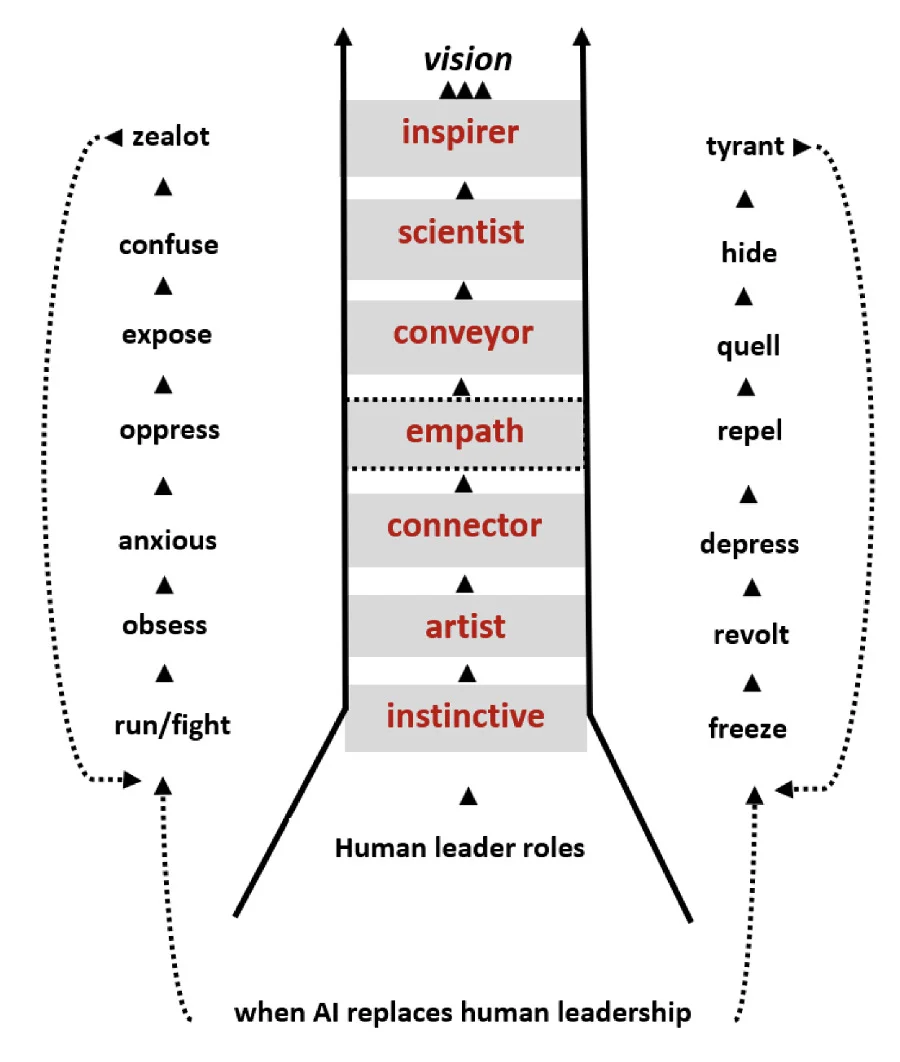
In figure 1, the outer progressions depict suboptimal outcomes derived from AI-centric approaches, while the middle column details responsible leader expressions across these leadership roles. The team and / or organisational context will require that the leader switch between their respective roles:
- Instinctive leaders excel in contexts of strategic challenge, competitiveness, environmental uncertainty, and incomplete data, where personnel positively value the intuitive navigation of uncertainty. AI lacks this human instinct and, without human intervention, can generate flight, fight, or freeze responses to strategic challenges.
- Artistic leaders embody the roles of innovator, designer, and curator, crafting elegant, appealing solutions for an organisation. Personnel derive satisfaction from such leadership artistry. Challenges emerge through potential revolt when creations lose harmony with human needs and desires, or via fixation with AI-driven innovations in products, processes or systems irrespective of authenticity and necessity.
- Connector leaders function as networkers who bring opportunities to organisations. Personnel respond enthusiastically to exciting potentials in markets, supply chains, and financial domains, ignited through the sparks of interpersonal relationships. An exclusively AI scenario dehumanises the dynamic and diminishes connective capacity, which can remove the vitality and generate anxiety or depression.
- Empaths imitate servant leadership that is attuned to individual and team needs. Personnel can discern when these needs are genuinely addressed and thus tend to follow willingly toward a shared vision. AI is incapable of expressing empathy and cannot embody genuine servant leadership traits, which tends to alienate followers and, at worst, impose inhumane systems or directives.
- Conveyors exemplify communicative leadership, projecting prominence and resonance. Personnel will rally more easily around a clear vision delivered with optimal candour and clarity. An AI-only communicator falters over the exposure or quelling of certain information, potentially leaking commercial secrets or sensitive data, or inappropriately withholding or deleting vital details in the absence of human insight.
- Scientist leaders exhibit decisiveness amid facts and data, harnessing persuasive power that achieves rational alignment with personnel. AI offers strengths in accessing data for this role but, like the conveyor, lacks human discernment regarding informational adequacy, potentially engendering confusion or misinformation among personnel.
- Inspirers convey visionary leadership that galvanises personnel to pursue the whole mission of the organisation with dedication. AI lacks inspirational vision, potentially prompting personnel to perceive its orders and processes as proxies for tyranny or zealotry, and devoid of soulful human nature.

What’s next?
As personnel increasingly incorporate AI tools in daily workflows and communications, the roles of leaders in fostering motivation, harmony between empowerment and autonomy, and mitigation of disengagement or bias take on paramount importance. Technological efficiencies must be harmonised with risks to limit stakeholder disengagement and algorithmic prejudices. In the AI era, the role of empathy takes on new importance when informed by research of emotional intelligence (EQ). Navigating this landscape demands that leaders prioritise human-centric roles, as delineated in figure 1, to energise personnel, enhance productivity, and instil empathetic courage regarding control or oppression. The roles offered in this piece provide a foundation for using technology as supportive augmentation for the human aspects of leadership while averting the biases that arise from automated systems. Ultimately, extending respect, motivation, autonomy, and essential resources to personnel will yield strong engagement and superior returns on such organisational investments.


