
By Simon L. Dolan
Drawing from Kabbalah, this article explores how balance, integration, and the “Power of Three” can shape sustainable leadership and lasting success.
In the intricate mosaic of human endeavor, the pursuit of success in both business and personal life often hinges on a blend of wisdom, strategy, and profound insight. Drawing upon the ancient and mystical teachings of the Jewish Kabbalistic tradition, this article explores how the concept of the “Power of Three” can serve as a guiding principle for navigating the complexities of modern enterprise and personal fulfillment. By examining the symbolic and practical dimensions of this triadic framework, I aim to uncover actionable lessons that resonate with contemporary challenges and aspirations.
The Kabbalistic Context
This triadic framework serves as a powerful reminder that true strength emerges from the harmonious convergence of diverse yet complementary forces.
The Kabbalah, a branch of Jewish mysticism, offers a rich symbolic language that has captivated scholars and practitioners for centuries. Central to its teachings is the notion of the “Sefirot,” a system of ten emanations that represent divine attributes and processes. Among these, the number (3) three holds a special significance, often manifesting in triads such as the triune nature of the divine (Echad, Shlosha, and Yetzirah), the three realms of existence (Assiyah, Yetzirah, and Beriah), and the three pillars of moral decision-making (righteous, neutral, and wicked).
Bridging Tradition and Modernity
While rooted in spiritual and metaphysical contexts, the principles of the Power of Three possess a timeless relevance that transcends their original setting. This article seeks to bridge the ancient wisdom of Kabbalistic thought with the pragmatic demands of today’s business landscape and personal development. By distilling key insights from the Kabbalistic tradition, I aim to provide a framework that encourages holistic thinking, strategic foresight, and ethical integrity—essential qualities for achieving sustainable success in both professional and personal realms.
There are three objectives for this article
- To explore the Symbolism of Three: Delve into the Kabbalistic significance of the number three and its metaphorical applications.
- To derive Practical Lessons: Translate mystical concepts into actionable strategies for business management and personal growth.
- To encourage Integrated Thinking: Promote a balanced approach that harmonizes spiritual insight with practical execution.
For many years, I have noticed that—consciously or subconsciously—I have consistently used the metaphor of “three” in much of my writing, especially in my professional books and conceptual models. Examples include the triaxial model of values, the three dimensions of trust, the three pillars of resilience, and many others[1].
Reflecting on this recurring pattern led me recently to write an article on “The Power of Three”, published in the MyEducator Blog[2]. The present article is a continuation and extension of that reflection, with a particular focus on lessons derived from the millennia-old Jewish mystical tradition known as Kabbalah.
As I delved deeper into my research, I was both fascinated and pleasantly surprised to discover that the idea was far from entirely novel. The sages of Kabbalah had already recognized and explored the symbolic and practical power of “three” thousand of years ago. What I initially perceived as a personal conceptual inclination turned out to resonate with an ancient and profound philosophical tradition.
What a delightful coincidence—or perhaps, from a Kabbalistic perspective, not a coincidence at all.
By embracing the Power of Three, as illuminated through the lens of Jewish Kabbalistic tradition, I invite readers to embark on a journey of discovery that promises not only enhanced business acumen but also a deeper, more meaningful engagement with the life of the spirit and the material world.
The Meaning of number three in the tradition of the Kabbalah
In Jewish mystical thought — especially in the tradition of the Kabbalah — the number three is often seen as a symbol of balance, completion, harmony, and transformation. While Kabbalah does not present “the power of three” in the modern self-help sense, many of its central structures are built around triads. That gives strong symbolic support to my metaphor for success in work and life[3].
1. Stability: “A Cord of Three Strands”
One of the most frequently cited biblical metaphors is found in Ecclesiastes: “A cord of three strands is not quickly broken.” Within Jewish interpretation, the number three symbolizes resilience. This is because while two forces may counteract each other, the introduction of a third element fosters integration and enhances durability.
The principle of the triad—comprising three complementary elements—offers profound insights for achieving sustainable success in both professional and personal domains:
- Talent Alone Is Fragile: While innate ability is an asset, it lacks the robustness necessary to withstand prolonged challenges without support.
- Effort Alone Burns Out: Diligence without strategic direction or rest can lead to exhaustion and diminished returns over time.
- Vision Alone Stays Abstract: A compelling vision, without actionable steps and relational grounding, remains an unfulfilled aspiration.
However, when these three dimensions align, success becomes not only achievable but also enduring:
- Competence: Mastery of skills and knowledge provides the foundation upon which all other elements can be built.
- Meaning: A sense of purpose imbues efforts with significance, motivating sustained engagement and resilience.
- Relationships: Strong interpersonal connections offer support, feedback, and opportunities for collaboration, enhancing adaptability and growth.
So, referring to the Kabbalistic wisdom encapsulated in the metaphor of a cord of three strands encourages a holistic approach to life and business. By integrating competence, meaning, and relationships, individuals and organizations can cultivate resilience and achieve sustainable success. This triadic framework serves as a powerful reminder that true strength emerges from the harmonious convergence of diverse yet complementary forces.
2. The Kabbalistic Structure: Right – Left – Center
One of the deepest mystical patterns in Kabbalah is the idea that reality stabilizes through three columns:
| Column | Symbolic Meaning |
| Right | Expansion, generosity, creativity |
| Left | Discipline, limits, judgment |
| Center | Balance, harmony, wisdom |
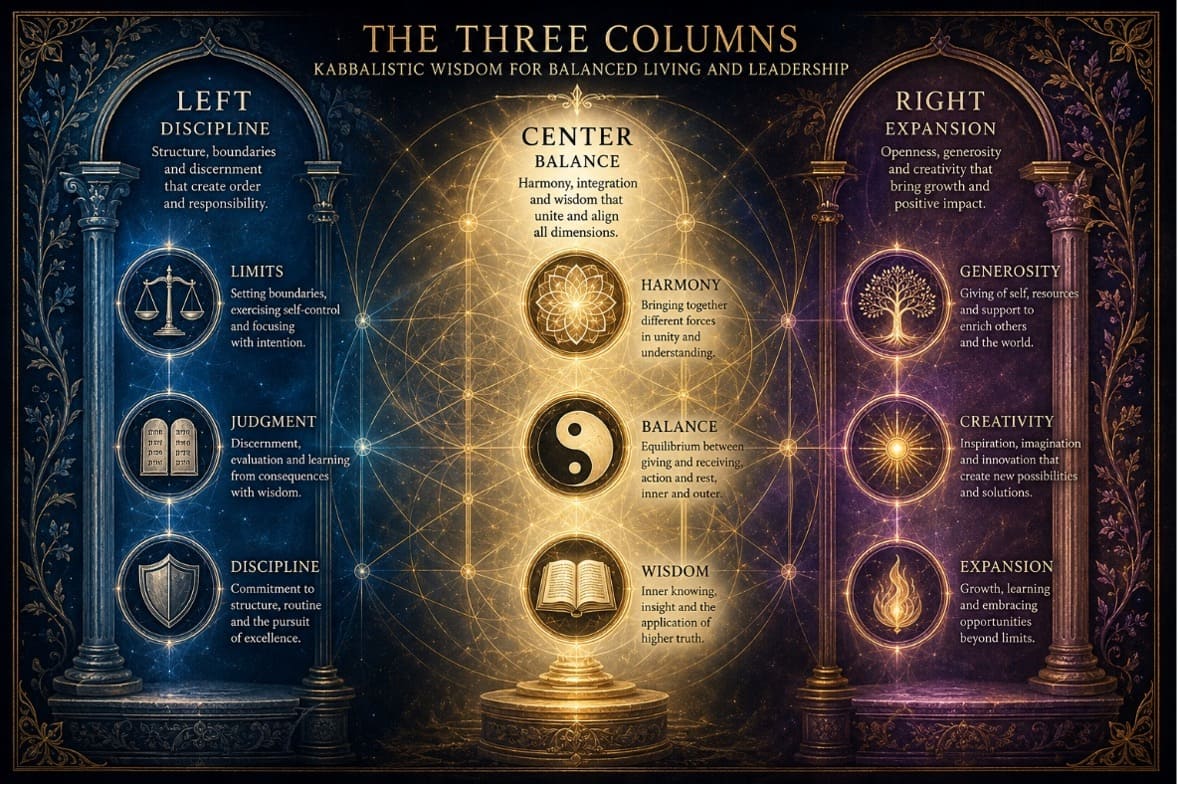
This triadic structure appears in the famous Tree of Life. For those who are not familiar with this concept, here is a summary: The famous Tree of Life in the Jewish mystical tradition of Kabbalah does not originate from a single book or one historical author. Rather, it evolved gradually over centuries from biblical, rabbinic, and mystical sources. However, the classical formulation of the Tree of Life as we know it today—with the ten sefirot arranged in interconnected triads and columns—emerged mainly in medieval Kabbalah, especially in two foundational works:
- Sefer Yetzirah (“Book of Formation” or “Book of Creation”) Probably composed between the 3rd and 6th centuries CE. Introduced the idea of cosmic structure through numbers and emanations. It speaks of the “ten sefirot” (eser sefirot belimah), which later became the basis for the Tree of Life system.
- Zohar – Written in 13th-century Spain and traditionally associated with Rabbi Shimon bar Yochai, though historically linked to Moses de León. Expanded the symbolic, spiritual, and psychological meanings of the sefirot. The Zohar deeply shaped the imagery of the Tree of Life and its three-column structure.
Mystically, the center path is not mediocrity; it is the intelligent integration of opposites. This translates beautifully into leadership and personal success:
- Ambition without ethics becomes destructive.
- Compassion without structure becomes weakness.
- Structure without humanity becomes rigidity.
- Success emerges from integration.
That is profoundly aligned with modern ideas of emotional intelligence and resilient leadership[4].
3. Three Levels of the Human Being
Kabbalistic and Hasidic traditions frequently articulate the human being as a multi-layered entity, emphasizing the significance of alignment across these dimensions for achieving effectiveness and success. One prevalent triad within this framework comprises:
- Thought
- Speech
- Action
The alignment of these three components is posited to be essential for a person to operate at their optimal capacity. When thought, speech, and action are harmoniously synchronized, individuals are more likely to experience coherence in their endeavors, leading to enhanced outcomes in both personal and professional domains.
In contemporary organizational discourse, the principles encapsulated by this triad can be operationalized as follows:
- Think, underscores the importance of reflective and strategic mindfulness within organizational contexts. This involves: Critical Analysis: Engaging in rigorous critical thinking to evaluate situations, challenges, and opportunities from multiple perspectives. Innovation and Creativity: Encouraging innovative thought processes that lead to novel solutions and strategic advancements. Alignment with Organizational Goals: Ensuring that thoughts are consistently aligned with the overarching objectives and values of the organization
- Speak, emphasizes the necessity of clear, transparent, and inclusive communication. Effective speaking within an organizational setting involves: Clarity and Precision: Conveying ideas and intentions with clarity to minimize misunderstandings and ensure mutual comprehension. Inclusivity and Empathy: Adopting communication styles that are empathetic and inclusive, thereby fostering a sense of belonging and engagement among all stakeholders. Feedback Mechanisms: Establishing channels for constructive feedback that encourage continuous improvement and alignment of spoken intentions with organizational realities
- Act Consistently, focuses on the consistent and purposeful implementation of thoughts and spoken intentions. This involves: Alignment of Actions with Intentions: Ensuring that actions are directly aligned with the articulated thoughts and communicated intentions, thereby reinforcing credibility and reliability; Consistency in Behavior: Maintaining consistent behavior across various scenarios to demonstrate commitment and build a reputation for dependability; Impact Assessment: Regularly assessing the outcomes of actions to ensure they contribute positively to organizational goals and adjust strategies as necessary
When one dimension contradicts the others, trust erodes. In our own research we have discovered empirically the three dimensions of trust to include: Reliability, Concern and Harmony. [5] We showed that sustainable leadership cannot rest on competence alone. Long-term effectiveness emerges from the integration of these three essential dimensions of trust, only together, these dimensions create the psychological and ethical foundation for enduring organizational success.
By integrating these three elements—thought, speech, and action—organizations can harness a synergistic approach that not only enhances operational efficiency but also nurtures a culture of integrity and purpose-driven performance. The same applies to leaders; when they are reliable, show genuine concern to their followers and act to produce harmony it serves as a powerful catalyst for achieving sustained success in business and life.
4. Transformation Often Happens in Three Stages
Jewish mystical storytelling, deeply rooted in the Kabbalistic tradition, frequently adheres to a three-part structure that mirrors universal patterns of growth and transformation. This triadic framework—comprising contraction or challenge, struggle or transition, and revelation or renewal—offers profound insights applicable to both personal development and business strategies.
- Contraction or Challenge – The initial stage involves a period of contraction or challenge, where individuals or organizations encounter obstacles that compel introspection and adaptation. This phase is crucial as it sets the foundation for subsequent growth by highlighting areas requiring attention and change.
- Struggle or Transition – Following the challenge, the second stage is characterized by struggle or transition. During this period, individuals navigate through difficulties, learning and evolving through the process. It is a time of active engagement with the challenges faced, fostering resilience and adaptability.
- Revelation or Renewal – The final stage is marked by revelation or renewal, where the insights gained from the preceding struggles culminate in a transformative breakthrough. This phase brings about a renewed sense of purpose, clarity, and capability, enabling individuals and organizations to emerge stronger and more aligned with their goals.
The three-stage model resonates with several contemporary growth frameworks, underscoring its universal applicability:
- Stress → Adaptation → Resilience: Stress initiates the need for adaptation, leading to the development of resilience[6]
- Failure → Learning → Mastery: Failure serves as a catalyst for learning, ultimately resulting in mastery of the subject or task.
- Crisis → Reflection → Transformation: A crisis prompts reflection, culminating in transformative change.
Understanding the power of three can empower individuals and businesses to navigate challenges with a structured approach. By recognizing the cyclical nature of growth—contraction, struggle, and revelation—stakeholders can harness these insights to cultivate resilience, innovation, and enduring achievement in both life and business endeavors.
In conclusion, the Kabbalistic tradition’s emphasis on the triadic process offers a timeless blueprint for transformation, encouraging a proactive and holistic approach to personal and professional development.
The Symbolic Importance of Three in Judaism
The number three holds profound significance within Jewish tradition, manifesting across various dimensions of religious thought, practice, and cultural heritage. This exploration delves into the multifaceted roles of the triad, illustrating its pervasive influence and the depth of meaning it conveys.
Patriarchal Triad
Central to the narrative of Jewish origins are the Three Patriarchs, whose legacies form the foundational pillars of faith and identity:
- Abraham – The progenitor of monotheism, whose covenant with God marks the inception of the Jewish people.
- Isaac – The son of Abraham, embodying the continuation of the divine promise and the perseverance of faith.
- Jacob – The patriarch who received the name “Israel,” symbolizing the transformation from individual to collective destiny.
These figures collectively represent the spiritual lineage and moral framework that guide Jewish belief and practice.
Tripartite Structure of the Torah
Ancient Jewish scholarship organized the Torah into three distinct sections, each contributing uniquely to the religious canon:
- Torah (Law) – The Five Books of Moses, providing foundational legal and ethical guidelines.
- Prophets (Nevi’im) – A compilation of prophetic writings that articulate divine messages and historical narratives.
- Writings (Ketuvim) – A diverse collection of poetics, historical, and philosophical texts that enrich the spiritual tapestry of Judaism.
This tripartite division underscores the comprehensive nature of Jewish scripture, integrating law, prophecy, and wisdom.
Pilgrimage Festivals
The Pilgrimage Festivals, or Shalosh Regalim, occur three times annually, each commemorating pivotal moments in Jewish history:
- Passover (Pesach) – Celebrates the Exodus from Egypt, symbolizing liberation and divine deliverance.
- Shavuot – Marks the giving of the Torah at Mount Sinai, emphasizing covenant and revelation.
- Sukkot – Commemorates the desert wanderings, highlighting themes of humility, gratitude, and divine protection.
These festivals collectively reinforce the cyclical nature of Jewish observance and the enduring connection to sacred history.
Priestly Blessing
The Priestly Blessing (Numbers 6:24-26) employs a threefold structure, each phrase invoking divine protection, peace, and favor:
- “The Lord bless you and protect you;
- The Lord deal kindly and graciously with you;
- The Lord bestow His favor upon you and grant you peace.”
This triadic formula encapsulates the core aspirations of Jewish communal life: safety, benevolence, and tranquility.
Mystical Symbolism of Repetition
In Jewish mysticism, particularly within the Kabbalistic tradition, the repetition of actions or concepts three times often signifies confirmation and spiritual completion. This practice reflects the belief that certain energies or intentions achieve full potency when reiterated thrice, aligning with the cosmic principle of the triad.
Thus, the pervasive presence of the number three in Judaism underscores its symbolic richness and theological depth. From the patriarchal lineage to the tripartite structure of the Torah, and from the pilgrimage festivals to the priestly blessing, the triad embodies unity, completeness, and divine harmony. Embracing this symbolic framework encourages a deeper appreciation of Jewish heritage and its enduring relevance in contemporary spiritual discourse.
A Modern Interpretation of the Rule of Three Inspired by Kabbalah
Embracing this symbolic framework encourages a deeper appreciation of Jewish heritage and its enduring relevance in contemporary spiritual discourse.
So, before concluding the article, I insist that “The Rule of Three”, a principle deeply rooted in mystical and philosophical traditions, finds a contemporary reiteration through the lens of Kabbalah. This modern interpretation emphasizes the interplay of complementary forces across various domains of human endeavor, suggesting that true and lasting success is achieved through the harmonious integration of these elements. Below, I explore this concept across three pivotal areas: personal life, work/leadership, and the broader existential quest for purpose and vision.
Personal Life
In the realm of personal life, the Rule of Three manifests as a balance between Purpose, Discipline, and Compassion.
- Purpose: This is the guiding star that aligns individual actions with deeper life aspirations. It is the internal compass that directs one’s energy and intentions toward meaningful goals.
- Discipline: The steadfast commitment to nurture and actualize one’s purpose. Discipline is the bridge that transforms aspirations into tangible achievements, requiring consistent effort and resilience.
- Compassion: The nurturing force that ensures personal growth is not at the expense of others. Compassion fosters empathy and connection, enriching the personal journey and contributing to a more harmonious existence.
Alternatively, this triad can be succinctly encapsulated as Mind, Heart, and Action:
- Mind: The repository of thoughts, ideas, and strategic planning.
- Heart: The wellspring of emotions, values, and motivations.
- Action: The execution of plans and the manifestation of intentions into reality.
Work / Leadership
In the professional sphere, particularly in leadership roles, the Rule of Three translates into a dynamic interplay of Vision, Execution, and Human Connection.
- Vision: The foresight that charts a course for collective progress and innovation. Visionaries inspire and guide teams toward ambitious yet achievable objectives.
- Execution: The meticulous process of turning visionary concepts into operational realities. Execution demands organizational prowess, adaptability, and a keen eye for detail.
- Human Connection: The relational aspect that binds individuals within an organization. Strong human connections foster collaboration, trust, and a shared sense of purpose, essential for cohesive and motivated teams.
Another succinct representation could be Learn, Adapt, and Contribute:
- Learn: Continuous acquisition of knowledge and skills, essential for personal and organizational growth.
- Adapt: The ability to adjust strategies and approaches in response to changing environments and challenges.
- Contribute: The proactive engagement in creating value, both within and beyond the immediate organizational context.
Purpose and Vision
At a higher existential level, the Rule of Three underscores the necessity of integrating Purpose, Vision, and Compassion to achieve enduring success and fulfillment.
- Purpose: The fundamental question of “Why?” that anchors all endeavors in a meaningful context.
- Vision: The aspirational “What?” that outlines the desired future state or outcome.
- Compassion: The “How?” that ensures the pursuit of purpose and vision is conducted ethically and empathetically, benefiting both the individual and the broader community.
Conclusion
The mystical insight gleaned from the Rule of Three, as interpreted through the lens of Kabbalah, is that success is rarely one-dimensional. Instead, it emerges from the harmonious interaction of complementary forces across personal, professional, and existential domains. By embracing this triadic structure—whether articulated as Purpose-Discipline-Compassion, Mind-Heart-Action, or Learn-Adapt-Contribute—individuals and organizations can cultivate a balanced and resilient approach to achieving lasting success. This modern interpretation not only honors ancient wisdom but also provides a practical framework for navigating the complexities of contemporary life with grace, purpose, and compassion.
“In Jewish mystical wisdom, the number three symbolizes the movement from opposition to harmony. Real success in life and work does not come from maximizing one force alone, but from integrating vision, discipline, and human connection into a balanced whole.”
 Simon L. Dolan