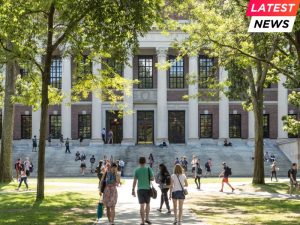
President Donald Trump announced Tuesday that Chinese students will continue studying in the United States under a new trade agreement with Beijing, signaling a shift in tone just weeks after his administration threatened tighter visa restrictions.
Trump posted on his social media platform, Truth Social, that the U.S. and China had reached a deal that includes access to rare earth materials and the continuation of Chinese student enrollment in American universities. “We are getting a total of 55% tariffs, China is getting 10%. Relationship is excellent!” Trump wrote, adding that the deal awaits final approval from Chinese President Xi Jinping.
The announcement follows recent remarks from Secretary of State Marco Rubio, who had said the administration would “aggressively” revoke visas for students linked to China’s Communist Party or enrolled in sensitive research fields.
It remains unclear whether Rubio’s directive remains in place. However, the president’s latest comments come amid efforts to ease tensions over export controls and student access, both of which have become flashpoints in U.S.-China relations.
China’s government has strongly criticized American policies restricting academic and technological exchanges, calling them discriminatory and damaging to U.S. credibility. The Chinese Foreign Ministry recently warned students to be cautious when considering certain U.S. states due to rising scrutiny and security concerns.
Recent arrests of Chinese nationals for allegedly smuggling biological materials have further strained relations. At the same time, state-level legislation in Ohio, Texas, and Florida has banned financial and research partnerships between public colleges and Chinese institutions.
Despite growing barriers, Chinese nationals remain one of the largest international student groups in the U.S., numbering around 277,000. Some have already begun exploring education options in other countries such as the UK and Australia, where policies are seen as more stable.
Though Trump’s comments may signal a thaw in one area of bilateral tension, visa applicants still face tightened screening, including expanded reviews of digital activity and security backgrounds.
Related Readings: