

By Patrick Reichert and Vanina Farber
This piece explores the ripple effects of America’s retreat from humanitarian aid and what it means for fragile states, global stability, and future financing models for the sector.
In 2023, the United States accounted for 42% of global humanitarian aid.
On July 1st, 2025, the United States Agency for International Development (USAID), for decades a cornerstone of global relief and development, officially shut its doors. Funding to thousands of life-saving aid programs was terminated. Local clinics, food distribution centers, refugee camps, and education projects lost critical support. In total, close to $40 billion in annual assistance evaporated with the agency’s closure, leaving a gaping void in the global humanitarian landscape.
The decision to shutter USAID wasn’t made in a vacuum. For years, foreign aid faced mounting criticism over failed projects, excessive overhead, and programs that created dependency rather than development. Critics also pointed to the system’s over-reliance on a single donor—a structural vulnerability that aid experts had long warned about.
With the wholesale shutdown of USAID, that structural vulnerability has been laid bare in the starkest terms. Whatever the system’s flaws, it had become the backbone of global emergency response. Furthermore, the majority of that response had clear, measurable impact. Emergency food assistance, vaccine distribution, HIV treatment, disaster relief: these are not experimental programs but proven interventions with well-documented results.
Although shortcomings in the humanitarian system have become increasingly apparent, reform should strengthen the foundation, not bring the whole structure down. This crisis has exposed the urgency to establish a new architecture: one that breaks down silos between humanitarian, development, and peacebuilding efforts; reduces dependency on any single state donor; and fosters collaboration among governments, international organizations, private philanthropy, and local communities. Instead, what we are seeing is not transformation but outright dismantling — leaving millions to bear the cost while the sector scrambles to rebuild from the ground up.
Unfortunately, last month, that void has deepened.
On July 17th, 2025, Congress passed the Rescissions Act of 2025, eliminating an additional $9.4 billion in unobligated foreign assistance and public broadcasting funds. Nearly $8.3 billion of that came directly from international aid budgets, slashing planned spending on humanitarian relief, health programs, democracy promotion, and economic support. Despite bipartisan concern, the bill passed narrowly along party lines and was swiftly signed into law. Though narrower in scope than the USAID shutdown, it reinforces a troubling trajectory: the dismantling of foreign aid as we know it.
It’s hard to overstate how disruptive USAID’s closure is to the humanitarian sector. In 2023, the United States contributed~$68 billion the world’s humanitarian aid. Of that, USAID’s direct spending accounted for about $40 billion, around 59% of the U.S.’s total humanitarian aid effort.[1] The agency is being folded into the state department, where it is to be replaced by a successor organization called “America First.”
With the funding cuts, humanitarian operations worldwide came to a standstill. For these programs, and the communities that depend on them, the opportunity to secure new resources and either complete, hand over, or responsibly close out their work is vanishing fast.
For implementing partners already reeling from USAID’s collapse, the Rescissions Act is a double-whammy. In some cases, planned back-up funding is now gone. In others, program transitions that were expected to be gradual are being aborted. And for fragile states that depended on American assistance—from Ukraine to Sudan, Congo to Gaza—the risk of a full-blown humanitarian collapse is growing by the week.
Amidst this uncertainty, we conducted a targeted analysis of USAID’s final funding obligations to understand where the gaps are sharpest—across geographies, sectors, and delivery partners. Our goal was to identify the most exposed communities and programs, and to help inform decisions about where resources and attention are most urgently needed.
Where the Gaps Are Sharpest: Who and What Is Most Affected?
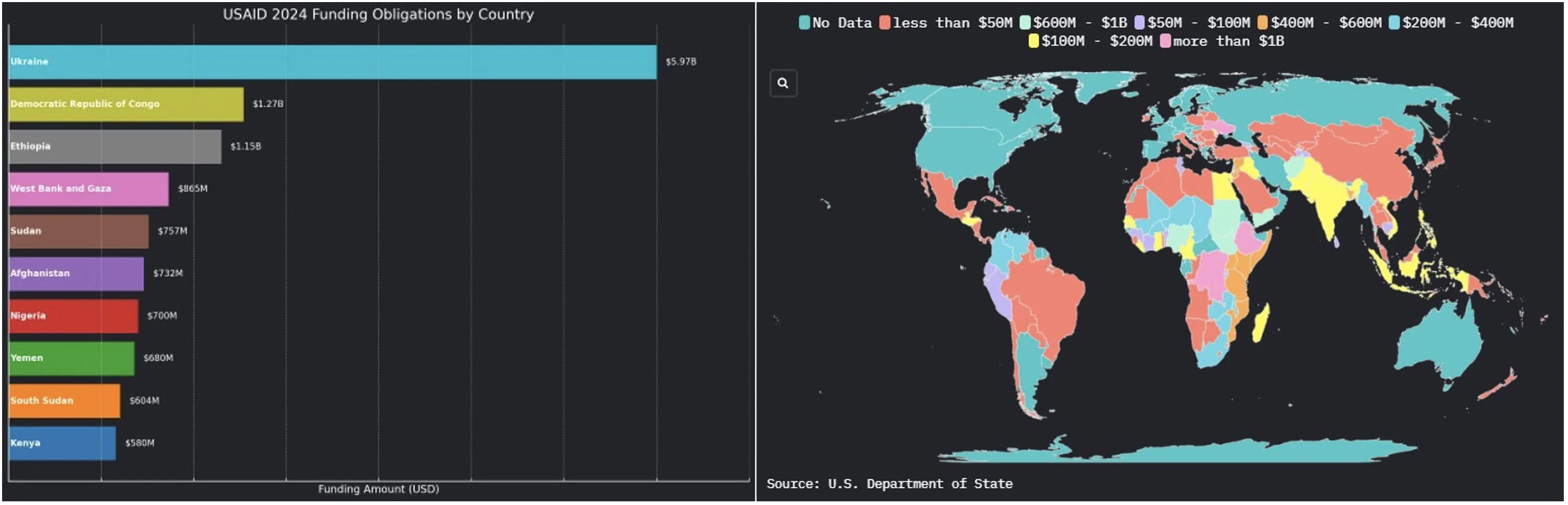
Analysis of USAID’s FY2024 obligations reveals the scale and scope of the disruption. Across more than 24,000 funding records, more than $35 billion had been committed globally. With many of these activities now paused or cancelled, critical humanitarian services face an existential threat.[2] At an average cost of $4,500 to save a life through proven global health interventions like malaria treatment or child illness prevention, the $35 billion lost from USAID’s shutdown represents an opportunity cost of over 7.7 million lives.
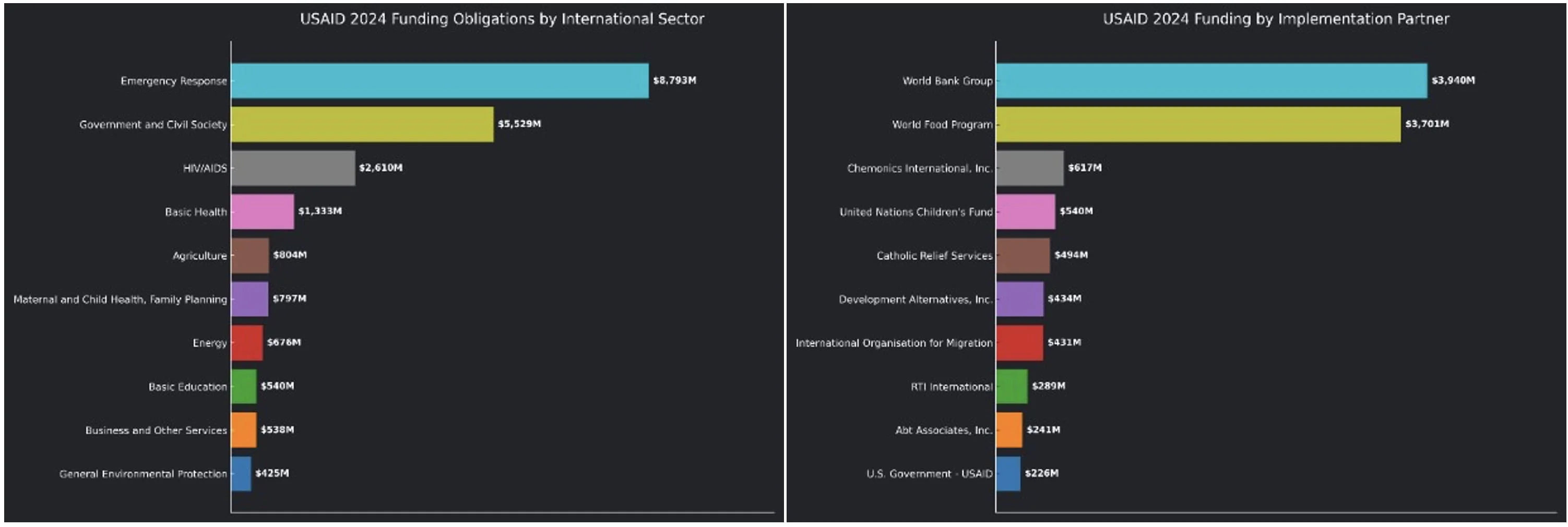
Many of the hardest-hit countries include Ukraine, the Democratic Republic of Congo, and Ethiopia: each expected to receive $1–6 billion in assistance. This funding spanned emergency food aid, healthcare, economic support, and more, all of which now faces uncertainty. Ukraine alone accounted for ~$6 billion of assistance in 2024, largely to bolster its war-torn economy and public services. Likewise, critical humanitarian and health programs (from emergency food aid to HIV/AIDS treatment) comprised some of the largest slices of the USAID portfolio.
Map of USAID 2024 Funding Obligations
USAID 2024 Obligations by International Sector & Implementing Partner
Ukraine: A Wartime Lifeline Cut Off
For Ukraine, USAID’s closure could not have come at a more precarious time. Ravaged by ongoing conflict and economic strain, Ukraine had become the single largest beneficiary of U.S. foreign aid via USAID in 2024, receiving roughly $6 billion. This figure included nearly $3.9 billion in direct budget support to keep the Ukrainian government and essential services running, as well as hundreds of millions for infrastructure and energy repairs to keep the lights on during wartime.
That lifeline has now been severed. The macroeconomic support that helped Ukraine pay salaries, stabilize its currency, and maintain critical public utilities is gone. Likewise, USAID-funded projects shoring up Ukraine’s electricity grid and heating systems have been left in limbo. The consequences are already looming. Without USAID, Ukraine faces a massive budget shortfall in the midst of a costly war and humanitarian crisis. Funds that had been sustaining hospitals, schools, and social safety nets have dried up. While European and other allies may try to fill some gaps, the sudden loss of U.S. economic support poses risks to Ukraine’s stability and its ability to provide basic services during the conflict.
Democratic Republic of Congo: Humanitarian Lifelines Severed
In the Democratic Republic of Congo (DRC), home to one of the world’s most complex and protracted humanitarian crises, the end of USAID funding has been devastating. With more than $1.3 billion in USAID obligations in 2024, the DRC now faces funding shortfalls for programs including food aid, healthcare, and conflict mitigation for millions of Congolese civilians and refugees from abroad.
Aid agencies on the ground warn of immediate and life-threatening impacts. According to Manenji Mangundu, Oxfam’s country director, “USAID cuts will have an immediate and devastating impact on millions of the world’s most vulnerable people who depend on humanitarian aid for survival.”[3] In eastern Congo’s conflict zones, where over half a million people were already desperate for food, water, and shelter, the sudden funding halt means relief efforts are grinding to a halt.
USAID-funded food convoys and nutrition programs are being suspended, and NGO-run health clinics are running out of supplies. Agencies that relied on U.S. funds for everything from cholera prevention to support for displaced families now find themselves without resources, forced to make decisions about who gets help and who is turned away.
The loss of U.S. aid is also causing chaos for the organizations themselves. Most humanitarian groups in DRC depended heavily on USAID grants; without them, many programs face closure and staff layoffs. Oxfam estimates that the health of up to one million people is now at risk in DRC due to cuts in vital clean water and sanitation services, heightening the threat of disease outbreaks like cholera and measles.[4]
The Scale of Human Impact: Food, Health, and Fragile States
Of all the sectors upended by USAID’s closure, emergency food aid may be the most immediately consequential. The shock comes at a time when global hunger was already at record highs. The U.N. World Food Programme (WFP) – the world’s largest hunger relief agency, has sounded alarm bells about a massive funding shortfall. In March 2025, WFP warned that 58 million people worldwide are at risk of extreme hunger or starvation unless urgent funding is secured, after seeing drastic donor shortfalls this year (including the loss of U.S. contributions). The agency’s donor income in 2025 is projected to be 40% lower than the year before, a gap that “threatened feeding programmes in 28 crisis zones around the world” from Congo to Sudan, Syria to Yemen.[5]
The United States has long been WFP’s largest donor, so the abrupt halt of USAID-administered food funding forced WFP to contemplate deep cuts. With donor budgets shrinking and U.S. foreign aid in flux, the agency faces tough choices about where – and whether – it can deliver food aid. WFP’s own estimates show it may receive only about $8 billion of the $16.9 billion it needs to assist 123 million people in 2025.[6] The funding shortfall comes even as private donations have tripled since 2019. However, private donations only account for ~3.5% of WFP’s funding, nowhere near enough to compensate.
Even before the USAID shutdown, WFP and other agencies had begun rationing aid due to funding gaps. For example, in East Africa, refugees in countries like Ethiopia and Kenya saw their food rations cut by up to 40% in 2023–2024 because donor money wasn’t keeping up.[7] WFP officials are prioritizing “the worst-affected regions and stretching food rations” as far as possible, but they acknowledge that they are approaching a funding cliff with life-threatening consequences.[8]
Programs in Sudan, South Sudan, DRC, Palestine, Syria, Yemen, and other hotspots are at risk of suspension in the coming months if new funding doesn’t materialize. In humanitarian terms, this means millions of hungry people could be cut off from food assistance. The most vulnerable – including children, displaced families, and refugees – will feel it first. Already, in Bangladesh, WFP has had to reduce rations for Rohingya refugees due to lack of funds.[9] In Afghanistan, Yemen, and Syria, programmes to prevent child malnutrition are being scaled back and could halt entirely. The USAID freeze adds immense pressure to an already strained system. The coming months will determine whether stopgap measures can avert the worst outcomes, or whether 2025 will see a dramatic spike in famine and undernutrition because the world’s largest donor stopped feeding the hungry.
Health Programs in Peril: The case of HIV/AIDS
The human impact of the aid cutoff is equally stark in the health sector, particularly for disease-specific programs that had depended on U.S. leadership. One of the most illustrative is the fight against HIV/AIDS. For two decades, the U.S. (through U.S. President’s Emergency Plan for AIDS Relief (PEPFAR) and contributions to the Global Fund) led a global campaign that saved millions of lives and brought AIDS under control in many countries.
However, when the U.S. government paused all foreign assistance, it caused an instant rupture in HIV services: deliveries of life-saving HIV medicines were interrupted, and prevention programs for at-risk populations were halted across dozens of countries.[10] Millions of people who depend on consistent antiretroviral treatment and outreach support were suddenly and abruptly cut off, left without care from one week to the next.
UNAIDS, the United Nations agency leading the global HIV response, has issued dire warnings. According to UNAIDS projections, if U.S. support for HIV programs is not quickly restored or replaced, the world could see an additional 6 million new HIV infections and 4 million AIDS-related deaths between 2025 and 2029.[11] “This is not just a funding gap. It’s a ticking time bomb,” said UNAIDS Executive Director Winnie Byanyima, noting how services have “vanished overnight” in some places and health workers have been sent home. The progress of the last decades is at risk of unraveling: before the crisis, global HIV infections and deaths had been steadily declining (new infections were 40% lower in 2024 than in 2010), but that hard-won progress could reverse if treatment and prevention stall out now.
Amid this bleak outlook, there was one notable exception. Following bipartisan pushback, the Senate amended the Rescissions Act of 2025 to preserve PEPFAR funding, stripping out a planned $400 million cut.[12] This move protected a cornerstone of the global HIV/AIDS response, ensuring that key services—such as antiretroviral distribution and testing—can continue in the short term.
However, the safeguard appears to apply only to PEPFAR. Other HIV/AIDS initiatives, particularly those funded through USAID or routed through broader global health platforms, were not exempted. With nearly $8 billion in international assistance rescinded overall, the fallout for HIV programs outside the PEPFAR umbrella is significant. Community-based prevention efforts, health systems strengthening, and cross-cutting support services are among the casualties, leaving dangerous service gaps in many countries.
On the ground, the disruption also entails knock-on effects. In countries like Mozambique, more than 30,000 health personnel (many of them involved in HIV and TB programs) have lost their jobs as U.S.-funded projects shut down.[13] Such losses not only hurt HIV treatment delivery but also weaken healthcare overall, as these workers also handle maternal health, vaccinations, and more.
Beyond HIV/AIDS, other health initiatives are suffering a similar fate. Tuberculosis clinics and outreach programs, some funded through USAID’s global health security efforts, are reporting shortages of medicines and diagnostic kits.[14] Malaria control programs that depended on U.S. funding for bed nets and spraying have scaled back, even as cases surge in places like Ethiopia.[15] Maternal and child health programs, from vaccine campaigns to nutrition for pregnant women, are likewise facing gaps.
In summary, the global health safety net has unraveled. The sudden withdrawal of the world’s largest donor is being measured in clinic closures, medicine stock-outs, and lives at risk. Whether it’s an HIV-positive mother in Kenya, a malaria-stricken child in Ethiopia, or a TB patient in Ukraine, vulnerable people are seeing their lifelines weakened. Health experts fear that without an urgent solution, the coming years could see resurgences of epidemics that had been under control, and a loss of confidence in health systems in some of the world’s poorest countries.
Can the Void Be Filled?
The closure of USAID’s programs in 2025 sent shockwaves through the humanitarian sector. The passage of the Rescissions Act of 2025 has now cemented a broader shift: a systemic retreat of the United States from its long-held role as the world’s leading humanitarian donor. Together, the agency’s shutdown and the rescissions mark an abrupt and ideologically driven pivot in U.S. foreign policy, one that deprioritizes humanitarian principles in favor of short-term domestic optics.
Front-line services have been disrupted, implementing partners destabilized, and local capacity gutted. In conflict zones and refugee camps, people who yesterday had food, medicine, or shelter provided by an American-funded project are waking up today to nothing. The ripple effects will not stop here. With each round of funding clawbacks, the humanitarian landscape becomes more fragile, more reliant on fewer actors, and more vulnerable to political shocks. The instability has rippled through organizations as well – tens of thousands of aid workers have lost employment globally due to the cuts, undermining local capacities built up over years.[16] It is a stark reminder of the interdependency and fragility of the humanitarian system and how quickly gains can be reversed.
Yet, amid the uncertainty, there are seeds of adaptation. Other nations and international institutions are under pressure to step up their contributions, even as many face their own budget constraints. Philanthropic actors, exemplified by Project Resource Optimization (PRO)[17], are innovating to plug critical gaps, however modestly. And affected communities and governments are striving to do what they can to fill the void – whether it’s health ministries reallocating scarce domestic funds to keep HIV clinics open, or local NGOs rallying volunteers to continue aid distribution on a shoestring. These efforts highlight the resilience and resourcefulness within the humanitarian sector.
Still, the road ahead remains challenging. The scale of disruption, $30+ billion annually, is not something that can be easily or quickly patched. The worry is that without prompt action to restore funding streams, today’s cutbacks will become tomorrow’s full-blown catastrophes – be it famine, disease outbreaks, or instability from unaddressed crises. The international community is therefore at a crossroads. Will new coalitions of donors emerge to restore at least a portion of the lost aid? Will cost-effective initiatives like PRO inspire more strategic giving to soften the blow? Can some projects spin-off into revenue-generating programs? Or will the world’s vulnerable populations simply be left to bear the brunt of a political decision beyond their control?
The 2025 USAID closure has infused a sense of urgency and clarity about what is at stake. This moment demands not just emergency stopgaps, but a fundamental rethinking of how global aid is structured, financed, and sustained. The old model—with its heavy dependence on a single donor and rigid institutional silos—has proven dangerously fragile. The new architecture must be more resilient: distributed across multiple funding sources, integrated across sectors, and rooted in partnerships that strengthen rather than replace local capacity.
The hope is that this crisis will catalyze not just a restoration of funding, but a reimagining of the humanitarian response itself. The Rescissions Act should be a rallying cry for systemic change. The world cannot afford for the lights to go out, but neither can it afford to simply flip the same old switches. The system holds—until it doesn’t. Now it’s time to build one that will.
 Patrick Reichert
 Vanina Farber