

By Dr Melissa Dunlop and Professor Adrian Furnham
The remote-working era brought us many challenges in communicating effectively with our fellow humans via a computer screen, but there are surely few contexts where the extreme subtleties of human interaction matter more than that of conversation between therapist and client. Can the relationship really work virtually?
There were many consequences of the COVID-19 pandemic, but one of the most lasting is the working-from-home phenomenon. We had to do everything online: hiring and firing, teaching and decision making, even partying. Further, some of the most sensitive and personal conversations, like that between therapist and client, coach and coachee, now had to be “virtual”.
Digitally mediated living changes the orienting anchors around which everyday realities are built. Public and private lives are less defined and contained by limitations of the time and space when activities are with people who don’t inhabit our physical location.
In this article, we share some of the things experts think about in supporting the development of safe, trusting relationships where each party is able to take “relational risks”. We look at some of the key differences between online and in-person “relating”, and share some of our experiences of what helps when it comes to really getting to know people online. This explains why many professionals still prefer to develop key relationships in person. We also suggest some considerations and adaptations for communicating more openly and effectively online.
Therapeutic views on space: shared physical environment versus digital window
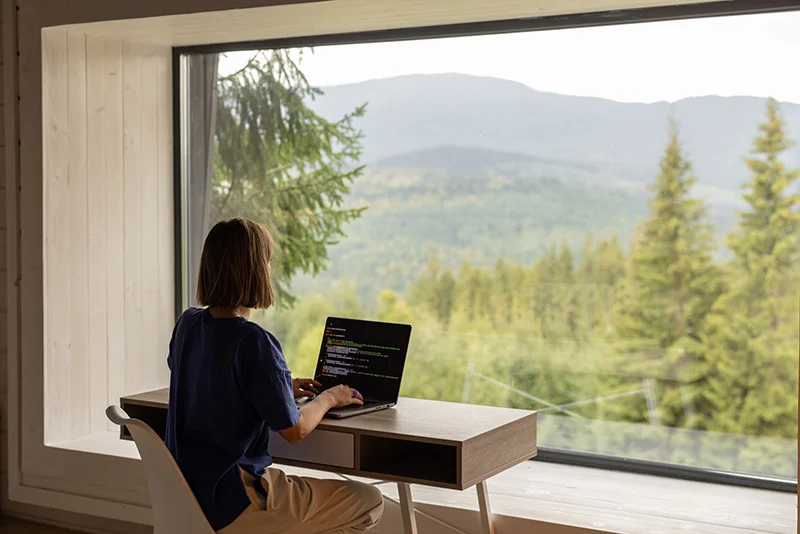
For the first 100 years of its practice, psychoanalysis and its descendant and related fields of counselling, psychotherapy, and coaching have taken place in real rooms which are managed and cared for by the practitioner to ensure privacy, comfort, and an unchanging backdrop for the work. Since Freud first developed the analytic method, there has been a strong consensus that the predictable and unchanging nature of the meeting time, and the room itself, have a beneficial effect upon the patient or client. Anyone visiting Freud’s rooms in London or Vienna cannot easily forget their uniqueness.
Counselling, coaching, and psychotherapy practitioners usually pay a lot of attention to the space in which they work, ensuring that it is private and calm, with enough detail of interest to engage the imagination, without overwhelming the senses with too much that is specific to the personality of the practitioner. Clients can rely upon the physical environment to be safe and unchanging and so they can relax, their attention freed to focus inward.
Yet meeting in the same location on a weekly basis is impossible for many, like those who are living as “digital nomads”. Meeting online allows access for people whose ability to travel is limited by health conditions, disabilities, a rural location, or one where the professional that they need isn’t available. Others have interesting reasons for choosing to work with someone they can never meet in real life, such as having a high profile in their own social sphere. For people who are especially concerned about privacy, knowing that the person they are working with is completely unrelated to their network can give much-needed reassurance. The potential to have a professional relationship that goes in-depth, yet remains essentially anonymous, can thus be enabled by an online framing.
But by replacing physical presence within the same room with a relationship that is mediated through a screen, online relating profoundly shifts a core foundation of therapeutic theory and practice: the assumption of embodied presence in the same space as an orienting anchor, the place that can be relied upon to stay the same while the people within it make changes. There was therefore a lot of questioning and doubt amongst practitioners about whether a therapy / counselling relationship could really be developed online.
In online meeting spaces, the four walls that contain the people meeting together in a shared environment are replaced by a screen, in fact two screens. While these give a feeling of a relation of closeness, each participant knows that there is distance between them. This dislocation between what is known cognitively and what is felt emotionally is a central feature of online social experience.
The online meeting room is both a digital space itself, and an analogous representation of the attachments and detachments of digital life. It has contributed to enabling the disparate geographies of many people’s lives and loves, for good or ill. In online meetings, we encounter one another within the contemporary relational structure of neither / both, where we each experience both places simultaneously, while at the same time existing together in neither. We are together-apart.
There is no pretending that this condition can provide the same sense of containment as can be found when one person comes into a space where they are hosted by the other, and where they can reasonably expect that the host has ensured that it is private, comfortable, and relatively predictable (there will be chairs, some water, etc.). But we have found that a different sense of containment is possible.
Subtle cues and visual communication
What does the online setting do to that human need for the consistency of physical relational contact which is so reassuring and helps us feel centred and oriented within reality? And can in-depth, emotionally sensitive relating really happen in this context?
Working online changes the “holding container” of therapeutic work from a room managed entirely by one person into something that has to be mutually created and maintained. Each party is responsible for ensuring they can be somewhere private and comfortable, with a stable internet connection and where they feel able to speak without inhibition. How each party meets this challenge will directly affect the quality of the relationship, with some of the immediate circumstances of each person’s life being in evidence, alongside their creative response to any adversity that may be present.
Working online changes the “holding container” of therapeutic work from a room managed entirely by one person into something that has to be mutually created and maintained.
For some people, meeting this initial challenge is a simple matter, as they already have a private study with a computer set up for work. A common difficulty for these people is switching psychologically out of other work modes and into the frame of mind that psychotherapy and coaching encourages: expansive, non-linear, creative, emotionally open, and relationally engaged. To achieve this, some, but certainly not all, will switch off notifications and other distractions coming through on their screens, while many find they need to change the physical device they are working on, a symbolic physical act which signals an internal shift of mode and status. This is an example of an apparently simple, everyday challenge that actually shows a lot about our interlocutor, their capacity for presence of mind, and their willingness to be present with us.
Those without a predefined private space in their home or workplace may find clever ways to adapt. During the pandemic, people often used their cars, as there was nowhere inside where they were able to be alone. People frequently come to online meetings on, or even in, their beds, as the bedroom can be the only private space in their home.
Some online practitioners are very firm about the importance of being formally dressed and presented for therapy and coaching, to be clear that it is a professional arrangement. Yet the choice of a more intimate setting and personal presentation can be interesting in the context of building more emotional authenticity. People’s choices about how to allow themselves to be seen, while usually pragmatic on a conscious level, act as a reminder that deeper relationships also engage with layers of identity and experience that are more private, ephemeral, and fluid than a polished presentation would convey. While, in the early stages of forming a relationship, the lack of good presentation might feel disrespectful or unserious, it is usually a sign of growing trust and confidence that the relationship is well established when someone gradually begins to present more informally with us.
Noticing how the other person is managing their part of the “container” can be part of the work of supporting the growth of a healthy relationship. This includes how they allow its solidity to slip, perhaps by not finding a sufficiently private space or by going somewhere with poor Wi-Fi. This often can’t be helped but, since it makes communication challenging, it also raises questions about whether they might be annoyed or ambivalent about the relationship.
The use of filters that conceal their real backgrounds is also interesting, along with other points of detail around people’s use of the screen as a framing device. We are visually motivated creatures and immersed in visual culture. While most of us have no formal training in visual communication, in online work it is helpful to be attentive to how people make use of visual language to portray themselves. Some appear to think carefully about this, while others seem to give it little thought; we find it interesting how the unconscious finds expression in these choices.
Working thus online introduces aspects of a person’s character that wouldn’t appear when working in-person. The aesthetics of their background give a flavour of their personality, while clothing, shoes, and general physical presentation carry less significance than they would in person.
In psychotherapy and coaching, we are mindful not to overwhelm those who could potentially be experiencing emotional difficulties. When considering having a potentially sensitive conversation online, it is important to think about the mental state. This could be worth clarifying directly, if it isn’t clearly evidenced both in their demeanour and in the way they manage the “online frame”. If these initial prerequisites aren’t sufficiently well met, it is certainly worth considering postponing the meeting to a time when the other person is in a better frame of mind and is more able to make space for an open dialogue with you.
Physical or virtual presence
The other major challenge posed by online working to established theories and practices is the absence of physical co-presence. Being physically present allows for subtle bodily attunement between people, much of it happening outside our conscious awareness. The most obvious of these is what happens around and through eye contact, which may be unobtrusively experienced, with qualities of comfort and connection, or perhaps painfully awkward to engage with or maintain.
In face-to-face interaction, a person feels when the other person’s pupils constrict or dilate, even if they don’t realise it has happened. The sensation of another person having an emotional response is conveyed through this and other biological responses, such as changes of temperature, the precise nature of which typically fall outside conscious awareness but are picked up somatically. We tend to feel it quite clearly when another person becomes sad or angry, and know that something has changed for them.
Psychotherapeutic practitioners working in person are used to relying on this “felt-sense” of the other person’s emotional landscape. Many find their sensitivity to be impaired when working online, to a degree that makes them uncomfortable working at emotional depth. They simply do not feel confident that they are working within their client’s window of tolerance and fear causing undue suffering or re-traumatisation as a result.
Eye contact isn’t possible online, even though we can make close approximations of it. It is also harder to spot when someone is feeling something upsetting. This can be concerning for practitioners who are keen not to overwhelm clients who are sensitised by conflict or trauma. However, clients themselves often report liking the sense of safety they gain from being more able to hide their bodies and bodily responses from their psychotherapist. Many report feeling less anxious, and enjoy the sense of control they experience by retaining some physical distance and being in control of their own personal space.

Sexual tension and the mystery of what can’t be known
Online relating seems to carry less potential to be erotically charged. This is perhaps paradoxical, since the online environment is generally disinhibiting, but no measure of “chemistry” can really be made. The physical sensation of anxiety is much reduced in the absence of embodied presence. However, more of what is usually inhibited can be spoken about, which suits talking therapies very well. There is no fear, for example, that talking about sexual matters could lead to confusion or misunderstanding.
The online environment enables more frankness, particularly where people might be hesitant to bring potentially shameful or taboo content in person. Thus the relationship carries no tension and may not feel very real.
In online work, the potential for crossing a physical boundary is removed, so there is not the same need to contain ourselves in the relationship. Therefore more extreme expression can often be risked without fear of consequence. While that is a problematic issue generally for contemporary culture (vis à vis the prevalence of extreme violent and sexual expression online), in a therapeutic context that disinhibition enables people to get to the heart of what they need to discuss much more quickly.
The “unreal” quality of the online relationship can be experienced as a barrier to true connection, or it can be worked with and used in positive ways, to overcome relational inhibitions. There are risks, however, where these shifts move too fast in psychotherapy, and people can feel destabilised emotionally as a result, so pacing needs careful handling, and it remains part of the skill of the practitioner to ensure that people don’t expose themselves beyond what they can comfortably bear.
In online relating, there is still a great deal of common feeling, be it love and desire for more contact, or fear of loss or abandonment. Online clients are important presences in the lives of therapists and coaches and, even though they may never physically meet, they do develop a sense of meaningful mutual connection.
While certain non-verbal aspects of mutual communication are missing, others can be present. We cannot tell if someone is tapping their foot nervously as they smile but, since part of them is obscured, there is an opening for asking about what is happening offscreen. In other words, we can explore verbally that which is hidden visually, in ways that would perhaps seem rude or inappropriate in person. This can lead the way to exploring other, more psychological parts of the client that they may also tend to keep hidden.
Some advice for relating with sensitivity online
Consider online working to be more, not less, of an embodied practice and pay attention to your presentation on the screen. Make sure you are comfortably seated and have recently had a chance to move around and attend to your own comfort needs. Use a wider-angled camera to show more of yourself physically than just your head and shoulders, and think about your background and how you are communicating visually through the lens. Don’t feel obliged to stare at the camera or screen; no eye contact is being made anyway.
Consider doodling and taking notes, in order to engage your body haptically during meetings and assist your listening. Find your inner focus by attending to your own breath and posture, and notice how the presence of the other person affects your inner feelings and sensation. This is good information about how they are likely to be feeling, too. You may wish to share some of your inner experience, including physical sensations and other impressions that come to you, such as visual images or references to films or other shared cultural objects, to see if these associations are helpful in bridging the physical gap.
Consistency remains necessary, in order to ensure that the person can experience the online relationship as something safe and dependable. The rhythmicity of a regular weekly meeting can help to build this, even when locations and their associated time zones are changing. Try to keep your own location and background the same and think about what your background might represent symbolically for people who are seeing it on a regular basis and how they may associate it with you. Be mindful if travelling yourself that a change of setting can be disturbing to people who are not expecting you to appear in a different environment. You may wish to forewarn them of your plans.
The medium affects the message
Therapeutic change is akin to the Observer Effect in physics, in which the attempts to measure a phenomenon change the phenomenon itself. The quality of our attending to the client is what matters. Working online is likely to work well for those who are happy and comfortable in that environment and less so for people who dislike it for any reason. Colleagues who remain committed to working only in person have valid reasons for upholding the primacy of the embodied, material reality as a core component of therapeutic relating, and human health and well-being more generally.
Those of us in the coaching, counselling, and therapy environments need to be particularly attentive to how the medium influences the message.
About the Authors

Dr Melissa Dunlop is a psychotherapist, supervisor, coach and researcher, mainly online.