
By Professor Debbie Bayntun-Lees
New research from Hult International Business School offers a fresh perspective on male engagement in gender equity. The Gender Equity Mindset Model provides a practical, emotionally attuned framework to help leaders and HR teams understand and support men at different stages of allyship, moving from disengagement to active partnership in creating inclusive workplaces.
The Missing Piece in Gender Equity
The business case for gender-diverse leadership is well-established. McKinsey’s latest findings show organisations with high gender diversity are 25% more likely to outperform on profitability, while the World Economic Forum has repeatedly emphasised gender equity as a driver of resilience and innovation in leadership teams.
Despite this, progress remains slow, and one persistent gap is men’s limited involvement in driving that change.
In one of the organisations we studied, fewer than 10% of over 2,500 invited male leaders responded to a survey on gender equity. In the second, the response rate was even lower – just 3.6% out of over 13,000 senior male employees. While these figures initially appear discouraging, they speak volumes: many men are not opposed to inclusion efforts, but feel unclear about their role, uncomfortable with the discourse, or unsure how to engage without risk.
To create systemic, sustainable change, we must first understand how men perceive gender equity—and what organisations can do to help them step into allyship with purpose and confidence. That was the goal of our latest study, which received 576 responses in total.
Understanding the Mindset Behind Allyship
Working with these two multinational organisations, we surveyed male employees across a range of business functions, seniorities, and geographies. Through qualitative and quantitative analysis, a clear pattern emerged: men don’t fall neatly into categories of “engaged” or “resistant.”
Instead, allyship emerged as a dynamic, developmental journey, shaped by organisational context, emotional readiness, personal identity, and cultural norms. We developed a framework to capture this progression: the Gender Equity Mindset Model.
In our latest research, we found that men’s engagement with gender equity efforts doesn’t fall neatly into categories of “supportive” or “resistant.” Rather, allyship is a developmental journey, influenced by emotional readiness, organisational culture, personal experiences, and broader social norms. To help organisations understand, and support, this evolution, we developed the Gender Equity Mindset Model.
Figure 1: The Allyship Journey – Gender Equity Mindset Model
The model/this diagram maps four core stages that men typically progress through on their journey to allyship. Each stage is associated with a distinct mindset and emotional state, and each presents unique opportunities for leadership development and cultural change. While the stages are described sequentially, our data shows that men may move fluidly between them depending on their context, support systems, and leadership environment.
This diagram illustrates the four progressive stages of male allyship – Apathy, Ambivalence, Reflective and Responsible, and Energised and Motivated, each aligned with a dominant mindset and emotional state. It provides organisations with a lens to understand where men are in their journey and how best to support their development into active equity partners.
Figure 1: The Mindset Journey to Gender Equity
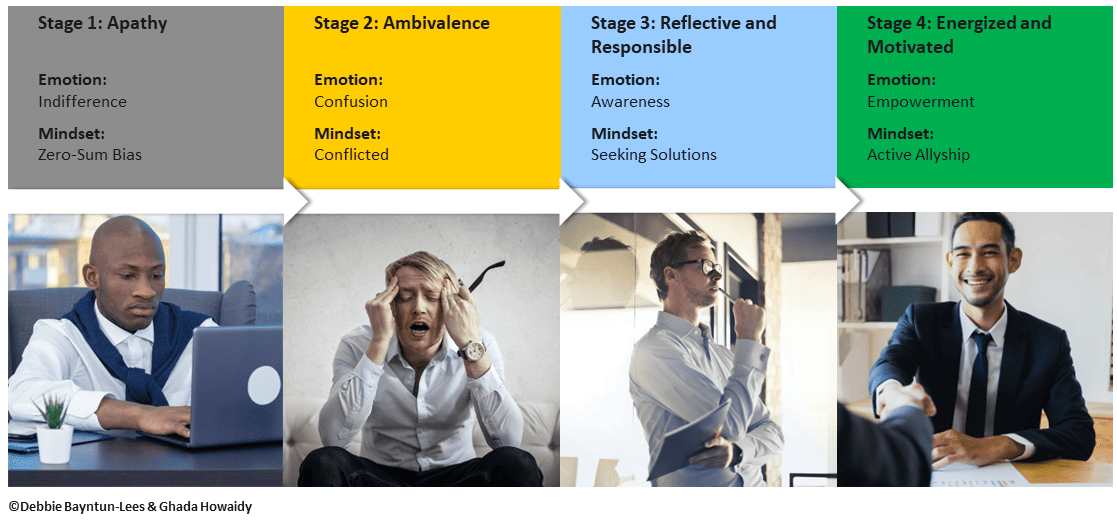
In Stage 1: Apathy, men express emotional detachment and intellectual disengagement from gender equity. The prevailing mindset here is one of zero-sum bias—the belief that gains for one group necessarily come at the expense of another. The emotional tone is often indifference or even quiet resistance, rooted in the perception that equity initiatives are unnecessary or irrelevant to their experience. As one participant shared, “It’s not something I’ve thought about. I’ve worked hard to get where I am—I assume others have the same opportunity.”
Stage 2: Ambivalence is marked by uncertainty and internal conflict. Here, men may agree with equity in principle but feel confused about their role or unsure how to contribute without risk. The dominant emotion is confusion, and the mindset is conflicted. Some men describe feeling excluded from the conversation or hesitant to speak for fear of being misunderstood. One participant reflected, “I’m aware of it, but sometimes it feels like the message is: ‘You’re the problem’- even if you’re trying to help.”
As men begin to reflect more deeply on their own social identity and observe the realities faced by women around them, they enter Stage 3: Reflective and Responsible. This stage is underpinned by a mindset of seeking solutions and an emotional shift toward awareness. It is often triggered by personal experiences, becoming a parent, mentoring a female colleague, or hearing stories of workplace inequality. “It makes me feel disappointed,” said one respondent. “I wouldn’t want my daughter to be treated like that at work.”
Finally, Stage 4: Energised and Motivated represents active, empowered allyship. These men are not only aware of gender equity issues, they feel a personal responsibility to challenge them. The mindset here is one of active allyship, and the emotional state is empowerment, often accompanied by urgency. These individuals advocate for systemic change, mentor others, and serve as visible champions of inclusion. As one participant put it, “It’s about doing what’s right, not just what’s expected. I want to be part of making this better – for everyone.”
From Awareness to Action: Targeted Interventions
One of the most powerful aspects of the Gender Equity Mindset Model is its developmental potential. It not only explains where men may be in their allyship journey; it also offers interventions aligned to each stage to help them move forward.
By aligning engagement efforts with the mindset stage of the individual, organisations can make allyship feel personal, possible, and purposeful.
Table 1: Enhanced Gender Equity Allyship Intervention Table
| Mindset Stage | Key Outcomes | Suggested Interventions |
| Apathy | Initial awareness and recognition of gender equity as relevant | • Reflective storytelling • Short videos or quizzes • Personal narratives from colleagues |
| Ambivalence | Acknowledgement of privilege, increased empathy, and early engagement | • Structured discussions • Scenario-based learning • Leadership modelling |
| Reflective and Responsible | Ownership of allyship behaviours and readiness to take action | • Peer mentoring • Action learning projects • Allyship goal setting |
| Energised and Motivated | Ongoing advocacy, peer influence, and contribution to systemic change | • Participation in inclusion councils • Advocacy roles • Sponsorship and mentorship of underrepresented talent |
Why This Model Matters Now
Too often, allyship is framed as a compliance issue, or worse, a performance. But genuine allyship requires inner work, relationship-building, and a willingness to challenge dominant norms.
Our research also revealed several reasons why some men hesitate to engage in gender equity efforts. Many expressed a fear of saying the wrong thing, concerned that even well-intentioned contributions could be misinterpreted or criticised. Others worried about being perceived as “the problem”, especially in environments where gender conversations were framed in ways that felt accusatory. Some men felt excluded from equity discussions altogether, unsure if their perspectives were welcome or relevant. Underpinning all of this was a lack of clarity around what allyship actually entails—what it looks like in practice, and how to do it authentically and effectively.
Organisational culture can either amplify these fears or create the conditions for growth. When companies offer men the psychological safety to explore, question, and reflect without judgement, they create space for transformation.
“Men who haven’t personally experienced discrimination often don’t engage—not because they don’t care, but because they don’t see how they fit in.”
—Participant
Allyship as a Shared Leadership Responsibility
This work is not only relevant for HR – it’s a leadership issue.
Equity cannot be achieved through policy alone. It must be embedded in how leaders behave, how teams operate, and how individuals make decisions. Allyship should be recognised in leadership assessments, tied to progression, and supported through continuous learning.
“I want to lead a team where everyone feels valued, and everyone sees the value in others. That’s not just a DEI issue-it’s a business imperative.”
—Participant quote, Energised Stage
Organisations that do this well report not only improved engagement and innovation but also greater retention of talent, particularly among women and underrepresented groups.
Looking Forward: Building a Culture of Shared Commitment
The Gender Equity Mindset Model offers a new language for understanding where men are in their allyship journey. But more importantly, it offers a roadmap for how to move forward together.
We’re also in the process of piloting a self-assessment tool, enabling organisations to map individual mindsets and tailor development plans accordingly. If you’re interested in learning more or integrating this tool into your equity strategy, feel free to get in touch.
Meaningful change happens when people are invited into it, not pressured or excluded. When men are given space to grow, reflect, and act with purpose, allyship becomes more than a value, it becomes a shared, sustained practice.
That’s how we create the cultures we say we want.
 Professor Debbie Bayntun-Lees