In the cloud era, cybersecurity is the focus of most business leaders, and rightly so. Just one malware-laden email, attachment or poorly defended access point can bring a manufacturing business crashing to its knees. As demonstrated by the recent Land Rover cyber failure in England, likely to end up costing the company an estimated $2.75 billion.
Even so, as cybersecurity becomes stronger, more robust and agile in defending businesses, dedicated hackers are more likely to hire mules to deliver viruses and exploits in person to breach those defences to access company data, financial services and customer records that can cost millions in fines and lost business.
And then, there are the hugely valuable stocks of supply chain goods, raw materials and products in warehouses, expensive production machinery, office equipment and specialist gear that fetch high prices on the criminal global market.
All told, failing to modernise physical security and only focusing on the digital opens businesses up to a massive range of threats.
The Best Practices to Stronger Physical Security
Depending on the ownership nature of your offices and production footprint or properties, physical security can be delivered by the landlord, external partners or operate as an entirely internally managed affair.
Whatever the approach, internal business control is required to protect the specific functions and valuables of your company, beyond simple perimeter security. This requires:
- An immediate audit, and regular follow-up inspections of the property, facilities, access points and existing security measures. This will lead to the identification of weaknesses around and within the business that physical security improvements or additions can address.
- Build layered security to verify all arrivals and departures at multiple points within the facilities, ensuring that only vetted workers can access key secure areas.
- Update access rights immediately as roles change, and audio logs to identify suspicious behaviour (a task AI is perfectly suited to).
By blending and layering physical and smart digital security, your business, workers and proprietary data, products and infrastructure are better protected.
Boosting Security, Both Smart and Physical
Digital and physical security systems are increasingly integrated through central control services to deliver smart features like AI-based scanning, live multi-identity tracking from vehicle ID, facial recognition, badge checking and other systems.
Large-scale central controls can monitor hundreds of cameras and other sensors simultaneously. With the AI surfacing any interesting, unusual, suspicious or anomalous activity for a security monitor agent to investigate.
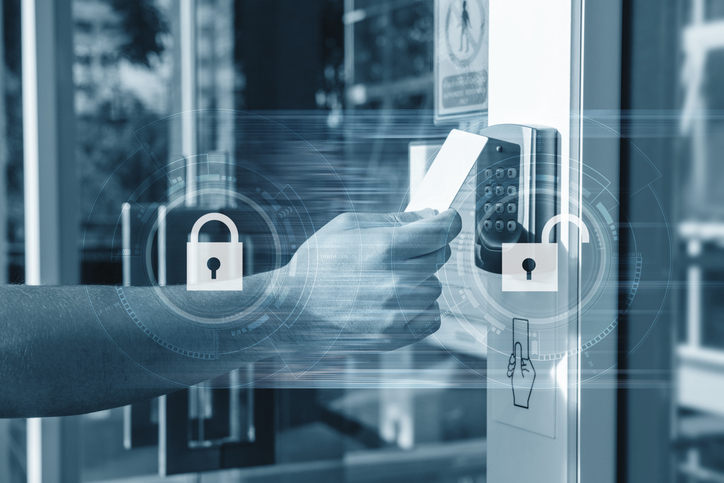
Boosted by commercial access control, the company can identify valid workers, visitors and contract staff, as well as report unexpected people in areas that they should not have access to. Access control through worker badges, their smartphones or other devices creates a useful layer to protect businesses from unwanted guest access. Backed up with facial recognition and security improved by several layers at critical access points.
Along with modern connected smart security cameras that can record with 4K video quality, extensive pan and zoom capabilities, they are capable of monitoring all types of situations and are suitable for each location they are installed in.
Many camera systems and models offer night vision, and microphones to warn or alert, making them hugely useful for any modern business. And at the back-end the endless recording capability of the cloud ensures that evidence trails can be linked and maintained across cameras and other systems.
Used in conjunction with licence plate recognition, modern fencing, and boots on the ground security; offices, manufacturing sites, IT systems, warehouses and car parks are secured against even the most dedicated efforts to penetrate.
Maintain the Human Factor
While cameras and access control systems are highly automated, staff must be trained to remain vigilant and look out for unusual activity. They should also be trained how to react to data provided by these AI-powered systems, including:
- How to respond to specific types of incidents involved one, several or many people trying to access the business.
- How to use live video feeds to intercept them (given the slight delay in the feed, and how to use zoom and tracking features to identify people or suspicious objects).
- How to respond to medical, environmental and other emergencies that the systems can report.
All of these processes need to be well-drilled, and workers need to know what is watching them to avoid privacy issues, while the business leadership can use the AI to ensure compliance and privacy are maintained across the business.
Another advantage is that these systems are regularly updated with new features and links to other software and systems. In the near future all security systems will link as one operational entity (where legal), spreading beyond the business to help track crime or missing goods/vehicles across large territory to help the authorities recover them.
We are already seeing expensive plants and industrial technology stolen, only appearing in foreign countries. And recovering them will soon be a greater priority as destination nations come under greater legal scrutiny.
Even for smaller businesses, some criminals will likely have their eyes on your property. Protecting the company premises not only benefits your insurance premiums, but also reassures employees and your security teams that your leaders mean business when it comes to security.