

By Hamilton Mann
In attempting to visualize the issues implicit in the adoption of AI in business, we commonly picture a two-dimensional relationship, such as AI vs productivity or AI vs employment. However, as Hamilton Mann makes clear, getting anywhere near true understanding requires us to consider a whole new axis.
Much of the early debate on artificial intelligence, and GenAI in particular, has borrowed from familiar strategy playbooks, contrasting efficiency against differentiation, automation against augmentation, disruption against continuous improvements. These frameworks, useful in their time, tend to flatten organizational reality into binary trade-offs. They capture broad patterns but leave out the subtleties of how AI actually reshapes firms, workforces, and societies.
In reality, AI is not a flat choice between cutting costs or market expansion. It unfolds across nine distinct strategic pathways, defined not just by growth potential, whether Low, Medium, or High, and by employment impact, whether jobs are Killed, Preserved, or Created, but also by a foundational axis that has long remained implicit: integrity alignment.
Integrity itself spans three states: it can be Damaged, when dignity, autonomy, and resilience are eroded; Compromised, when outcomes remain ambiguous or fragile; or Upheld, when results sustain and elevate human capacity.
By surfacing integrity axis as a structural dimension, this 3×3 framework, elevated into a cube, reveals the paradoxical effects of AI.
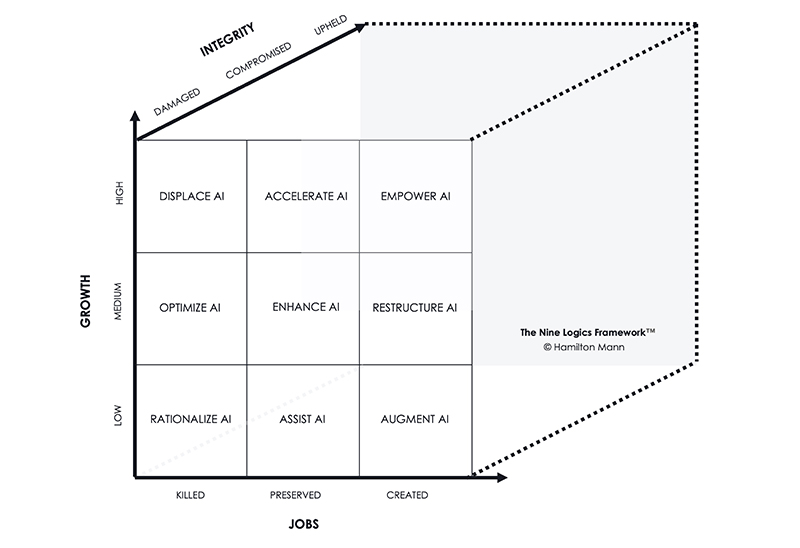
In some cases, AI rationalizes organizations into leaner forms, optimizes operations for measurable gains, or displaces workers at scale in pursuit of high growth. These pathways deliver efficiency or expansion on paper, but integrity shows their hidden cost: what appears as progress may in fact be systemic fragility, eroding the human capacity and resilience on which long-term prosperity depends.
In others, AI assists professionals by easing their burdens, enhances workflows through targeted support, or accelerates growth by multiplying human capacity without large-scale displacement. These pathways preserve employment and appear more human-centered, yet integrity reveals their ambiguity: jobs remain, but autonomy and judgment risk narrowing, as machine logic increasingly sets the terms of work.
In another set of logics, AI augments organizations with new expertise, restructures talent flows to unlock latent potential, or empowers entirely new markets and industries. These pathways promise genuine expansion, yet integrity poses the decisive question: are new roles and opportunities elevating human capabilities, or merely subordinating workers to algorithmic dependencies that erode judgment, stifle creativity, and atrophy essential human faculties.
Here, empowerment can mark either the highest alignment of prosperity and dignity, or its most sophisticated illusion.
It raises the stakes for leaders navigating not just efficiency and growth but also resilience, sustainability, and the dual test of social acceptability and humane legitimacy.
Rationalize AI
AI strips out labor to cut costs but fails to unlock new sources of demand. Organizations become leaner, but not stronger. Productivity gains look promising, yet financial performance remains fragile. This is efficiency without prosperity: systemic fragility grows as human capacity shrinks.
This is where the two-dimensional grid fails. Measuring jobs and growth alone suggests a leaner organization, yet the human system underneath becomes weaker. Without an integrity axis, leaders cannot see that rationalization is a false victory: it optimizes away people while corroding the very resilience required for long-term survival.
The case of Ocado:
In early 2025, Ocado, the British online grocery and technology company, announced that it would eliminate around 500 roles in its technology and finance divisions. The decision was not driven by collapsing demand or shrinking operations, but by the increased productivity of engineering teams equipped with AI systems. By automating tasks and streamlining processes, AI had made large portions of human labor redundant. For executives, the move was positioned as a rational step: lower costs, leaner operations, and greater efficiency.
Yet the broader picture reveals why this development exemplifies Rationalize AI. Although sales grew by 14 per cent, Ocado still posted a pre-tax loss of £374.5 million, while its technology sales growth slowed to 10 per cent, down from 18 per cent the year before. In other words, the efficiency gains generated by AI did not translate into sustainable growth or profitability. The company succeeded in cutting jobs and reducing costs, but it did not create new markets, unlock demand, or alter its trajectory of persistent financial losses.
This is the defining paradox of Rationalize AI: by using AI to strip out human labor, companies may succeed in lowering their cost base, but they do not necessarily strengthen their growth engine. Local productivity gains are achieved, but systemic performance remains stagnant or even deteriorates. Rationalize AI delivers leaner organizations, yet it does not deliver prosperity.
This case underscores the risks of mistaking efficiency for progress. In the short term, AI-enabled rationalization may reassure shareholders by showing cost discipline. In the long term, however, it leaves organizations more fragile, with fewer human capabilities to draw on and no new sources of demand to sustain growth. The strategic challenge for leaders is to determine whether they are deploying AI to transform their business or merely to shrink it. The deeper question is whether efficiency that weakens resilience can ever be called progress, or whether it signals an erosion of the very integrity needed for sustainable prosperity.
Optimize AI
AI substitutes for human labor in targeted functions while boosting organizational output. Companies enjoy measurable productivity gains and medium-tier growth. Yet profitability and resilience often remain uncertain, as efficiency masks latent vulnerabilities.
Optimization strips human resilience to the bone, producing brittle organizations addicted to quarterly gains.
As jobs are sacrificed and output improves, integrity shows the void beneath the numbers. Optimization strips human resilience to the bone, producing brittle organizations addicted to quarterly gains. Only the Integrity axis shows why optimization, while rational on paper, undermines the human foundations of sustainable growth.
The case of CrowdStrike:
In 2025, cybersecurity firm CrowdStrike announced a restructuring that revealed the double-edged nature of AI-driven efficiency. The company cut roughly 500 jobs, about 5 percent of its workforce, explicitly citing productivity gains from new AI systems as a key driver. The short-term results were striking: quarterly revenue reached $1 billion, a 25 percent year-over-year increase. Yet the bottom line told a more sobering story, with the company still posting a $92 million loss.
This trajectory illustrates the logic of Optimize AI. Jobs are eliminated, and the organization captures a measurable lift in productivity and revenue. The gains, however, remain fragile. AI delivered cost savings and output growth, but it did not guarantee profitability or long-term stability. Instead, the company now faces the challenge of sustaining performance without eroding the human and organizational capacities that underpin resilience.
This case underscores a pivotal strategic dilemma. AI can indeed optimize operations, but optimization is not the same as transformation. Leaders must decide if they are truly building stronger foundations for growth, or simply hollowing out their organizations in pursuit of short-term gains. Optimize AI highlights the risk of confusing efficiency with prosperity, a path where revenue may rise, but the structural capacity to generate enduring value remains uncertain. The real question is whether optimization strengthens the long-term fabric of the organization, or whether it locks firms into a cycle of fragile gains that sacrifice integrity for speed.
Displace AI
AI replaces labor at scale while fueling new industries, markets, and waves of consumption. Growth is rapid and expansive, but it comes at the cost of dismantling traditional employment structures. The result is high economic expansion coupled with deep social disruption.
This characterizes high-growth success despite job losses. And the integrity axis uncovers its true cost: systemic fragility and social disruption. It ultimately reveals that displacement is not just a trade-off between jobs and growth, but a governance failure that sacrifices resilience for expansion.
The case of Accenture:
By late September 2025, Accenture had laid off more than 11,000 people worldwide as part of an accelerated restructuring. The company described this not as a standard cost cutting program but as a deliberate exit of employees who could not be retrained fast enough for AI centered work. According to the Financial Times, Accenture’s CEO Julie Sweet made the message explicit in a call with analysts: “We are exiting on a compressed timeline people where reskilling, based on our experience, is not a viable path for the skills we need”. She added: “Those we cannot reskill will be exited”.
Accenture referred to this approach as “rapid talent rotation,” a phrase the company uses to describe exiting people quickly when reskilling is not seen as viable.
The severance costs were recorded as part of an $865 million business optimization program. The financial picture tells a story of expansion rather than distress. Quarterly revenue reached $17.6 billion, ahead of the company’s expectations, and full year revenue rose about 7% to roughly $69.7 billion. New bookings climbed above $21.3 billion in the quarter, and Accenture reported $5.9 billion in AI-related bookings over the full fiscal year. The company has nearly doubled its pool of AI and data specialists to 77,000 since 2023, and reported that more than 550,000 employees have already been trained in generative AI.
Here is the paradox: jobs are being destroyed at scale in the name of AI adoption, yet the stated ambition is not downsizing. Accenture has said it expects overall headcount to increase again in the next fiscal year, not shrink, and that savings from layoffs and divestitures will be reinvested into AI capability, new client delivery models, and talent that aligns with the markets the firm aims to lead.
This exposes the structural tension at the core of Displace AI. Accenture is capturing high value AI demand at global scale. It is winning multibillion dollar AI contracts, booking growth, and reinforcing its position as a preferred partner for clients who want to reinvent themselves with intelligent systems. At the very same time, it is rewriting the employment contract inside the firm. Roles are declared obsolete not because the company is failing, but because the company is succeeding in pivoting to AI faster than those workers can be re skilled. The public framing is one of reinvention and opportunity. The lived experience for thousands is forced exit.
The integrity axis reveals why this matters: Can growth that aggressively dismantles established employment structures at such a rapid scale claim to be progress if the social cost is externalized to workers who are no longer considered adaptable enough to remain inside the system? That is not a neutral efficiency decision. It is a societal decision about who is allowed to belong in the future.
This case exemplifies the Displace AI archetype with AI systems replacing human labor at scale, driving rapid business expansion. AI becomes the engine of new value creation and market expansion, revenues rise, bookings surge, investor narratives strengthen, the firm accelerates and society absorbs the shock. The question that integrity forces leaders to confront is whether this definition of success is aligned with the social contract between the firm and its employees, in particular when simultaneously claiming to be an inclusive, merit-based workplace that is free from bias and that seeks to foster a workplace culture based on respect and a sense of belonging. A “Great Place to Work,” so to speak.

Assist AI
AI supports workers rather than replacing them, reducing friction in workflows while keeping employment stable. Professionals still perform their core functions, but with fewer administrative burdens. Growth, however, remains incremental. The system is safeguarded, but not reinvented.
While this situation suggests stability, jobs are preserved and growth remains steady. Yet integrity reveals a subtler erosion. Workers may keep their titles, but their scope for judgment shrinks as AI dictates workflows. Only the Integrity axis makes this visible: jobs preserved, growth neutral, but dignity and autonomy partially lost.
The case of the NHS:
By 2025, NHS England began piloting AI-enabled ambient scribing tools designed to relieve general practitioners of the administrative burden of note-taking during consultations. Instead of manually recording symptoms, histories, and treatment plans, doctors could rely on an ambient AI system that listened, transcribed, and structured the conversation into a draft medical note. The promise was straightforward: give doctors more time with patients by letting AI handle the paperwork.
The early results confirmed that administrative time could indeed be reduced. GPs reported spending less time typing and more time maintaining eye contact, explaining diagnoses, or answering patient questions. But while the pilots improved quality of care and preserved the core role of the clinician, they did not produce new demand, new markets, or systemic economic growth. The number of jobs was not cut, but neither was the workforce significantly expanded. Doctors remained indispensable, and AI became an assistive tool rather than a transformative engine.
This illustrates the logic of Assist AI. Jobs are preserved, workflows are improved, and productivity gains appear locally meaningful. Yet the economic impact remains incremental, not expansive. The value lies in quality and efficiency at the margin, not in the creation of entirely new growth trajectories. Assist AI avoids the social disruption of mass job losses, but it equally avoids the disruptive potential of new industry formation.
This case highlights the double-edged nature of assistance as a strategy. When AI is deployed to support rather than supplant, it strengthens human roles and protects professional expertise. But by stopping short of reinvention, it also caps its growth potential. The strategic tension lies in whether AI is being used to protect the current system or to reshape it. Assist AI succeeds in safeguarding jobs and improving service delivery, but it risks entrenching existing limitations rather than overcoming them. The underlying but critical question is to what extent preserving stability without expanding human scope and perspectives amounts to genuine support, or instead quietly narrows autonomy under the appearance of protection.
Enhance AI
Without an integrity perspective, leaders miss a crucial question: are humans freed, or are they being deskilled by over-reliance on AI?
AI improves human productivity without cutting jobs, enabling smoother workflows and better services. Professionals are freed from repetitive tasks, but growth remains bounded. This path prioritizes human-centered efficiency, producing incremental but meaningful operational benefits.
At first glance, Enhance AI seems safe: jobs protected, workflows improved. Yet without an integrity perspective, leaders miss a crucial question: are humans freed, or are they being deskilled by over-reliance on AI? Integrity allows us to see whether technology extends human capacity or gradually hollows it out.
The case of Delta Air Lines:
From 2023, Delta said it was using AI to quickly make procedures known to reservations agents and to support in pricing which it presented as part of improving the speed and consistency of customer responses. As reported at the time, the airline has been testing AI that queries its internal policy and fare-rule databases in real time to surface the procedure the agent needs for a specific call, while a separate model has been proposing fare adjustments to human revenue managers rather than publishing prices automatically.
Delta has not presented these AI initiatives as a way to replace gate or call-center staff. Instead, it has framed AI as a way to enhance employees’ ability to serve passengers better and consistently, by giving them AI-surfaced information and recommendations.
“I think the initial foray into AI is on the customer service side”, said CEO Ed Bastian, responding to Morgan Stanley analyst Ravi Shankar’s question about the carrier’s use of the technology. “We’re working with our reservations team to try to help our reservations agents parse the historical policies and questions and things that you may you may call into a real agent”. This directly supports the employee-in-the-loop reading.
According to the 2024 Delta Difference report, as the airline rolls out advanced technologies it “takes a balanced approach to AI, using it to improve operations and enhance the customer experience while prioritizing our customers’ and employees’ safety, security and trust”. Delta’s headcount fell sharply in 2020 because of the pandemic, but by 2023–25 it had rebuilt to about 100,000 employees again, according to the company’s own disclosures.
Financially, over 2024–25, Delta reported revenue growth in the mid-single digits and highlighted improved operational performance. In 2024, at its Investor Day on November 20, the company told investors it was targeting mid-single-digit revenue growth as part of its differentiated-and-durable plan. In January 2025, when it released its December-quarter and full-year 2024 results, Delta reported record revenue and described “industry-leading operational performance”, with year-on-year revenue growth in that same mid-single-digit range.
This trajectory captures the essence of Enhance AI.
The gains came from smoother workflows, customers benefits from more responsive service, and incremental productivity increases, not from AI-driven workforce reductions. Yet the fundamental issue beneath the numbers is the tension between employees being truly empowered and their judgment being narrowed by dependence on machine-generated recommendations. The decisive challenge lies in determining whether technology in such cases expands human capability, or instead quietly deskills the workforce by reducing expertise to the execution of AI-suggested choices.
Accelerate AI
AI accelerates organizational growth while retaining and even amplifying human capacity. Firms preserve jobs, invest in their people, and use AI as a multiplier of productivity and innovation. Growth is significant, but it does not require large-scale workforce displacement.
The Jobs and Growth axis already shows this as a favorable case, but the integrity axis makes explicit why: growth is paired with the preservation of autonomy and dignity. With an integrity axis, Accelerate AI is revealed not just as a good strategy but as ethical leadership, proof that inclusion and prosperity can scale together.
The case of Cisco:
In a climate where many of its peers were trimming headcounts amid rising interest in AI, Cisco’s CEO Chuck Robbins offered a striking divergence. In a recent CNBC interview, Robbins emphatically stated, “I don’t want to get rid of a bunch of people right now,” underscoring Cisco’s strategic choice to harness AI as a productivity multiplier, not a vehicle for downsizing.
This decision is deeply resonant: Cisco’s fiscal Q4 results demonstrated significant gains and revenue rose 8 percent to $14.7 billion, buoyed by soaring demand for AI infrastructure. The company reported over $2 billion in AI-related orders, more than double its initial target.
These numbers encapsulate the essence of Accelerate AI: Cisco preserves its engineering workforce, even expanding AI development roles, while leveraging the technology to amplify innovation and performance. Rather than displacing talent, AI consolidates it, fueling growth without sacrificing employment.
This story is instructive in its counter-narrative to the efficiency-first mindset. By embedding AI as an enabling tool rather than a replacement, Cisco shows that scaling growth does not require shrinking human capacity. Accelerate AI asks leaders: can we harness AI to elevate our people and generate growth without sacrificing our workforce? Cisco suggests the answer is yes.
The enduring tension is whether such examples mark the beginning of a broader shift toward inclusive growth, or remain exceptional cases in a landscape still dominated by an exclusive efficiency-driven economy.

Augment AI
AI sparks the creation of adjacent roles—engineers, analysts, content creators—that sustain AI-driven lines of business. Growth is steady but limited. The organization reconfigures around new forms of expertise, but markets are not fundamentally transformed. The grid celebrates job creation here, but without integrity it cannot distinguish between jobs that empower and jobs that serve as a crutch for a temporary peak of demand. An integrity axis forces us to ask: do these new roles build enduring capabilities and pathways for human expertise, or do they merely anchor workers to the support of keeping the system running relative to short-term financial performance? Growth alone cannot answer that.
The case of Anthropic:
In 2025, the maker of the Claude AI model announced that it would create more than 100 new jobs across Europe, expanding in cities such as Dublin and London. These roles spanned engineering, research, sales, and business operations, and were positioned as additive hires to sustain the company’s rapid growth in AI services. Unlike rivals that leaned on layoffs or hiring freezes, Anthropic emphasized net job creation as it sought to build out the infrastructure and talent required to compete in a global AI market.
Yet this expansion came with a striking paradox. Even as Anthropic added new categories of expertise orbiting its core AI business, its CEO, Dario Amodei, warned publicly that AI could displace vast numbers of jobs, particularly in routine knowledge work. His remarks, widely reported and countered by NVIDIA’s Jensen Huang, underscored the tension between firm-level augmentation and system-wide disruption.
Financially, Anthropic’s growth was steady rather than transformative. Revenue gains reflected increasing adoption of Claude and its enterprise offerings, but they remained bounded within the competitive dynamics of the AI sector. The hiring drive demonstrated the emergence of new roles linked to the deployment dynamic of AI, but it did not reinvent markets or trigger exponential new demand.
This trajectory reflects the essence of Augment AI. Jobs were created in meaningful numbers, sustaining the company’s evolving ecosystem, but the growth remained incremental. Anthropic layered AI-focused roles onto its business model, turning technology into a catalyst for adjacent expertise rather than systemic reinvention.
This case also illustrates the inherent ambiguity of augmentation. The uncertainty lies less in the existence of new roles than in the conjunctural and opportunistic conditions under which they are created. When augmentation is driven primarily by short-term market demand, it remains fragile, vulnerable to fluctuation, and easily discarded if competitive pressures shift. Without anchoring in structural change, these roles risk becoming temporary adaptations rather than durable transformations.
Augment AI forces leaders to ask not only whether they are creating roles to meet momentum, but also whether those roles are a structural part of a new core system to sustain long-term growth or a fix to immediate competitiveness. The former is true augmentation. The latter is conjunctural augmentation and risks feeding into a broader tide of displacement.
Restructure AI
AI restructures organizations by enabling new internal pathways for talent and skills. Employees transition into new roles as firms align human capital with emerging technological needs. Growth emerges from within, not through market disruption, as companies unlock latent potential in their workforce.
While this place highlights job creation and moderate growth, its real value only emerges with an integrity perspective: Restructure AI sustains dignity by enabling reskilling and mobility, showing that technology can evolve with workers rather than against them. This distinguishes between cosmetic job churn and genuine empowerment.
The case of Walmart:
In 2025, Walmart launched a large-scale reskilling program that leveraged AI to transform how frontline employees navigated careers within the company. Rather than relying on automation to reduce headcount, Walmart invested in AI-driven career pathways that helped workers transition into emerging roles such as drone technicians, robotics supervisors, and technical support specialists. AI systems were deployed to analyze skills, identify adjacencies, and recommend reskilling journeys tailored to employees’ backgrounds.
The results have been striking. More than 50,000 cashier roles have been restructured into new, future-oriented positions, while thousands of other associates have accessed new learning opportunities and internal career moves. For individuals, the change has been transformative: one cashier, for example, retrained as a robotics supervisor after receiving a personalized AI recommendation and structured learning guidance. For Walmart, the benefits have been equally significant: internal talent redeployment has reduced turnover costs, enhanced operational resilience, and ensured that the company’s workforce evolves in step with its increasingly automated supply chains and stores.
This is a textbook case of Restructure AI. Jobs are not only preserved but actively created through the restructuring of organizational processes, while business growth is tangible even though moderate. Walmart has unlocked the value of human capital already inside the company, redirecting it toward the capabilities most needed in an AI-driven economy, while pairing this approach with a set of AI-enabled initiatives. Together, and building on this restructuring approach, Walmart has delivered measurable results: digital sales rose 25 percent year over year. Yet these gains, while tangible, have not led to radical expansion into new markets.
The core lesson here is that AI can act as a mechanism of organizational redesign rather than mere automation. By turning internal mobility into a dynamic, AI-enabled process, Walmart demonstrates how companies can avoid the false trade-off between efficiency and employment. Growth in such scenarios does not come from cutting costs or conquering new industries, but from reimagining the structure of work itself. The overarching challenge is whether such restructuring consistently elevates human flourishing, fulfillment and autonomy, or whether it risks being reduced to a managed rotation of labor that serves organizational needs more than individual growth.
Empower AI
AI unlocks entirely new markets and business models, creating jobs and scaling growth dramatically. This is AI at its most expansive: empowering individuals and industries, redefining access and opportunity. Yet it also destabilizes incumbents who rely on sustaining strategies, forcing leaders to adapt or be left behind.
While this scenario is the most celebrated, the integrity axis reminds us that not all empowerment is equal. Are new jobs designed to elevate autonomy, or do they risk locking humans into algorithmic dependence? Integrity is what distinguishes empowerment from manipulation.
The case of Duolingo:
By late 2024, Duolingo had become the most downloaded education app in the world, boasting more than 100 million monthly active users and 8 million paid subscribers, underpinned by AI-driven personalization, gamification, and adaptive learning mechanisms. This meteoric rise exemplifies Empower AI: new markets are unlocked, jobs are created, and growth is expansive.
Behind the numbers lies a broader employment story. As Duolingo scaled, its business growth materialized in tangible investments in human capability, hiring educational designers, community outreach specialists, AI content creators, and engineers to extend the platform beyond language instruction into new areas like music and mathematics. These roles were born not from administrative routines, but from the need to develop and expand Duolingo’s AI-driven learning ecosystem.
The strategic impact is profound. Duolingo did not merely displace labor with automation. Instead, it used AI to empower a new generation of workers, elevating the nature of jobs in education technology while creating value that extended beyond traditional markets. Duolingo has turned AI into a lever for inclusion, learning accessibility, and continuous expansion, starkly illustrating the promise of Empower AI.
This case challenges the belief that AI inherently streamlines or replaces work. For Duolingo, AI did neither. Instead, it sparked a wave of job creation and market expansion. Empower AI forces leaders to consider whether technology should be a tool of displacement or a gateway to human-centered growth. The defining question is whether such empowerment truly expands human agency and creativity, or whether it risks entrenching new forms of algorithmic dependence that erode the very integrity it claims to uphold.
Navigating the Nine Logics of AI
Leaders are not simply choosing between short-term productivity gains and long-term growth outcomes, or attempting to balance both, through AI. They are navigating nine distinct logics of AI deployment, each with its own promise and peril, hinging on integrity being damaged, compromised, or upheld.
As with any framework, it would be vain to expect organizations to sit entirely within a single logic. In practice, companies often run several AI deployments in parallel, embodying multiple logics at once. Besides, none of the embraced logics unfold in a vacuum; regulatory regimes, investor pressures, and labor market dynamics strongly influence which logics become viable.
Yet even within such systemic constraints, executives retain decisive agency in steering how AI is deployed.
AI deployment is not just a technological decision. It is a societal decision.
The nine archetypes of AI deployment remind us that technology is never neutral. Rather than framing a strict categorization, each pathway, whether rationalizing costs, optimizing operations, displacing labor, assisting activities and workflows, enhancing capacity, accelerating economic growth, augmenting expertise, restructuring organizations, or empowering human capital, offers guidance for strategic choice and brings the paradoxes to light. AI is celebrated as a driver of efficiency and growth, yet its impact is fractured across competing logics. Some strategies strip out human labor while leaving organizational fragility intact. Others preserve or create jobs but cap their growth potential. And a select few unleash expansive new markets while forcing difficult questions about resilience, equity, and sustainability. Integrity alignment turns this paradox into a sharper diagnosis: fragility arises where integrity is low, stagnation where integrity is partial, and sustainable empowerment only where integrity is high.
In essence, AI deployment is not just a technological decision. It is a societal decision. Whether organizations end up leaner or stronger, stagnant or expansive, exclusionary or empowering depends less on the capabilities of the technology than on the intentions of those who wield it. Their integrity makes this explicit, transforming abstract intentions into measurable questions of whether AI sustains or undermines human autonomy.
For executives, the challenge is to resist the seduction of efficiency alone. Rationalization and optimization may satisfy shareholders in the short term, but without a parallel commitment to empowerment and human development, they risk hollowing out the very foundations of long-term growth. Conversely, paths that invest in people and preserve resilience, assistive, augmentative, restructuring, or empowering logics require patience and strategic courage, but they promise outcomes that align profitability with legitimacy and social acceptability. Navigating these challenges with integrity alignment helps identify which paths truly strengthen both prosperity and legitimacy, and which merely defer systemic fragility under the illusion of efficiency.
This is why Artificial Integrity, rather than the limitation to mere mimicry of human cognition, must guide AI development and implementation to resist the assignment of being driven solely by raw performance, blind to ethical, social, and moral considerations. Exhibiting Integrity, not just intelligence, is the next frontier for AI, making it an intrinsic part of its functioning and aligning it with human values, to support the right path toward fostering approaches that reconcile human growth (jobs preserved or created), business growth, and integrity alignment.
Yet even with the prospect of such development, navigating the nine logics of AI deployment ultimately places the responsibility on executives, who must decide whether they are building organizations that grow only by shedding their human core, or cultivating ones resilient enough to expand by empowering. The answer will define not just the next generation of business leadership, but the social contract between organizations and the societies whose prosperity and work they reshape. Integrity will determine whether that contract is written on fragile ground or on a foundation capable of enduring, with AI.