
By Professor Prithwiraj (Raj) Choudhury
To date, remote working has typically been viewed as a perk for the employee. But could it actually be your organisation’s ace up the sleeve?
For decades, jobs were tied to offices and cities that dictated where people lived. Today, that relationship is being redefined.
This is not simply about working from home. It involves a deeper shift in how work itself is organised – what I call Work from Anywhere (WFA).
Different from remote or hybrid work, WFA is not a perk. It is a redesign of work centred around geographic flexibility, where work moves to the worker rather than the other way around.
Beyond the Office
Organisations can recruit across regions and markets, accessing skills that would otherwise be out of reach.
Cisco is a pioneer of WFA. One study of their employees in Venice found people working from an average of 3.5 locations: cafes, bars, home, shared spaces, and occasionally the office. The office is no longer the default but one of many options predicated on a new understanding of work: different types of work require different environments.
While in-person interaction remains essential for trust, culture, and collaboration, many individual tasks do not require being in the same physical space.
The real question isn’t where work happens, but how it is designed.
WFA: strategic advantages for organisations
WFA isn’t simply a perk for employees. Nor are the gains limited to flexibility.
WFA offers a set of strategic benefits that can drive competitive advantage:
Expanding access to talent
Geography no longer limits hiring. Organisations can recruit across regions and markets, accessing skills that would otherwise be out of reach.
Leveraging diversity
Expanding the talent pool taps into greater diversity of culture and perspective, a proven engine of global growth.
Strengthening resilience
In a world shaped by geopolitical uncertainty, organisations with WFA capabilities are better prepared. They are not reacting to shocks, they’re absorbing them.
Reducing churn in a competitive talent market
Employees are more likely to want to stay in their job when they can choose where they live, based on affordability, family, or quality of life.
When Workers Choose Where to Live
WFA means that employees are no longer forced to organise their lives around their jobs.
When people can choose where they live, they are empowered to focus on personal priorities and values. This might mean improved housing options and more sustainable lifestyles. For dual-career households, it reduces the need to coordinate two careers in a single city.
For organisations, this has direct implications: empowered employees are more engaged, more productive, and more likely to stay.
WFA: Why organisations still struggle
Many organisations still cleave to outmoded ideas about the office. Some impose top-down mandates that require employees to attend the office during the week, without experimentation or evidence.
Organisations that succeed with WFA typically pilot different models across teams, evaluate performance, and scale what works.
This requires rethinking key elements of how work happens:
- How work is documented and shared
- How teams collaborate asynchronously
- How employees are onboarded and integrated
- How performance is measured in distributed settings
These are not surface-level changes. They go to the core of how organisations function. The leaders who succeed are those who are willing to test, learn, and adapt.
Why Progress Has Been Slow
Regardless of its positive effects, WFA is not yet widely adopted. In many cases, this is not due to a lack of opportunity, but rather a lack of readiness.
Trust remains a barrier
Some leaders worry that employees are less productive outside the office. Yet this is often a people-management issue rather than a location issue.
Operational complexity is underestimated
WFA requires more than digital tools like Zoom or Teams. It calls for a fundamental rethink about how work is structured: how teams are onboarded, how culture is built, how performance is measured, and how compliance across geographies is managed.
Expanding WFA Through Technology
Historically, WFA has been largely limited to knowledge workers. Through the use of technology, that boundary is beginning to shift.
Digital twins are virtual replicas of physical systems such as hospitals, factories, or airports. They allow professionals to monitor and manage operations remotely. Combined with sensors, automation, and AI, these systems enable tasks that once required physical presence to be performed from a distance.
At the same time, advances in agentic AI are reshaping how work is executed. These systems can independently complete tasks, support decision-making, and operate across time zones, increasing overall productivity.
However, these technologies require careful implementation. Early experiments with AI agents often fail due to poor integration or unrealistic expectations.
The key to success is understanding this: it’s not about replacing human capability, but enhancing it.
Redrawing the Talent Map
Getting WFA right offers clear value to organisations.
Unshackled from local labour markets, organisations can build teams that better reflect the diversity of their customers and operate more effectively across markets. A globally distributed workforce can bring insights into local contexts, and can adapt products, services, or even business models to what a local market would prefer.
As workers disperse geographically, the distribution of talent also begins to shift.
Smaller cities and towns stand to benefit. For years, many regions have experienced “brain drain” as talent concentrated in major urban centres. WFA can reverse this. As workers relocate to more affordable areas, they bring a demand for services, infrastructure, and local economic activity.
Work in an Uncertain Future
The future of work will be defined not by where people sit, but by how effectively organisations design work across distance, technology, and human needs.
The future of work will be defined not by where people sit, but by how effectively organisations design work across distance, technology, and human needs.
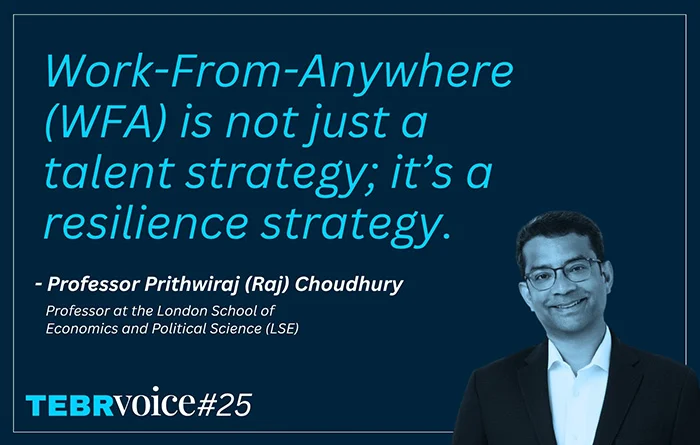
WFA is not just a talent strategy; it’s a resilience strategy. Accelerated by the pandemic and espoused by forward-thinking organisations around the globe, WFA can buffer organisations from churn, shocks, and competitive and innovation risks.
Successful organisations will be those that eschew strict models and experiment instead with the distribution of work.
Flexibility is not a compromise, it’s a strategic advantage.