

By Russell Cowley
As workplace burnout rises, Gen Z employees are reviving meaningful breaks and reshaping how businesses think about productivity, wellbeing and connection.
For years, Gen Z has been criticised for lacking resilience, focus and loyalty at work. But across UK workplaces, younger employees are challenging outdated norms around constant availability and presenteeism – especially when it comes to taking breaks. Russell Cowley, general manager at FreshGround, believes Gen Z’s approach to proper breaks may actually be fixing a workplace culture the rest of us helped create.
The lunch break Is making a comeback
The decline of the lunch break did not happen overnight. Over the past decade, many employees have gradually fallen into patterns of eating at their desks, skipping breaks entirely or squeezing lunch between meetings. Hybrid working only accelerated the trend, blurring the line between work and personal time and creating a culture where stepping away from a screen could feel unproductive.
Research consistently reflects this, and studies have shown that a large proportion of UK workers now take less than half an hour for lunch, and StandOutCV reported 82% of Brits do not take a full lunch break, with two thirds of workers eating lunch at their desk most days. The working day has become increasingly compressed, filled with video calls, constant notifications and expectations of immediate responses.
But younger workers appear to be resisting that model. Recent workplace data indicates that more than half of Gen Z employees (56%), take their full lunch break every day, while 66% regularly eat with colleagues. Many are also choosing to spend that time socially, whether eating together, grabbing a coffee or simply stepping away from their workspace with colleagues. And this represents a different attitude towards productivity itself.
For previous generations, breaks were often viewed as something earned after work had been completed, or sacrificed to demonstrate commitment. Many professionals became conditioned to associate busyness with value. Gen Z, however, increasingly see rest and recovery as part of effective performance rather than separate from it.
And why, because the modern workplace has created environments where employees rarely pause. Calendars packed with consecutive meetings leave little room for reflection, creativity or genuine interaction and while this level of activity may appear efficient on paper, it often produces fatigue rather than output.
Studies from organisations including Microsoft’s Work Work Trend Index have highlighted the impact of digital overload and meeting fatigue on employee wellbeing and long-term productivity. Continuous engagement without recovery time ultimately diminishes focus and collaboration.
Ironically, many of the qualities businesses say they value most, such as innovation, communication and teamwork, are often squeezed out by the very working practices designed to maximise efficiency.
A different understanding of productivity
Gen Z’s approach to work is forcing businesses to reconsider what productivity actually looks like.
Rather than measuring performance solely through hours spent at a desk, younger employees are more likely to prioritise balance between concentration and recovery. They are comfortable stepping away temporarily in order to return with better focus and energy.
This mindset aligns with growing evidence around sustainable performance. Research has repeatedly shown that productivity is strengthened through cycles of effort and recovery, not prolonged periods of uninterrupted work.
The issue has also become increasingly tied to employee wellbeing. In April 2026, the International Labour Organization again warned about the health risks associated with excessive working hours, linking overwork to rising physical and mental strain, and potentially up to 840,000 deaths a year. Long-term fatigue does not simply affect individuals – it also impacts efficiency, engagement and retention across organisations. Against that backdrop, taking a proper lunch break starts to look less like a perk and more like a sensible business practice.
Social breaks, in particular, play an important role. Informal conversations over lunch or coffee often create the kind of spontaneous interaction that structured meetings fail to replicate. Relationships are built more naturally, collaboration becomes easier and workplace culture develops organically rather than through forced initiatives.
This may explain why many younger employees increasingly view lunch as the primary social moment of the working day, replacing the after-work drinks culture that traditionally dominated office life. Hybrid working patterns, changing attitudes to alcohol and greater emphasis on wellbeing have all contributed to this shift.
For businesses struggling to rebuild culture after the pandemic, that change is significant. The challenge may not simply be getting people back into offices, but creating environments where employees can connect while they are there.
What workplace drink trends reveal about generational change
The same attitudes influencing how Gen Z take breaks are also shaping what they choose to consume during them.
Younger workers are moving away from purely functional drink habits and exploring alternatives that align with wellness, identity and personal experience. Traditional tea and coffee still have their place, but many Gen Z consumers are experimenting with drinks such as matcha, chai and functional beverages designed to support calmness, focus or sustained energy.
According to research from Mintel and Lumina Intelligence, younger consumers are far more likely to explore these emerging categories than older generations. Matcha in particular has experienced rapid growth, 30.22% year-on-year, becoming one of the fastest-growing beverage trends globally.
Drinks such as matcha have become associated with lifestyle, wellness and self-expression, particularly across social media platforms like TikTok. For younger workers, what they drink increasingly reflects how they want to feel during the day, rather than simply providing caffeine or routine.
For decades, office drinks were largely transactional – coffee acted as fuel, while tea was often part of habit and familiarity. Gen Z are approaching these rituals differently. The act of stepping away for a drink has become part of a broader emphasis on mindfulness, connection and intentional breaks.
This too mirrors wider consumer behaviour. A Deloitte survey has highlighted how younger generations place greater value on experience-led consumption and products that reflect personal identity, and workplace habits are evolving in exactly the same way.
In many respects, the growing popularity of functional drinks, matcha and alternative café culture is symbolic of a larger workplace transformation. Younger employees are actively questioning inherited routines rather than following them automatically. The same logic applies to how they structure their working day.
Rethinking workplace culture beyond presence
It is easy to frame generational differences as a problem for employers to solve. Yet many of the behaviours associated with Gen Z may actually reflect an attempt to correct workplace habits that have become unsustainable.
If employees spend entire days moving from meeting to meeting, eating lunch at their desks and leaving without genuine interaction, workplace culture inevitably suffers. Collaboration becomes transactional, relationships weaken and burnout increases. And, simply bringing people back into offices will not solve those issues on its own.
What Gen Z appear to understand is that culture is often built in the smaller moments between formal work, such as conversations over coffee, shared lunches and opportunities to step away briefly from constant digital engagement.
Rather than viewing breaks as lost productivity, businesses may need to start recognising them as an important contributor to performance, wellbeing and retention.
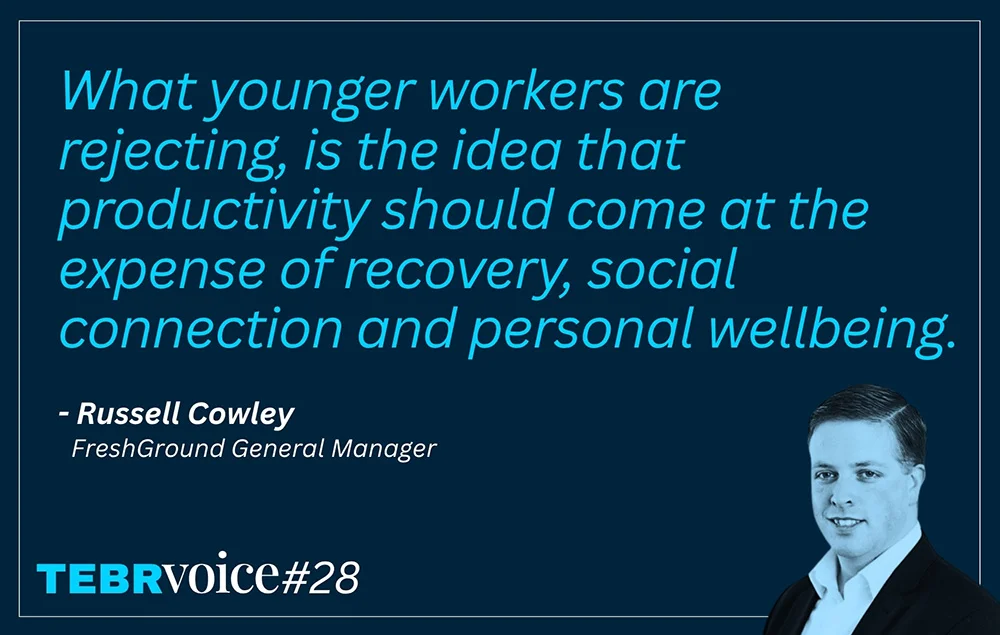
What younger workers are rejecting, is the idea that productivity should come at the expense of recovery, social connection and personal wellbeing.
Conclusion
The workplace has spent years celebrating ‘being busy’ while actually eroding the habits that help people perform at their best. Gen Z’s willingness to protect their breaks may seem small on the surface, but it reflects a broader rethinking of how work should function. As businesses continue searching for ways to improve culture, engagement and productivity, the answer may not lie in adding more meetings or longer hours. It may simply begin with giving people permission to properly step away.
 FreshGround general manager