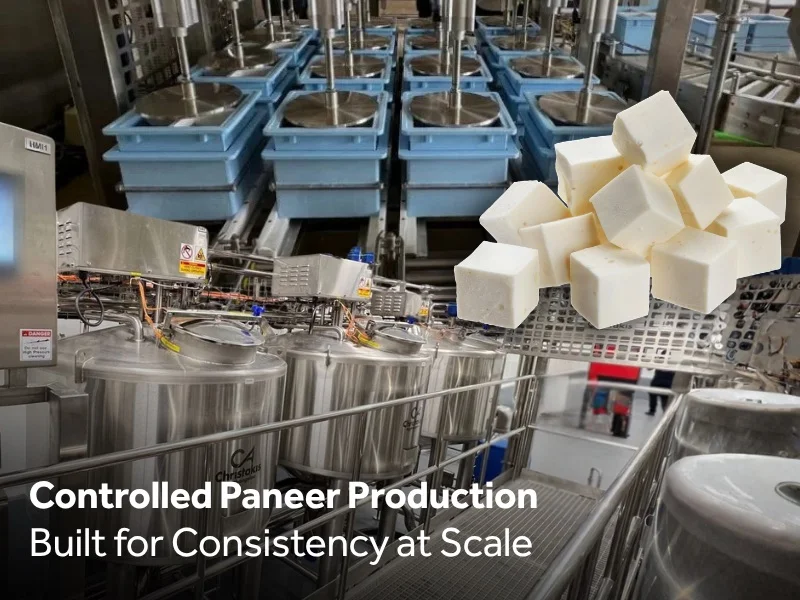
Paneer has long been valued as a traditional soft cheese product, known for its clean flavour, firm yet soft texture, and wide use in cooking. Today, its demand is expanding beyond traditional markets, creating new opportunities for dairy producers that need to serve larger volumes while keeping quality stable.
This growth brings a clear challenge. Paneer must remain true to its identity, but production can no longer rely only on manual skill and operator judgement. As demand increases, producers need greater control over texture, moisture, shape, yield, and consistency. The future of paneer production lies in combining traditional product knowledge with modern process control.
For Agathangelou, this shift reflects a clear direction in dairy engineering: helping producers move from manual, operator-dependent processes to controlled systems that support quality at scale.
The Challenge of Traditional Paneer Production
Traditional paneer production depends heavily on human handling and experience. In smaller operations, this can work well because teams can monitor each batch closely. At industrial scale, the same approach becomes harder to manage.
Manual handling can create variation from one batch to another. Differences in curd handling, pressing, cutting, cooling, and transfer can affect the final product. Even small changes in moisture or curd structure can influence texture, shelf life and yield. For producers supplying retail, foodservice, or export markets, this variation becomes a business issue because every batch needs to meet the same quality expectations.
Why Control Matters in Modern Dairy Production
In modern dairy production, control is about building an environment where every stage supports predictable results. For paneer, this means stable curd behaviour, accurate moisture management, careful pressing, defined shape, and reduced product loss. A more controlled production line helps producers plan output, manage resources, reduce waste, and maintain quality across production runs.
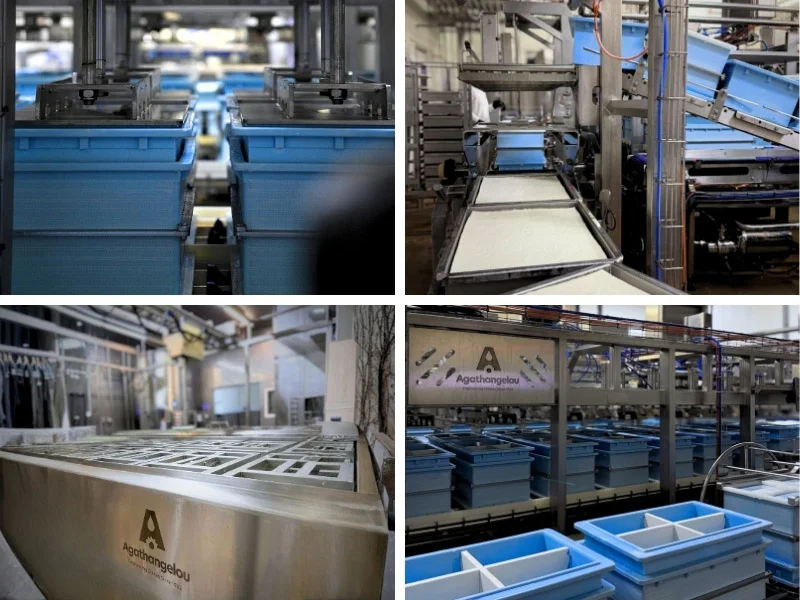
For Agathangelou, process control is not only about automation software. It is also about mechanical design, product movement, vat configuration, moulding, drainage, cutting, and the way each stage connects to the next. When these elements work together, producers can maintain quality across production runs and reduce the risks that usually appear during scale-up.
Automation as a Practical Solution
Automation in paneer production should not be seen as a move away from tradition. Its value lies in helping producers protect the qualities that make paneer distinctive while reducing the risks that come from manual variation.
Automated systems support repeatable processes. They help reduce labour dependency, improve hygiene, minimise curd losses, and create a more stable production flow. When handling is reduced and each stage is better controlled, the product can maintain its expected texture, appearance, and quality at higher volumes.
This makes automation practical for producers facing rising demand, higher labour costs, stricter quality requirements, and pressure to improve efficiency without weakening the product. It also allows operators to focus less on repetitive handling and more on supervision, monitoring, and quality control.
Agathangelou’s Paneer Production Lines
Agathangelou’s approach to paneer production lines manufacturing is built around control, consistency, and scalability. With decades of experience in dairy processing, the company develops paneer production lines that help producers move from operator-dependent processes to more standardised and reliable production.
Its automatic paneer lines are designed to reduce handling and improve yield through a controlled production process. Depending on the configuration and automation level, the line can support large-scale capacities while keeping the operator’s role focused mainly on supervision.
Agathangelou’s engineering approach also considers where a producer is today and where the business may need to be tomorrow. A company may begin with one capacity level and later increase output as demand grows, without changing the entire production concept. This makes the line suitable for businesses that want to grow in a planned and sustainable way.
Business Benefits for Dairy Producers
Automation gives paneer producers a more reliable way to increase capacity while keeping quality under control. Together, these benefits support stronger brand trust through consistency, better profitability through improved yield, easier compliance through higher hygiene standards, and long-term growth through scalable systems.
The Future of Paneer Production
Paneer production is entering a new phase. The product remains rooted in tradition, but the way it is produced is becoming more controlled, measurable, and scalable.
The future will belong to producers that can protect the identity of paneer while meeting modern expectations for consistency, hygiene, efficiency, and reliability. Agathangelou’s approach reflects this balance, helping dairy producers scale paneer production with confidence, quality, and reliability.
From craft to control, the goal is not to change what paneer is. The goal is to help producers make it better, more consistently, and at the scale today’s market requires.
To explore Agathangelou’s paneer production solutions in more detail, connect with our team online or meet us in person at an upcoming exhibition we will be attending.
The photos in the article are provided by the company(s) mentioned in the article and are used with permission.
Disclaimer: This article contains sponsored marketing content. It is intended for promotional purposes and should not be considered as an endorsement or recommendation by our website. Readers are encouraged to conduct their own research and exercise their own judgment before making any decisions based on the information provided in this article.