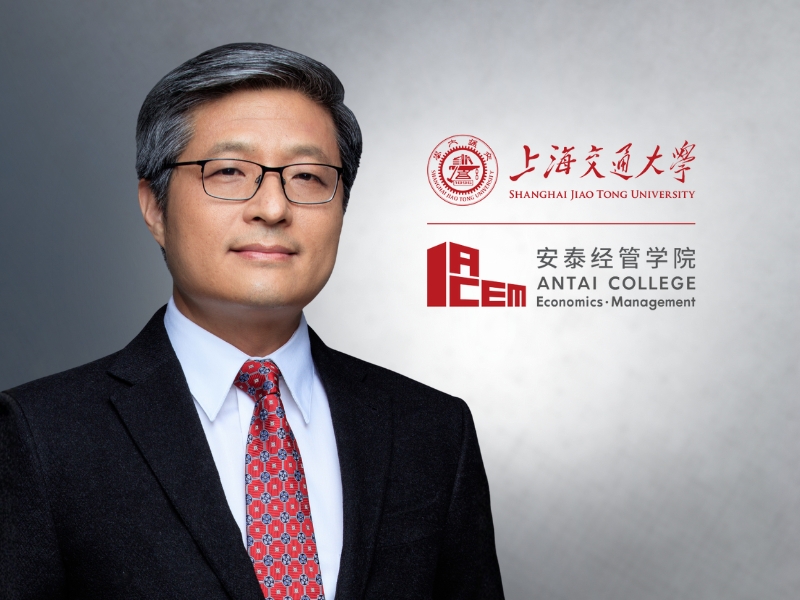
We sometimes hear theory and practice spoken of as two separate aspects of business education, connected but distinct. Shanghai Jiao Tong University’s Antai College of Economics and Management has adopted an arguably bolder perspective, one that builds the links between theory and practice into the fabric of its business training.
Thank you for taking the time to speak with us, Mr Fangruo! Antai College has become one of China’s top-ranked business schools. What are the key strategies and milestones that have driven its development in recent years?
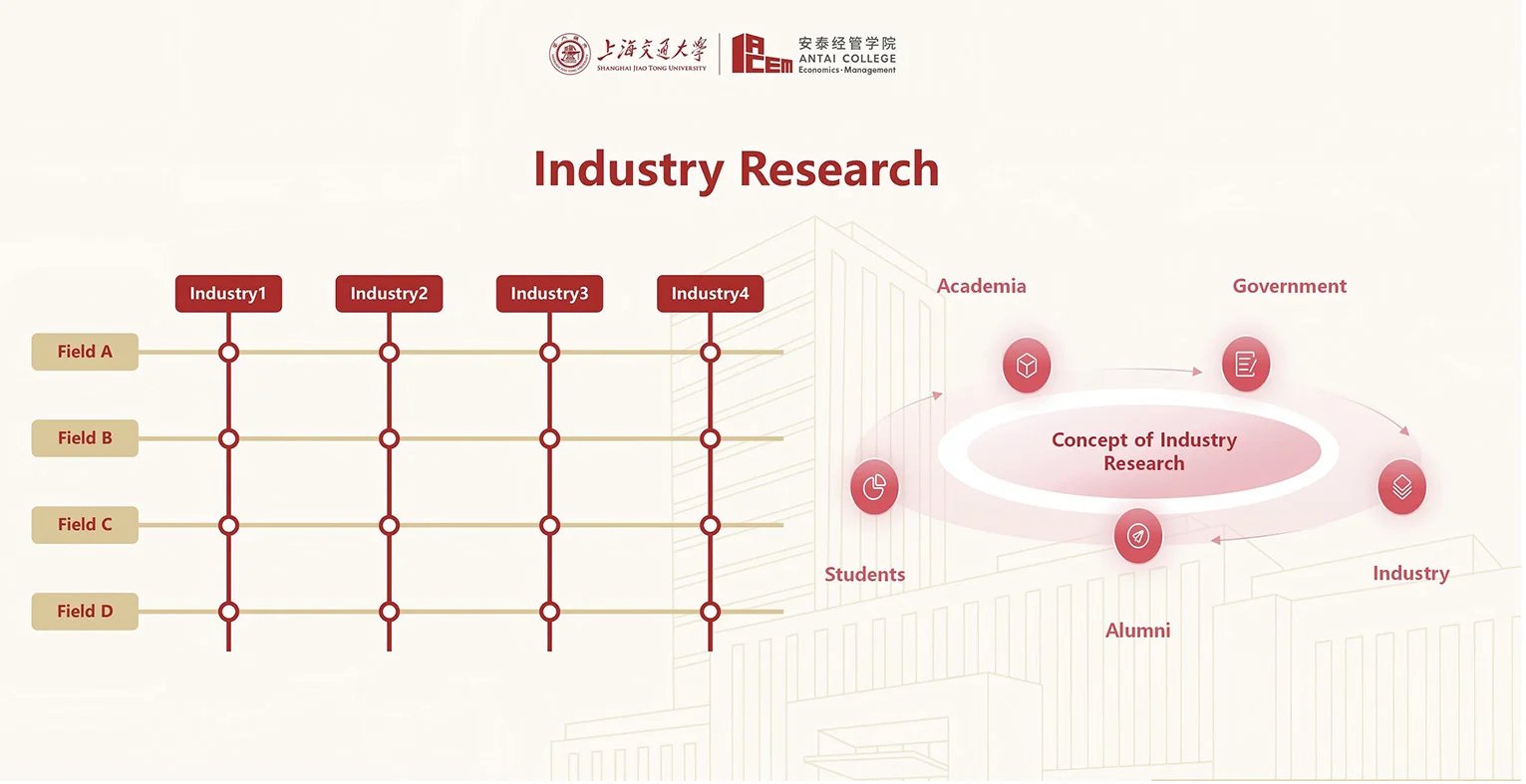
Indeed, Antai College is widely regarded as a top business school in China, but we have not slowed down our pace for innovation and development. In 2018, we redefined our strategy, to focus on strengthening the connection between theory and practice. We use a picture to describe this strategy, consisting of horizontal and vertical lines. The horizontal lines represent academic discipline-based research, while the vertical lines represent industry research. Therefore, in our minds, knowledge creation has two different paths, one geared toward theory building and the other serving industry needs. The horizontal and vertical paths crisscross each other, reinforcing the connection between theory and practice. This strategy has fundamentally changed every aspect of the college life, from research to teaching, creating a healthy ecosystem for business education.
You’ve emphasized “interdisciplinary integration and the connection of theory and practice” as central to Antai’s vision. How does this philosophy shape the college’s teaching?
The impact on the college’s teaching can be delineated at three different levels. First and foremost, the industry-research strategy has changed the teachers, i.e., serving the purpose of training the trainers. Every year, we organize around 30 industry research teams, consisting of faculty and students. These often-interdisciplinary research teams frequently visit companies and see for themselves the real problems and the innovative solutions that the frontline managers have come up with. This experience has expanded their knowledge base and provided the professors with increased confidence when teaching classes. Second, we have introduced many industry-focused courses. Our industry research effort has covered most of the important sectors, such as energy, health, finance, manufacturing, distribution and logistics, etc. The principal industry researchers have taken the lead in offering elective courses along the lines of their industry research efforts. Third, every time a team visits a company, it is often the case that a number of students will come along. The students contribute to the industry research effort while gaining first-hand knowledge about industry operations. Such experiences often lead to internship or employment opportunities.
Antai has a strong reputation for industry collaboration, as well. Can you share examples of how partnerships with leading companies and institutions enhance students’ career opportunities?
The college has built a multi-level, systematic framework for industry collaboration. It has moved beyond traditional one-off project cooperation to establish an “ecosystem-based” model of university–enterprise partnership that responds to the evolving needs of both companies and students at different stages. This model covers the full collaboration chain—from resource sharing and curriculum co-design to joint talent cultivation. The college regularly invites industry experts to engage in career development programs and to serve as student career mentors, co-establishes internship and training bases with leading firms, and jointly develops practice-oriented professional courses, building a solid foundation for students to excel in top institutions.
As one of Antai’s flagship talent development initiatives, the Career Navigation Program invites distinguished industry leaders and accomplished alumni from diverse sectors to serve as career mentors for current students, providing personalized guidance and sharing professional insights. Launched in May 2004, the program has now reached its 30th edition, engaging over 1,000 mentors and benefiting more than 3,500 students, continuing to serve as a cornerstone of Antai’s efforts to bridge academia and industry.
As one of Antai’s flagship talent development initiatives, the Career Navigation Program invites distinguished industry leaders and accomplished alumni from diverse sectors to serve as career mentors for current students, providing personalized guidance and sharing professional insights.
Since early this year, Antai’s industry collaboration initiatives have continued to expand and deepen. In April, the college launched the inaugural Finance Class with the Bank of China Shanghai Branch, recruiting students from SJTU’s 2026 graduating cohort. Through a four-dimensional training model—specialized coursework, cross-sector visits, practical training, and mentorship—the program provides six months of structured learning to cultivate talents specifically for the financial sector.
In July, the college further partnered with Tencent, L’Oréal, UBS Group, and China Telecom to establish the “AI + Career” Joint Talent Development Alliance. The initiative aims to equip business school students with enhanced employability and interdisciplinary literacy in the AI era, helping them adapt to the emerging industry trends.
In specialized talent development, Antai’s full-time MBA program has formed long-term strategic partnerships with prominent domestic and global enterprises such as Apple and CIMC Vehicles. Within these collaborations, companies present real-world project challenges drawn from their business operations, and students apply to participate based on individual career interests. These projects are fully integrated into the MBA curriculum, enabling students to translate theory into practice while fostering two-way evaluation and recruitment opportunities. Each year, we have students who secure positions with partner firms through these collaborations, realizing an efficient and precise match between talent training and corporate needs.
Globalization is central to modern business education. How is Antai College strengthening its international presence and partnerships, particularly in today’s evolving global landscape?
Driven by our mission, we strive to develop internationalization on all fronts—actively joining and leading international organizations, closely collaborating with top business educational institutions worldwide, and increasing the number of overseas-educated faculty, international students, and full English programs. Our aim is to further elevate Antai’s international impact through achievements in student education, scientific research, and societal engagement. Through our Asia Pacific Center in Singapore, we seek to expand our international standing in Asia and beyond, thereby achieving our vision of “a world-class business school firmly rooted in China.”
The IMBA program at Antai is unique in offering a global perspective with a Chinese focus. How does this program prepare students to navigate both Eastern and Western business environments?
This mission is central to our educational philosophy. We have built a comprehensive developmental framework that moves beyond teaching international and Chinese business in isolation, instead creating a deeply integrated learning experience. This is achieved through a purposefully structured ecosystem comprising three core pillars:
First, our integrated curriculum establishes a robust foundation in global management principles, systematically contextualized within China’s unique economic and social landscape. This fusion ensures that students gain not only universal business knowledge but also a nuanced understanding of its application in local contexts.
Second, our pedagogy emphasizes practical applications. Our distinguished faculty employ case studies and team projects that synthesize Eastern and Western business practices. This approach enables students to navigate real-world scenarios, applying theoretical frameworks to solve complex problems involving both multinational and local enterprises.
Finally, our experiential global learning component offers extensive international exposure through dual-degree programs, exchanges with top-tier partner schools, and study tours. A defining feature is the emphasis on bringing these global insights back into the classroom, creating a continuous cycle of learning that solidifies the ability to operate effectively across cultures. This cohesive developmental architecture is designed to cultivate leaders who are adept at bridging business environments and leveraging a truly global perspective.
What kinds of students are most attracted to Antai’s IMBA program, and how does the program support their professional aspirations?
We attract proactive, forward-looking individuals who come to us not merely for a credential, but for genuine transformation. Our students generally fall into two broad categories: career accelerators who are experienced professionals aiming to fast-track their growth within a global context, especially with a focus on China; and career transformers seeking to pivot across industries, functions, or geographic regions by leveraging our network and curriculum to build credibility in new fields.
The transformative impact of our program is consistently affirmed by our alumni. Some of the graduates, now developing their careers as entrepreneurs, emphasized how the program instilled the ability to use an international vision and mindset to make decisions. Some alumni highlighted the immensely diverse classroom with students from varied cultural, ethnic, and professional backgrounds which expanded horizons and enriched their social network, a network that proved instrumental during exchanges at institutions like Bocconi University and subsequent careers with multinational companies.
To reach these aspirations, we provide a comprehensive support system. Students gain immediate access to our extensive, engaged alumni community, where a culture of “helping your younger sisters and brothers” ensures ongoing mentorship and professional advantage. We encourage students to align their thesis with a company project or internship, transforming academic requirements into tangible career opportunities that often lead directly to job offers. Furthermore, our commitment extends beyond graduation through lifelong learning opportunities, including course audits, exclusive events like the annual forums, and ongoing alumni activities, ensuring that our graduates continue to grow and adapt throughout their careers.
How can you ensure that Antai continues to grow as a global leader in business education?
Antai aims to become a world-class business school firmly rooted in China. There are two key words here: “China” and the “world”. We want to be closely connected with China’s business community, which offers a fertile ground for business research and business education. We also want to redouble our internationalization effort, to be a bridge between China’s business community and the business communities of other countries, and to be an active collaborator with our sister business schools around the world. To be a global leader in business education, we need to embrace our local economy / society and, at the same time, to reach out for international cooperation.
Looking ahead, what is your vision for Antai College over the next decade?
Over the next decade, I hope Antai will continue to pursue the industry-research strategy. This will keep us on the right track, and will continue to provide us with endless ideas for innovation. We are developing a framework for doing industry research in a business school context, much like Harvard Business School’s introduction (and perfection) of the case method. We hope this will encourage more business schools to join us on this journey, because to really change the business school culture, we need a critical mass of business schools marching in the same direction.
And finally, how do you define success?
In my mind, the ultimate definition of success is the business school’s contribution to mankind. This, of course, is a very broad stroke. To get there, there are many intermediate steps, including research, teaching, and service to society at large. An accurate measurement of success is perhaps an immense task, or simply impossible, but let’s make sure we are moving in the right direction, one step at a time.