
By Professor Simon L. Dolan
Coaching has outgrown its Wild West beginnings. Without professional competence, clear boundaries and honest self-audit, a powerful helping practice can become a source of harm.
Coaching is no longer the new kid on the block. It has entered boardrooms, leadership programmes, universities and personal development markets around the world. Organisations invest heavily in it. Individuals turn to coaches when facing career transitions, relationship difficulties, leadership challenges and life-changing decisions. The promise is compelling: greater awareness, better choices, stronger performance and meaningful change.
Yet a troubling question remains: who ensures that the person calling themselves a “coach” is actually competent to coach?
Professionalism requires the humility to identify these gaps before they become someone else’s problem.
In many countries, coaching can be practised without a legally protected professional title or universally required qualification. A weekend course, a handful of online certificates or an impressive social-media profile may be enough for someone to start selling services that influence other people’s careers, relationships, well-being and organisations.
The result can resemble a jungle: excellent professionals work alongside inadequately trained practitioners, with clients often unable to distinguish one from the other.
This is not an attack on coaching. Quite the opposite. Coaching is too valuable to be left vulnerable to poor practice. Most responsible coaches want to help people grow. But good intentions, charisma and personal experience do not automatically confer professional competence.
The question is no longer whether coaching deserves to be taken seriously. It is whether the profession is prepared to take responsibility for the standards that serious work with human beings demands.
The uncomfortable evidence: coaching can do harm
Coaching research has largely focused on positive outcomes, and there is good reason for that. Studies and reviews have reported benefits in areas such as goal attainment, self-regulation, well-being and work performance. But a mature profession must examine not only what works, but also what can go wrong.
In their 2019 literature review, organisational psychology researchers Schermuly and Graßmann examined nine studies addressing negative effects of coaching. They found that negative effects occurred in the studies reviewed, although most were low in intensity and only a few were severe. Their findings also suggested that relationship quality and supervision could help reduce risks. The authors argued that negative effects should be acknowledged rather than treated as taboo.
This evidence should be interpreted carefully. The research base was limited, and it does not establish how frequently harmful coaching occurs across the entire profession. But it demolishes a comforting assumption: coaching is not automatically harmless simply because it is intended to be positive.
Poor practice can mean wasted time and money, misplaced confidence, damaged relationships, inappropriate pressure to change, or missed opportunities to obtain professional help. In more serious cases, a coach who mistakes psychological distress for a motivation problem may encourage a client to push harder when the appropriate response is to pause and seek qualified support.
The British Psychological Society has specifically drawn attention to the risks when coaches lack sufficient training or supervision to recognise mental-health concerns and make appropriate referrals. The danger is compounded by a familiar human blind spot: practitioners may be unaware of what they do not know (Hepworth et al, 2025, and published entirely on the British Psychological Society web site).
This is the heart of the problem. An incompetent practitioner may not recognise their incompetence. And the client, who is paying for expertise, may have even less ability to recognise it.
Codes of ethics are necessary – but not enough
To be fair, coaching is not without professional infrastructure. The International Coaching Federation (ICF), the European Mentoring and Coaching Council (EMCC), the Association for Coaching and other organisations have developed ethical codes, competency frameworks, credentials and professional development pathways.
The ICF Code of Ethics sets expectations for professional conduct and accountability. The Global Code of Ethics provides guidance for coaches, mentors and supervisors and is supported by multiple professional bodies.
These initiatives matter. They offer benchmarks, encourage reflective practice and provide mechanisms for addressing misconduct within participating organisations. But their reach has limits: adherence is not universal, and a code cannot by itself ensure that every person offering coaching has received adequate training or can recognise the limits of their competence.
This article is not a call for blanket government regulation. Coaching takes many forms, across different sectors and populations. In an interview published in 2008, the late Sir John Whitmore, one of the pioneers of modern coaching, questioned the practicality of regulating such a diverse field and stressed the importance of responding appropriately to the circumstances and the individual (Kauffman & Bachkirova, 2008).
I shared concerns with John about the direction of the profession. We had several meetings in London and we agreed that the challenge is to preserve coaching’s flexibility without allowing flexibility to become an excuse for inadequate preparation.
The profession needs a stronger culture of competence, not simply more badges, memberships or certificates. It needs practitioners who know what they can do, understand what they cannot do, and act responsibly when the distinction matters.
Eight competencies every professional coach should examine
In my work on professional competencies for Coaching by Values, I developed a practical framework and, especially, a self-audit approach. Although the original framework was developed in a specific methodology, the underlying principle applies to coaching more broadly: competence must be examined, demonstrated and continually developed, not merely claimed.
The following framework offers eight areas every coach, regardless of their preferred school or model, should consider.
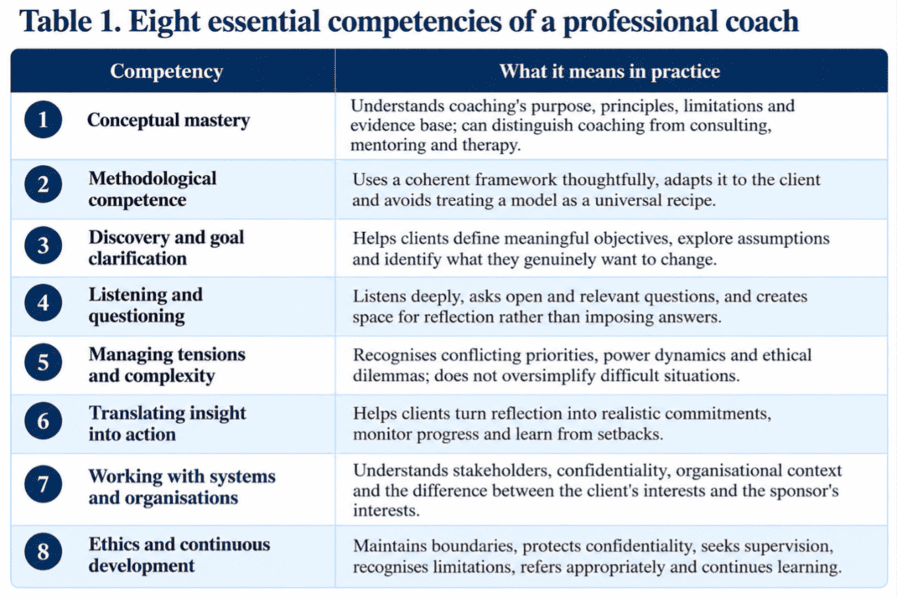 These competencies are not a checklist for obtaining instant mastery. They are areas of professional responsibility that require training, practice, feedback and reflection.
A coach may be excellent at listening but weak at recognising psychological risk. Another may understand leadership well but struggle with contracting, confidentiality or conflicts of interest. A third may have a sophisticated model but apply it mechanically.
Professionalism requires the humility to identify these gaps before they become someone else’s problem.
The most important question: do you know your limits?
Coaching is not psychotherapy, medical care or a substitute for either. Nor is every difficult emotion a clinical problem. The challenge is to distinguish situations in which coaching is appropriate from those requiring another kind of expertise.
A client experiencing ordinary uncertainty about a career decision may benefit from coaching. A client showing signs of serious psychological distress, trauma-related difficulties, addiction or a medical condition may need assessment and support from a suitably qualified professional. Sometimes coaching and therapy can coexist, provided the roles are clear, the client understands the distinction and appropriate consent and boundaries are maintained.
The ethical failure is not that a coach lacks the skills of a psychologist or physician. The failure is pretending to have them or continuing beyond one’s competence rather than seeking appropriate support.
A professional coach should be able to say: This is beyond my expertise. I can help you identify your next steps, but I cannot provide the assessment or treatment you may need.
That sentence is not a sign of weakness. It is evidence of professional maturity.
Referral should not be viewed as losing a client. It is an act of responsibility. And coaches should establish relationships with qualified psychologists, therapists, physicians and other relevant professionals before a crisis occurs, rather than scrambling to find help when a client is already at risk.
Before you coach: audit yourself
One of the most useful habits a coach can develop is a structured self-audit. Not a marketing exercise, not a self-congratulatory questionnaire, and not a substitute for external evaluation. It is an honest assessment of competence that leads to a development plan.
The audit should ask three questions for each competency:
- What can I demonstrate in practice?
- What evidence supports my assessment?
- What do I need to learn or practise before taking on work that depends on this competency?
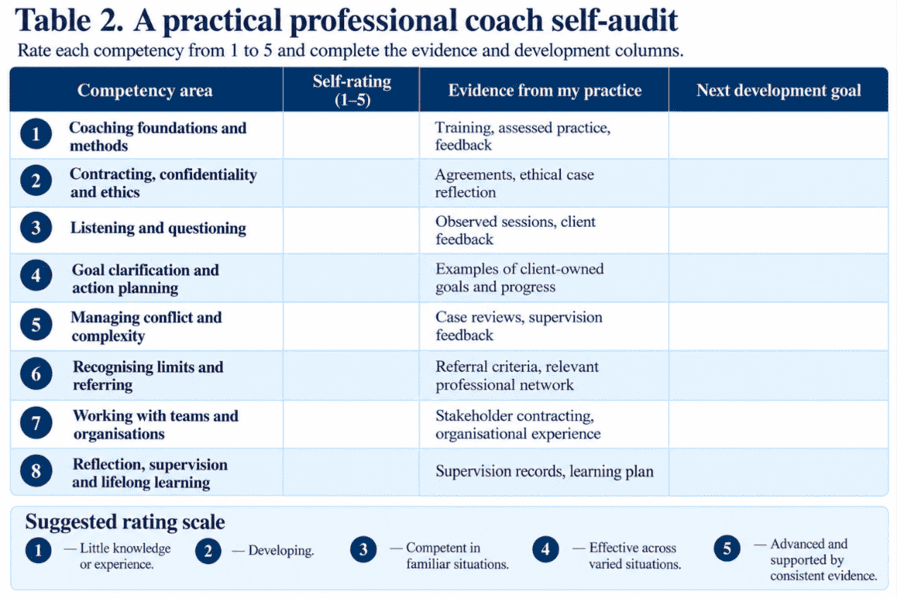
The rating is only a starting point. A self-assessment is vulnerable to overconfidence, blind spots and wishful thinking. Wherever possible, it should be complemented by mentor coaching, observed practice, client feedback, supervision and relevant credentials.
Most importantly, a low score in a safety-critical area must not be compensated for by a high average elsewhere. A coach who scores five out of five for questioning but one out of five for recognising mental-health risk is not ready to handle every coaching situation.
The outcome of the audit should be a learning and practice plan, with specific goals, timelines and evidence of progress. For example, a coach might undertake additional ethics training, practise contracting under supervision, observe experienced practitioners, or develop a referral protocol before accepting clients whose needs may exceed their competence.
Choose your training as carefully as your clients choose you
Not all training programmes are equivalent. Some provide rigorous education, observed practice, feedback, supervision and assessment. Others may emphasise inspiration, proprietary techniques or rapid certification without adequately testing whether participants can practise safely.
Prospective coaches should investigate the provider rather than rely on its marketing claims.
Before enrolling, ask:
- Is the curriculum clearly defined and grounded in credible knowledge?
- Is practical coaching sessions observed and assessed?
- Do trainers have relevant professional experience and qualifications?
- Are ethics, scope of practice, referral and mental-health boundaries explicitly taught?
- Is supervised practice included?
- Does the programme explain what its certificate does—and does not—mean?
- Is there a commitment to continuing professional development?
A certificate is evidence of completing a programme; it is not necessarily proof of competence in every setting. Equally, the absence of one particular credential does not automatically make a coach incompetent. What matters is a credible, demonstrable pathway to safe and effective practice.
Organisations commissioning coaches have responsibilities too. They should examine training, experience, credentials, supervision arrangements, professional references and the coach’s ability to work within a clear ethical framework. Choosing the lowest price or the most persuasive personality is not an adequate procurement strategy when people’s development and well-being are at stake.
From individual responsibility to a culture of professionalism
The coaching profession cannot eliminate every risk. No helping profession can. But it can do much more to make poor practice less likely and competence more visible.
Coaching does not need more people who merely call themselves coaches. It needs more practitioners who can demonstrate that they are ready to do the work responsibly.
Professional associations should continue to strengthen ethical standards, competency frameworks, supervision and credible credentialing. Training providers should be transparent about outcomes and limitations. Employers should demand evidence rather than rely on charisma. Experienced coaches should mentor newcomers and speak openly about mistakes and difficult cases.
Coaches themselves must take the first step: audit their competence honestly, practise within their limits, refer when appropriate and commit to ongoing learning.
These are not bureaucratic extras. They are fundamental safeguards for the people who place their trust in us.
Coaching is too important to leave to chance
Coaching has matured beyond the stage when enthusiasm and a powerful questioning technique could be considered sufficient preparation. Its growing influence creates a corresponding responsibility.
The answer is not to make every coach identical or to impose a single model on a diverse field. Nor is it to dismiss the many excellent professionals who already work with integrity and skill. It is to make professional competence a genuine expectation rather than a voluntary aspiration that clients must somehow verify for themselves.
My challenge to every coach, and to everyone considering becoming one, is simple:
Before asking clients to examine their beliefs, behaviours and blind spots, examine your own. Before helping others move beyond their comfort zones, understand the limits of your competence. And before accepting responsibility for another person’s development, make sure you are prepared to carry it.
Coaching does not need more people who merely call themselves coaches. It needs more practitioners who can demonstrate that they are ready to do the work responsibly.
That is how we protect clients. That is how we protect the many professionals who do this work well. And that is how coaching earns the trust its future depends on.
 Professor Simon L. Dolan