
By Simon L. Dolan
“Happiness may not be the goal of life – Perhaps contentment is”
For much of my professional life, I have been accompanied by a deceptively simple question:
What makes a life worth living?
I have never been entirely comfortable with the idea that happiness should become the ultimate objective of our existence. Happiness is too transient to serve as a permanent destination. It comes, it goes, and it returns. We can experience moments of extraordinary happiness, but no human being can remain happy continuously.
Life inevitably contains pleasure and pain, achievement and failure, love and loss, certainty and doubt. And yet, I see nothing wrong with wanting to increase the number of happy moments in our lives. From a relatively hedonistic perspective, it seems entirely reasonable to try to ensure that our lives contain more moments of happiness than of unhappiness.
But I believe there is something deeper than happiness.
That something is contentment.
Contentment does not mean being permanently happy. Nor does it mean living without problems, conflict or suffering. It is closer to an inner sense that, despite life’s inevitable difficulties, our existence makes sense and is sufficiently aligned with who we are, what we value and what we believe our purpose to be.
And this brings us to two concepts that have accompanied much of my work: purpose and meaning. A life with purpose addresses, at least partially, the question What am I here for? A life with meaning addresses another equally important question: Why does what I do matter? But there is something else.
We do not all seek the same thing
One of the most common mistakes we make when talking about happiness and well-being is to assume that there is a universal recipe. There isn’t.
Human beings are profoundly different. We have different histories, personalities, circumstances, aspirations and, above all, different values. What gives one person meaning may be almost irrelevant to another.
We should periodically examine our relationships rather than allowing them to be determined entirely by habit.
For more than four decades, I have explored this dimension through the world of values. My triaxial model proposes that human values can be understood through three broad axes: economic-pragmatic, ethical-social and emotional-developmental [1].
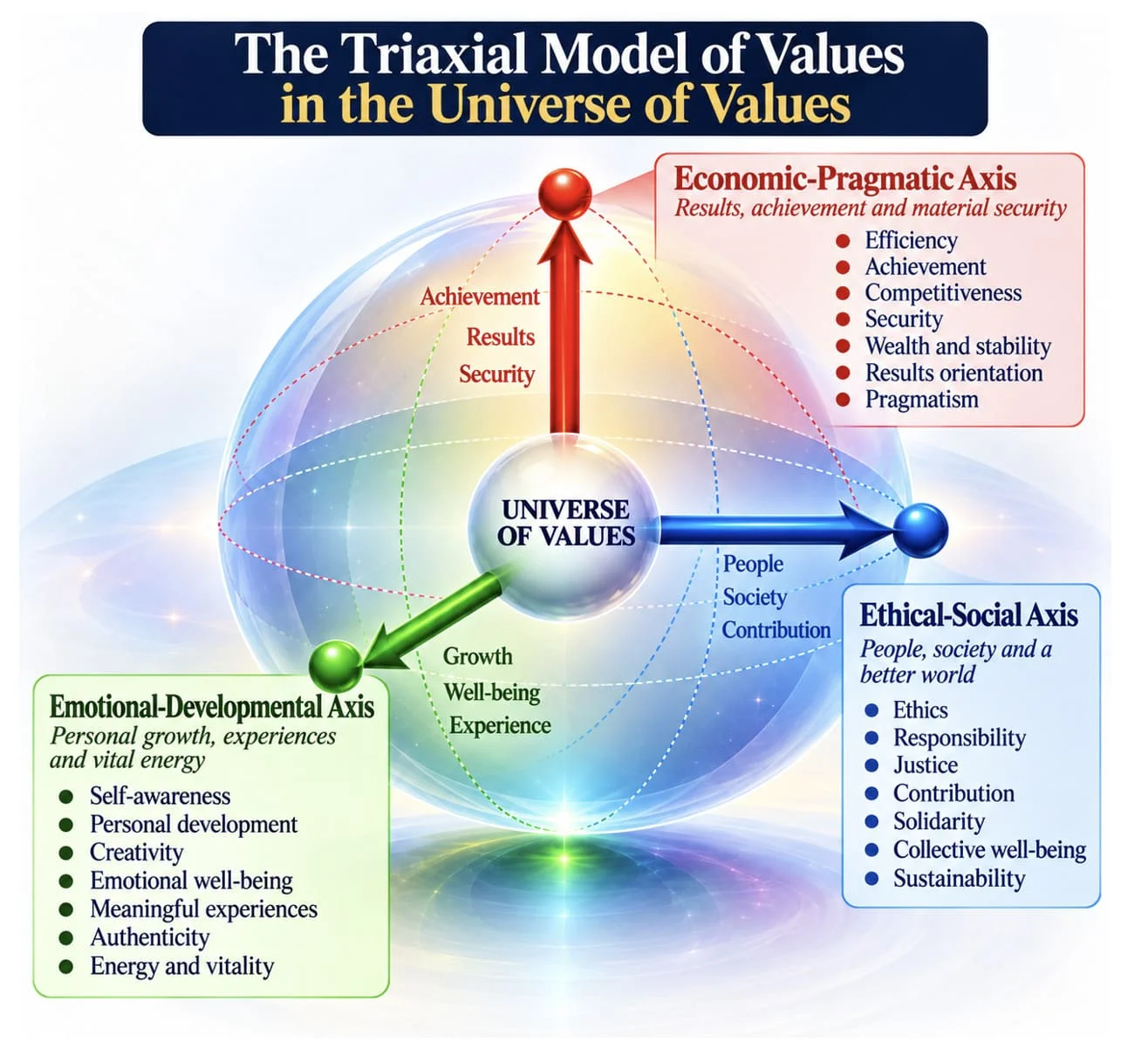 Values function, in a sense, like a compass. But a compass alone is not enough. We also need certain conditions to maintain a reasonably healthy equilibrium. And this is where I want to introduce a deliberately simple (yet innovative) idea.
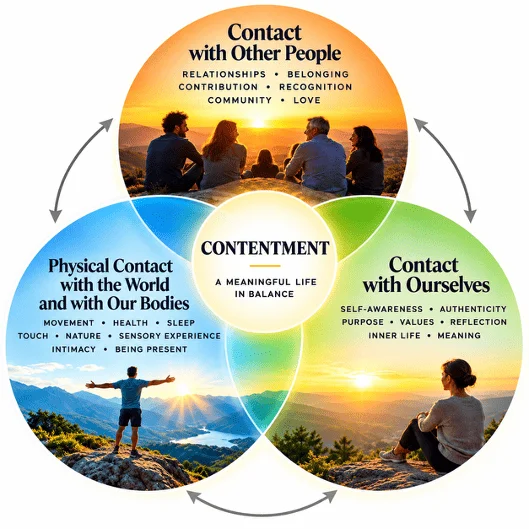
Rather than attempting to construct yet another universal hierarchy of human needs—as Maslow famously did, I propose reducing the enormous universe of human needs to three broad forms of contact.
They are not rigid categories. They are not a hierarchy. And they will not have exactly the same importance for every person. There are three dimensions that interact continuously:
contact with other people,
physical contact with the world and with our bodies, and
contact with ourselves.
These three forms of contact provide, I believe, useful architecture for thinking about contentment.
1. Social Contact: Our Need for Other People
The first dimension is social contact. We are social animals. We need other people. Friends, partners, siblings, children, parents, colleagues, students, communities and professional networks can satisfy different forms of human connection.
But social contact does not simply mean having people around us. It includes belonging, recognition, acceptance, contribution, identity, professional relationships and even those aspects of social life that we sometimes associate with status or ego.
We can be surrounded by people and still feel profoundly alone. And we can have a relatively small circle of relationships and yet feel deeply connected. So, the important question is not simple:
How many people do I have in my life? It is: What is the quality and meaning of my relationships with them?
Contemporary research into well-being and meaning in life gives considerable importance to social relationships. Belonging, interpersonal connection and the perception that our lives matter to other people are closely related to the experience of a meaningful life (Lambert et al., 2013; Martela & Steger, 2016)[2]. Yet social contact is not necessarily beneficial simply because it is social. Relationships and social environ[3]ments can also become sources of stress, alienation and harm, particularly when unhealthy patterns become normalized within the broader social environment (Martínez Morán & Dolan, 2025).
But there is an important qualification. Not all social contact is good contact.
We can belong to groups that diminish us.
We can maintain relationships that repeatedly undermine our sense of self.
We can become trapped in professional environments in which recognition depends upon competition, comparison or conformity. And,
We can use social media to create the appearance of connection while experiencing very little genuine intimacy.
In our recent book, titled “The Harmful Society”, we explore precisely what can happen when toxic forms of social interaction cease to be exceptional and become normalized features of the environment in which we live and work[4].
A society can offer enormous amounts of social contact and, at the same time, produce very little healthy human connection. This distinction matters. The solution to loneliness is not necessarily more people. It may be better relationships.
The challenge of social contact
One of the difficulties is that our social needs change throughout life.
A young person may need an extensive peer network and intense social recognition.
A parent may derive much of his or her identity from family relationships.
A professional may find meaning through colleagues, clients, students or a team.
Later in life, some people may discover that a smaller number of deeper relationships becomes more important than a large social network. There is therefore no universal formula. The question each of us needs to ask is: Which relationships allow me to give and receive something that genuinely matters?
That question shifts the focus from quantity to quality.
How can we cultivate healthier social contact?
The answer begins with intentionality. We should periodically examine our relationships rather than allowing them to be determined entirely by habit. Some useful questions are:
- Who can I be genuinely myself with?
- With whom can I have a conversation that goes beyond the superficial?
- Which relationships give me energy, and which consistently drain it?
- Where do I feel that I belong?
- To whom do I contribute something meaningful?
- Who depends upon me in a healthy way?
- Whom do I depend upon?
- Are there relationships I maintain primarily because of obligation, fear or habit?
- Have I allowed professional or digital relationships to replace deeper human contact?
There is also an important element of giving. Connection is rarely created simply by asking what others can give us. It is strengthened when we become useful to other people, when we listen, when we show up, when we remember, when we forgive and when we allow ourselves to be vulnerable.
Perhaps one of the simplest ways of improving our own social well-being is therefore to ask:
Whose life can I make slightly better today?
Contentment is not purely a private experience. It is partly relational.
2. Physical Contact: Our Relationship with the Body and the World
The second dimension is physical contact. We may have forgotten how profoundly physical we remain. Before we were professionals, academics, entrepreneurs, parents, consumers or users of technology, we are bodies. And bodies have needs.
Physical contact can take many forms: intimacy, sexuality, affection, embracing, holding hands, massage, dancing, exercise, sport, walking, being outdoors, touching natural materials, feeling sunlight or water, or simply experiencing the physical presence of another person.
These needs change considerably over the course of life. Age, health, physical condition, libido, personality and circumstances all influence how important different forms of physical contact are to everyone. But the principle remains:
We experience life through our bodies, not merely through our minds.
Our contemporary culture often encourages us to live as if the body were simply a vehicle carrying the brain from one intellectual task to another.
Technology makes this particularly easy. We can spend hours sitting at a desk, looking at a screen, communicating without touching, travelling without walking and consuming information without physically engaging with the world around us. We become increasingly connected digitally while becoming increasingly disconnected physically.
The body cannot simply be ignored
When important physical needs remain neglected for long periods, the consequences can be psychological as well as physical.
Lack of movement affects how we feel.
Poor sleep affects how we think.
Chronic stress affects the body.
Isolation can deprive us of forms of physical affection that human beings have traditionally experienced through family and community.
None of this means that there is a simple formula linking a particular amount of physical contact to psychological health. Human beings differ enormously, and individual circumstances matter.
But it does suggest something fundamental: The body is not separate from well-being. If we want to understand contentment, we cannot treat physical experience as an afterthought.
Physical contact is larger than physical intimacy
It is important not to reduce this dimension to sexuality. Sexual intimacy can certainly be an important part of physical contact for many people, but it is only one component. Physical contact can also mean:
- walking with someone;
- embracing a friend;
- playing with a child;
- exercising with others;
- gardening;
- cooking;
- dancing;
- swimming;
- being in nature;
- working with our hands;
- caring for an animal;
- travelling without rushing;
- feeling the sun, wind or rain;
- simply inhabiting our physical environment rather than constantly observing it through a screen.
These experiences remind us that being alive is a bodily experience.
How can we cultivate healthier physical contact?
The first step is to notice how disconnected we may have become. We can ask:
- How much of my day do I spend physically inactive?
- When was the last time I experienced genuine physical affection?
- Do I regularly move my body in ways that I enjoy?
- Do I spend time outdoors?
- Do I engage with physical activities that require attention rather than passive consumption?
- Have screens replaced physical experiences in my daily life?
- Am I treating my body as something to control rather than something to inhabit?
There is an important distinction here between disciplining the body and listening to the body. Modern culture often sends contradictory messages. We are told to optimize our bodies, measure them, improve them and control them. But contentment may require something slightly different: learning to inhabit our bodies with greater awareness and acceptance.
The objective is not to create a perfect body. It is to re-establish contact with the body we have.
3. Contact with Ourselves: The Inner Dimension
The third dimension is perhaps the most difficult to define. It is contact with us. Some people call it spirituality. Others call it consciousness, self-knowledge, authenticity, inner life, meditation or mindfulness.
The terminology matters less to me than the underlying question: Am I actually in contact with whom I am? This may be one of the most important questions we can ask during our lifetime.
Many people spend decades pursuing external objectives without ever asking whether those objectives are genuinely their own. They accumulate recognition, money, possessions, qualifications, relationships, professional positions and achievements. And yet they continue to experience difficult-to-explain emptiness. Perhaps they do not lack anything externally. Perhaps what they lack is contact with their own inner life.
The problem of living according to borrowed values
This is where the relationship between values and contentment becomes especially important. We are surrounded by messages telling us what a successful life should look like.
Be productive.
Be wealthy.
Be attractive.
Be influential.
Be recognized.
Build a career.
Buy a house.
Travel.
Have experiences.
Build a personal brand.
Remain relevant.
There is nothing inherently wrong with any of these aspirations. The problem arises when we pursue them without knowing whether they correspond to our own values.
A person can be extremely successful according to external measures and still feels unsuccessful internally. This is one of the great paradoxes of modern life. We may spend enormous energy achieving things that we never consciously decided were important.
This is why values matter so much.
They provide a means of distinguishing between what we genuinely value and what we have learned to value.
The importance of reflection
Contact with ourselves requires some form of reflection. That reflection may take the form of meditation, prayer, journaling, therapy, philosophical inquiry, long walks, conversations with trusted people or simply periods of solitude.
The method is less important than the willingness to stop and listen. In a culture of constant stimulation, silence can become uncomfortable. But without some degree of silence, it is difficult to hear our own thoughts.
Without reflection, it becomes difficult to distinguish our desires from the desires that have been placed inside us by family, culture, advertising, professional expectations or social comparison.
This is one reason for the extraordinary growth of practices such as meditation and mindfulness. Their methods and philosophical foundations differ, but many share a common aspiration: to increase our awareness of our own experience.
How can we cultivate contact with ourselves?
Again, the questions may be more useful than the answers.
- What do I actually value?
- Which parts of my life feel genuinely mine?
- What am I doing because I want to do it, and what am I doing because I believe I should?
- If nobody could see my achievements, which achievements would still matter to me?
- What gives me a sense of meaning?
- What would I regret not having done?
- When do I feel most authentic?
- What have I been avoiding asking myself?
- If I removed status, money and recognition from the equation, what would remain important?
These questions can be uncomfortable. But discomfort is not necessarily a sign that we should stop. Sometimes discomfort is evidence that we have touched something important.
The Three Forms of Contact Are Connected
It would be a mistake to interpret these three dimensions as independent compartments. They interact continuously. A breakdown in one can affect the others.
Loneliness can affect the body.
Physical illness can affect relationships.
Loss of meaning can lead us to compensate through work, consumption, status or excessive social activity.
And,
A person who feels disconnected internally may seek constant external stimulation.
A person whose physical life has become impoverished may become psychologically withdrawn.
A person who lacks meaningful relationships may attempt to compensate through achievement.
This is why contentment is not simply a matter of fixing one problem at a time. It is a matter of balance and interaction. And here our values become relevant once again.
- Someone whose value orientation is strongly economic-pragmatic may naturally devote more attention to achievement, security and material outcomes.
- Someone whose values are strongly ethical-social may place greater emphasis on relationships, contribution and collective well-being.
- Someone whose values are strongly emotional-developmental may place greater emphasis on experience, creativity, authenticity and personal growth.
None of these orientations is inherently right or wrong. The important question is whether our lives allow sufficient room for the dimensions that are genuinely important to us.
The Danger of Imbalance
Every strength can become a weakness when taken to an extreme.
- Social contact can become dependency.
- Physical experience can become compulsive consumption.
- Inner reflection can become isolation.
- Work can become an escape from relationships.
- Relationships can become an escape from ourselves.
- Spirituality can become an escape from the physical world.
This is why I prefer the idea of dynamic balance rather than a prescription. There is no ideal percentage of our lives that should be devoted to each form of contact. The balance will change.
At different stages of life, one dimension may legitimately dominate. A new parent may temporarily devote enormous energy to relationships. A person recovering from illness may need to concentrate on physical well-being. Someone experiencing a major transition may need more solitude and reflection.
The problem is not imbalance itself. The problem is persistent imbalance without awareness. The most important question may therefore be:
Do I know which dimension of contact is currently missing from my life?
Practical Architecture for Contentment
The three-contact framework becomes useful when we turn it into regular practice of reflection. Not a rigid program. Not another productivity system. Simply a way of paying attention.
Perhaps once a month, or whenever life feels particularly unsettled, we might ask ourselves three questions.
1. How am I doing in my relationships?
Who am I connected to?
Who am I neglecting?
Where do I experience belonging?
Where do I feel lonely?
Am I giving as much as I am receiving?
2. How am I doing physically?
Am I sleeping sufficiently?
Am I moving?
Am I experiencing touch and affection?
Am I spending time outdoors?
Am I inhabiting my physical environment or merely passing through it?
3. How am I doing internally?
Do I know what I value?
Am I living according to those values?
Do I have enough silence and reflection?
Do I know what gives my life meaning?
Am I becoming more, or merely accumulating more?
These questions are deliberately simple. Their value lies not in producing perfect answers but in making invisible imbalances visible.
From Happiness to Contentment
Perhaps, then, the question we should ask is not:
How can I be happy all the time? That is an impossible question.
A more useful question might be: How can I build a life in which I experience enough moments of happiness while maintaining a deeper sense of contentment?
The objective is not to create a perfect body. It is to re-establish contact with the body we have.
Contentment does not eliminate suffering. It does not guarantee success. It does not protect us from illness, ageing, loss or disappointment. Nor does it require us to abandon ambition. Instead, it may provide something more fundamental: a sense of coherence.
The feeling that our life is reasonably aligned with our purpose, our values, our relationships, our physical nature and our inner identity.
Happiness comes and goes. Contentment also fluctuates. But contentment can be cultivated. Perhaps the art of living is therefore not the endless pursuit of happiness. Perhaps it is learning to maintain meaningful contact with three worlds:
with other people,
with our bodies and the physical world,
and with ourselves.
Three forms of contact. Three dimensions of human existence. One life.
And perhaps a life well lived is not one in which we manage to eliminate unhappiness, but one in which, despite everything life inevitably brings us, we remain sufficiently connected to know who we are, what we value, why we are here, and whom we are here with.
 Professor Simon L. Dolan