
By Prof. Simon L. Dolan
You don’t have to work in a laboratory to discover the secret of longer life – just follow these simple guidelines from the people of the Blue Zones.
What can we learn from the people of the “Blue Zones”, those parts of the world that exhibit exceptional longevity? Surely they know – consciously or not – something that the rest of us do not. Founder of the Global Future of Work Foundation Simon Dolan colors in the background to the Blue Zones lesson.
Aging on Purpose
Why do some communities around the world produce extraordinary numbers of healthy centenarians? The answer is not found in a miracle gene or a magical diet alone. The so-called “Blue Zones” — regions such as Okinawa, Sardinia, Ikaria, and Nicoya — reveal a deeper truth: longevity is multidimensional. It emerges from the interaction of lifestyle, values, social connection, resilience, and meaning (Buettner, 2012).1
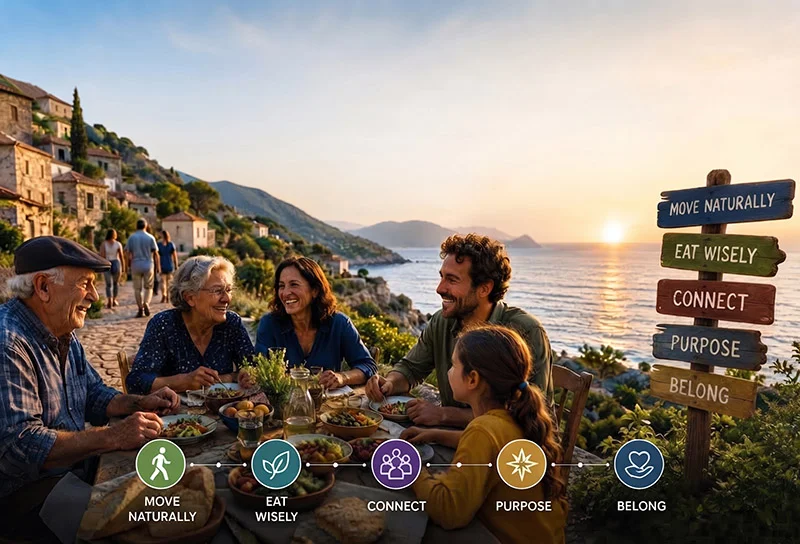
The popular narrative often focuses on nutrition or physical activity. Certainly, Blue Zone populations eat mostly plant-based foods, move naturally throughout the day, and maintain strong community ties. Yet one factor consistently appears across all these cultures: a profound sense of purpose.
Okinawans call it “ikigai” — “the reason to wake up in the morning.” In Costa Rica, people speak of “plan de vida”, a life plan infused with meaning and contribution.
Resilience is the capacity to align one’s behavior with deeply held values while adapting to uncertainty.
This is where my work (alone and with many colleagues) becomes especially relevant. I argue that resilience is not merely the ability to endure adversity; it is the capacity to align one’s behavior with deeply held values while adapting to uncertainty. My “Resilience Rings” framework (with my colleague Javier) integrates neuroscience, psychology, and human values to explain why some individuals flourish despite stress and change (Casademunt & Dolan (2023); and Dolan, Shrestha and Leuca (2025))2.
The Three Ways of Resilience
Modern neuroscience increasingly supports the perspective that resilience is a multifaceted construct, bolstered by a suite of interrelated mechanisms that foster emotional well-being and adaptive functioning. Research in affective neuroscience elucidates three primary pathways through which resilience is strengthened: the mitigation of chronic stress, the enhancement of positive emotions and social bonds, and the cultivation of a transcendent orientation that diminishes excessive self-focus through practices such as mindfulness, spirituality, or service to others. These mechanisms operate synergistically to modulate key brain systems implicated in emotional regulation, reward processing, and cognitive flexibility.
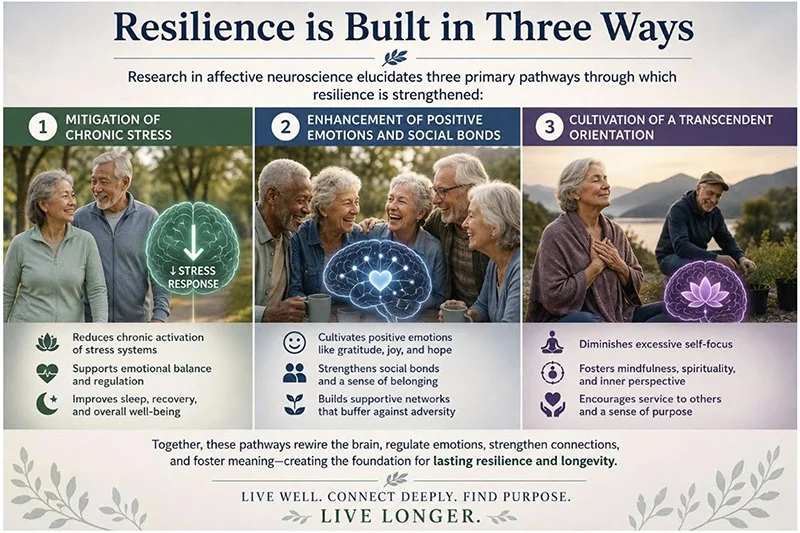
Firstly, reducing chronic stress is paramount, as prolonged exposure to stressors can dysregulate neural circuits involved in the hypothalamic-pituitary-adrenal (HPA) axis, leading to maladaptive patterns of emotional reactivity. Interventions aimed at stress reduction, such as cognitive-behavioral techniques and lifestyle modifications, have been shown to normalize cortisol levels and promote neuroplastic changes that enhance resilience (McEwen, 2007).3
Secondly, amplifying positive emotions and fostering robust social connections are critical for reinforcing neural networks associated with the reward system and social cognition. Positive affect has been linked to increased dopamine release in the mesolimbic pathway, which not only enhances feelings of pleasure but also strengthens the brain’s capacity to anticipate and pursue rewarding outcomes (Fredrickson, 2001)4. Moreover, strong social bonds activate oxytocin-mediated pathways that promote trust, empathy, and cooperative behavior, thereby buffering individuals against adversity (Cacioppo & Cacioppo, 2018)5.
Lastly, transcending excessive self-focus through mindfulness, spirituality, or service to others encourages a shift in attentional and cognitive processes that underlie resilience. Mindfulness practices, for instance, have been demonstrated to increase prefrontal cortical activity, which facilitates top-down regulation of limbic structures involved in emotional reactivity (Hölzel et al., 2011)5. Similarly, spiritual engagement and altruistic behaviors have been associated with heightened activity in the anterior cingulate cortex and insula, regions implicated in empathy and perspective-taking, thereby fostering a broader sense of interconnectedness and purpose (Wachholtz & Pargament, 2005)6.
Transcending excessive self-focus through mindfulness, spirituality, or service to others encourages a shift in attentional and cognitive processes that underlie resilience.
Collectively, these pathways converge to influence brain systems that are essential for effective emotional regulation, the experience of reward, and the flexibility of cognitive processes. By integrating these insights into clinical and educational settings, we can cultivate resilience in individuals, empowering them to navigate life’s challenges with greater efficacy and optimism. The burgeoning field of affective neuroscience offers a hopeful and actionable framework for promoting mental health and well-being, underscoring the profound potential of human adaptability and growth (Davidson & Begley, 2012).8
The Protective Role of Purpose
In practical terms, the perception of meaningfulness exerts a transformative influence on biological processes. Individuals who perceive their lives as purposeful consistently demonstrate attenuated stress responses, enhanced emotional stability, and more favorable aging trajectories. Empirical evidence from investigations into Blue Zone populations underscores the protective role of purpose, suggesting that it may serve as a robust buffer against systemic inflammation, depressive symptomatology, and cognitive deterioration. These findings not only highlight the profound interplay between psychological constructs and physiological outcomes but also encourage further exploration into how fostering a sense of purpose can be harnessed to promote holistic well-being and longevity. The implications are profoundly encouraging, offering a pathway through which individuals and communities might actively cultivate environments that nurture purpose, thereby potentially mitigating a spectrum of adverse health outcomes. This perspective invites optimism and proactive engagement in practices that elevate meaningful living, promising a brighter, healthier future for all.
Viktor Frankl, a psychiatrist who was a survivor of the Holocaust, has much to teach us about resilience. One key lesson from his work is that having a sense of meaning and purpose can fuel persistence and survival in some of life’s most difficult situations; you will learn about post-traumatic growth, the experience of positive life changes after a stressful or traumatic event (Frankl 2006)7. You will see ways that individuals have used their emotional suffering to help others, including having a clear and impactful “survivor mission.” Meaning and purpose can be given, but Southwick and his colleagues argue that it can also be made; they argue that some essential areas in our life can be taught (Southwick, Charney & DePierro (2023).8 This is perfectly supported by the work of Hill and Turiano in their essay on “Purpose in Life as a Predictor of Mortality Across Adulthood” (Hill and Turiano, 2014)9.
Be True to Your Values
Values profoundly shape human decision-making processes, as evidenced by extensive research in the field of neuroscience. Studies have elucidated the intricate neural pathways through which personal value systems influence motivation, confidence, and behavior, particularly those associated with reward processing and judgment formation. When individuals consistently act in accordance with their core values—such as contribution to society, familial bonds, continuous learning, spiritual growth, or compassionate engagement—they cultivate a harmonious alignment between their cognitive appraisals, emotional responses, and behavioral outputs. This internal coherence not only fortifies psychological resilience but also significantly enhances overall well-being.
In recent years, my research endeavors have sought to elucidate the intricate relationship between personal values and neurobiological processes, particularly within the domains of value-based decision-making and the implications of value congruence on mental health outcomes. The empirical evidence amassed through this work demonstrates that aligning one’s actions with deeply held values can serve as a potent buffer against stress, diminish anxiety levels, and cultivate a profound sense of purpose and fulfillment (Dolan & Dolan, 2024; Garti & Dolan, 2021)10. These findings highlight the critical role of integrating value-oriented frameworks into both individual growth strategies and therapeutic modalities, thereby empowering individuals to leverage their intrinsic values to achieve a more harmonious and satisfying existence. This approach not only enriches our theoretical understanding but also offers practical pathways for enhancing well-being across diverse contexts.
By recognizing and nurturing the values that resonate deeply with us, we can unlock profound psychological benefits, paving the way for enhanced emotional stability, increased self-efficacy, and a richer, more meaningful existence. I hope that my colleagues and disciples who study the interplay between values, stress, resilience, and longevity will continue to inspire practitioners to explore innovative approaches that leverage the intrinsic motivational forces of values to support holistic well-being. Embracing this perspective not only enriches our understanding of human behavior but also empowers us to lead lives that are more authentic, resilient, and joyful.
Conclusion
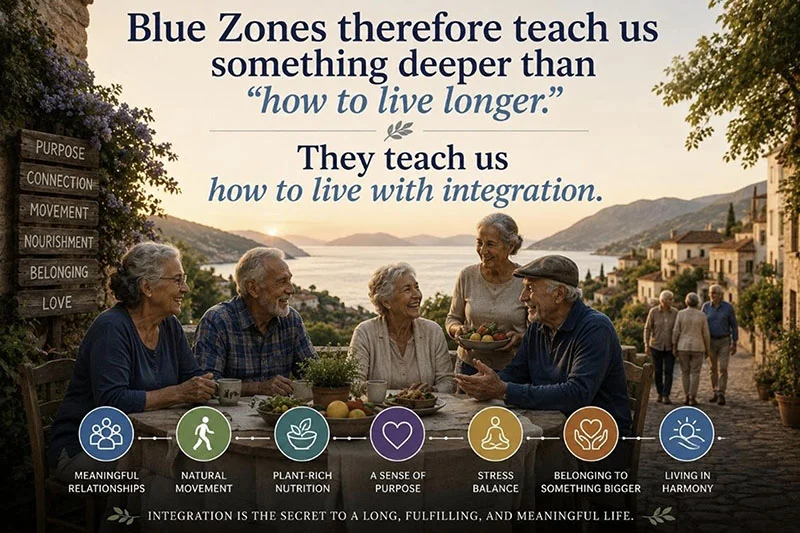
Blue Zones therefore teach us something deeper than “how to live longer”; they teach us how to live with integration. In these communities, movement is natural, relationships are authentic, work remains meaningful, and aging itself is not feared but respected. Older adults often continue contributing to family and society, preserving a sense of identity and usefulness well into advanced age.
The insights gleaned from the Blue Zones, corroborated by the empirical findings, underscore a profound paradigm shift in our understanding of longevity. Rather than viewing the extension of life as a mere quantification of years, the Blue Zones model illuminates the quintessential role of vitality, purpose, and interconnectedness in fostering a truly extended existence. This perspective challenges the prevailing fragmentation of contemporary life, where work, technology, and achievement often exist in isolation from one another, devoid of deeper meaning and communal resonance.
The central inquiry transcends the conventional question of “How long will we live?” to embrace a more profound and existential query: “Why do we live?” (Dolan & Raich, 2021)11. The centenarians inhabiting the Blue Zones provide a compelling testament to the power of a life imbued with purpose and belonging. Their narratives suggest that the pursuit of meaning—rooted in strong social ties, a sense of community, and a harmonious engagement with one’s environment—may constitute the most potent elixir for both longevity and well-being.
Thus, the lesson from the Blue Zones is not merely an invitation to extend our years but a clarion call to enrich the quality of our lives through meaningful engagement and connection. By adopting the principles exemplified by these longevity hotspots, individuals and societies alike can cultivate environments that nurture not only physical health but also spiritual and emotional flourishing. In doing so, we may unlock the potential for a life that is not only longer but also richer, more fulfilling, and deeply resonant with the essence of what it means to be human. Embracing this vision offers a hopeful and inspiring path forward, encouraging each of us to seek and sustain a life of purpose and connection (Dolan, 2011; Dolan & De Pablo, 2023)12.