
By David Liddle
Organisations are rethinking how culture is created, moving towards cultural citizenship – a model that empowers people to shape purpose, relationships and shared value.
Across Europe, and across every sector, organisations are navigating rapid change, political and economic instability, and shifting workforce expectations. Leaders are grappling with the challenge of how to build cultures that can withstand this complexity, while also supporting their people, and sustaining high performance. This article looks at the emergence of cultural citizenship – a new approach which positions employees as active partners in shaping the culture they experience every day.
Imagine a workplace where people don’t wait for culture to be handed down to them. A place where employees shape the way the organisation works, speak up with confidence, resolve issues early and feel connected to a purpose that matters.
In these environments, culture isn’t a programme, an engagement initiative or a set of posters on the wall. It is something people build together through everyday decisions, conversations, behaviours and relationships.
For decades, organisations have invested heavily in employee engagement, values programmes, wellbeing initiatives, culture change and leadership development. Yet many continue to wrestle with disengagement, mistrust, employee silence, workplace conflict and behaviours that sit uncomfortably alongside their stated values.
Perhaps we need to think differently about the relationship between people and organisational culture.
Many organisations are already moving in this direction, recognising that culture cannot be owned by HR or sustained through top-down initiatives. Culture emerges from how people interact, how leaders exercise power, how decisions are made, how conflict is handled, what behaviours are rewarded or challenged, and how people make sense of their work together.
What we are seeing emerge is the concept of cultural citizenship.
I define cultural citizenship as the capacity, opportunity and shared responsibility of people to participate actively in shaping the culture of their organisation.
No longer are people viewed as utilities to be exploited, assets to be depreciated, capital to be transacted, talent to be consumed, or resources to be controlled. It views employees as active partners in creating the conditions in which people, teams and organisations can thrive. It gives people both a stake and a say in how their organisation works.
Cultural citizenship also carries an important idea of reciprocity.
Citizenship involves rights and responsibilities. People need voice, fairness, belonging, psychological safety and the opportunity to influence the systems around them. Alongside these rights sit responsibilities: to participate, contribute, listen, challenge constructively, resolve disagreements and take responsibility for the impact of our behaviour on others.
This reciprocity is at the heart of a modern social contract. It matters.
Organisations cannot ask people to take responsibility for culture while denying them the agency, voice and influence required to shape it. With responsibility must come agency. With accountability must come voice. With participation must come the possibility of influence.
The Cultural Citizenship Roadmap
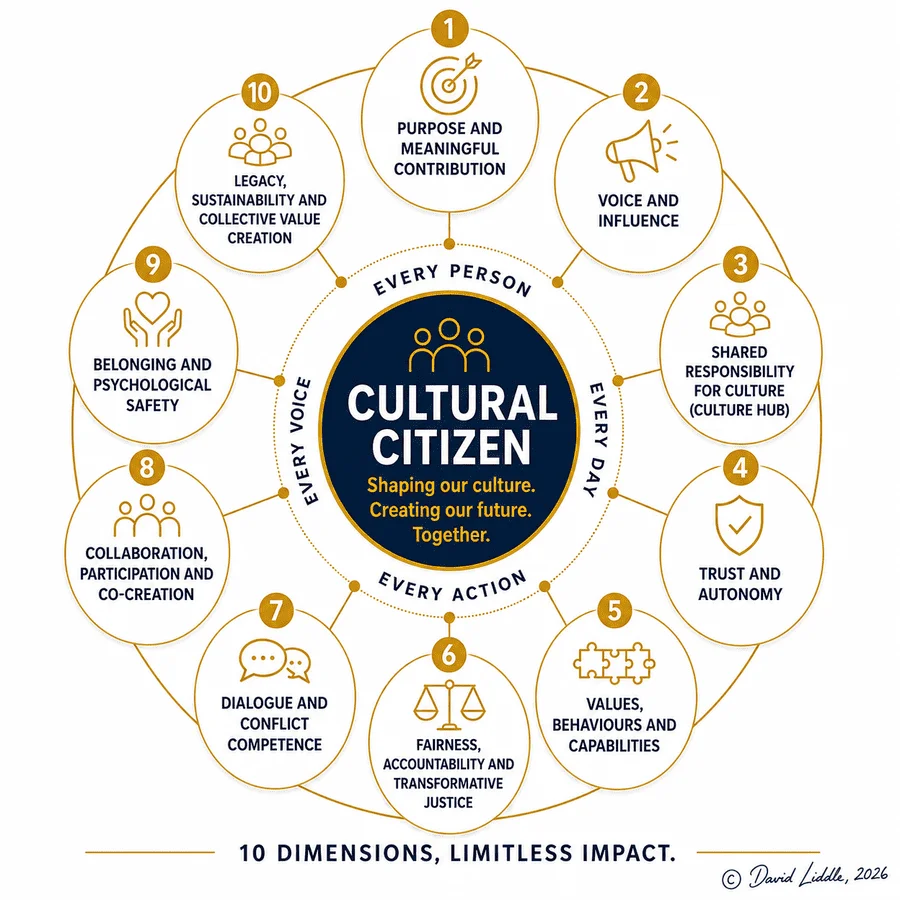
To help organisations navigate this new era, I have developed a ten-dimensional Cultural Citizenship Roadmap.
It is not intended to represent a linear journey. It is a practical framework for thinking about the conditions that enable cultural citizenship to flourish.
The dimensions interact, overlap and reinforce one another. Organisations may begin with any of them, and progress will often involve moving backwards and forwards as culture evolves.
The roadmap is best understood as a system. When its dimensions work in harmony, they create the conditions for cultures that are fair, human and high-performing.
Each dimension is anchored in a simple question, designed both as a prompt for reflection and a guide for action.
1. Purpose and Meaningful Contribution
Question: How does our purpose show up in our everyday work?
Purpose becomes meaningful when people can see how their work contributes to something worthwhile.
There is an important distinction between having a purpose statement and experiencing purpose at work. Purpose becomes culturally significant when it influences everyday priorities, decisions and behaviours.
Deloitte’s Mind the Purpose Gap[i] research, involving more than 4,000 UK employees, found that employees who experience alignment between organisational purpose, culture and leadership behaviours, and who understand how their day-to-day work contributes to that purpose, report greater motivation and trust and a lower desire to leave.
In practice, this means making purpose visible in everyday decisions, explaining the ‘why’ behind choices and connecting individual and team contribution to organisational and societal outcomes.
Cultural citizens need to understand the contribution they are being invited to make.
2. Voice and Influence
Question: How are we ensuring everyone has a voice and can influence change?
Voice is central to cultural citizenship.
People need opportunities to express ideas, concerns, disagreement and challenge. Yet voice has little value if people believe that speaking up changes nothing.
Creating genuine voice therefore means building channels for two-way dialogue, actively seeking diverse perspectives, listening to challenge and demonstrating how employee contribution has influenced decisions.
This also requires leaders to become comfortable with dissent.
Healthy cultures do not depend upon agreement. They create the conditions in which people can disagree well, challenge assumptions and speak truth to power without fearing that doing so will damage their career or relationships.
Voice creates the opportunity to speak. Influence demonstrates that speaking matters.
3. Shared Responsibility for Culture
Question: How do we make culture everyone’s responsibility?
Culture becomes stronger when responsibility for it is shared.
Research by Daniel Denison and Aneil Mishra[ii] identified involvement, consistency, adaptability and mission as important cultural characteristics associated with organisational effectiveness. Their research also demonstrated relationships between aspects of culture and outcomes including growth, profitability, quality and employee satisfaction.
Shared responsibility means moving culture beyond the confines of HR programmes and leadership initiatives and embedding it within everyday organisational life.
Teams can co-create cultural norms. Colleagues can challenge behaviour constructively. Leaders can create clarity around what good looks like. People can recognise that every interaction either strengthens or weakens the culture around them.
There is, however, an important caveat. Shared responsibility must never become transferred responsibility.
Leaders retain a particular responsibility because they exercise greater organisational power. Cultural citizenship asks everyone to contribute to culture while recognising that those with the greatest power have the greatest responsibility for creating the conditions in which others can participate.
4. Trust and Autonomy
Question: Are we creating the conditions for trusted decision-making and autonomy?
Cultural citizenship requires agency.
Trust and autonomy create conditions in which people can exercise judgement, take appropriate interpersonal risks and contribute with confidence.
Excessive control can create cultures of permission, where people wait for authority before acting. Greater autonomy allows decisions to be taken closer to the people, customers and problems they affect.
In practice, this means devolving appropriate decision-making, encouraging experimentation, creating clarity around boundaries and supporting people to take initiative.
Autonomy is not the absence of accountability. It requires clarity about purpose, expectations and responsibility.
Trust people with meaningful agency and they become participants in the organisation, not spectators of it.
5. Aligning Values, Behaviours and Capabilities
Question: How well are our values, behaviours and capabilities aligned, and held to account?
Values are the golden thread that shapes the behaviours we expect, the capabilities we build and the conversations we have every day.
They become meaningful when people can see them reflected in who gets promoted, what gets rewarded, how decisions are made, how customers are treated and what happens when behaviour falls short.
Cultural citizenship therefore requires clarity about what good looks like and the capability to bring those expectations to life.
Accountability must also travel in every direction.
Leaders need to hold people to account for their behaviours. Colleagues need to be able to challenge one another constructively. Employees need to be able to hold organisational power to account when leadership behaviour or organisational systems fall short of stated values.
The credibility of values is ultimately determined by what happens when living them becomes difficult.
6. Fairness, Accountability and Transformative Justice
Question: How can we build justice systems that are fair, human and transformative?
How an organisation responds when something goes wrong tells us a great deal about its culture.
Traditional grievance, disciplinary and performance processes can become slow, procedural and adversarial. They can entrench positions and damage relationships when what people often need is an opportunity to be heard, understand what has happened, establish accountability and find a way forward.
Acas has estimated the annual cost of workplace conflict to UK employers at £28.5 billion. [iii]More recent Acas research[iv] also demonstrates the importance of informal resolution, with discussion with a line manager and direct conversation with the other person among the most common ways employees seek to resolve workplace conflict.
This is why a growing number of organisations are exploring resolution-focused and transformative approaches to workplace justice.
The Resolution Framework, which I developed as an alternative to traditional grievance and disciplinary procedures, is one example of this movement. It is now being applied across organisations including the BBC, Aviva, Burberry, TSB, KPMG and NHS England.
The principle extends beyond any particular framework.
Justice systems shape culture.
A culturally mature organisation seeks accountability while preserving dignity, encourages early resolution wherever possible and uses conflict as an opportunity for learning, restoration and change.
7. Dialogue and Conflict Competence
Question: How confident are our leaders and employees in navigating conflict through dialogue?
Dialogue is one of the defining capabilities of a healthy organisation.
Recent Acas research into workplace conflict in Great Britain found that informal approaches remain central to resolution: 45 per cent of respondents experiencing conflict discussed it with their line manager and 30 per cent discussed it with the other person.[v]
This matters because everyday disagreements are inevitable wherever human beings work together.
Cultural citizenship does not mean the absence of conflict. It means developing the confidence and capability to engage with it constructively.
Leaders need to hold difficult conversations early. Employees need the confidence to raise concerns. Teams need the skills to explore disagreement without allowing it to become destructive.
Conflict is information. Dialogue is how we make sense of it.
Cultural citizens do not avoid disagreement. They learn how to disagree well.
8. Collaboration, Participation and Co-creation
Question: How are we building collaborative systems and promoting meaningful participation and co-creation?
Cultural citizenship thrives when people have opportunities to build solutions together.
Collaboration brings different perspectives into the room. Participation creates ownership. Co-creation allows people affected by organisational decisions to contribute to their design.
In practice, this means creating cross-functional spaces for problem-solving, involving employees in the design of policies and organisational systems, and creating opportunities for people at different levels to shape decisions.
But participation must have consequence.
Repeatedly asking people for their views and then ignoring them creates cynicism. Consultation theatre can be more damaging than no consultation at all because it creates the appearance of influence without its substance.
Meaningful participation requires organisations to explain what people can influence, listen carefully to their contribution and demonstrate what happened as a result.
9. Belonging and Psychological Safety
Question: How are we building a culture where everyone feels they belong and can speak up without fear?
Belonging is an emotional anchor of cultural citizenship. Psychological safety creates conditions in which people can take interpersonal risks.
Amy Edmondson’s work on psychological safety has helped organisations understand the importance of environments in which people can raise ideas, questions, concerns and mistakes without fear of humiliation or punishment.
Creating those conditions requires leaders to model curiosity, welcome challenge, acknowledge their own fallibility and respond to mistakes with learning and proportionate accountability.
There is another important dimension to belonging.
Belonging should never require conformity.
Strong cultures allow people to belong while retaining their difference. They create sufficient safety for employees to challenge prevailing assumptions, question established practice and express dissent.
The cultural citizen is included in the group and retains the freedom to challenge it.
10. Legacy, Sustainability and Collective Value Creation
Question: What legacy are we creating today, and how do we ensure our organisation thrives for people, the planet and future generations?
Cultural citizenship ultimately asks us to think beyond ourselves.
The decisions made by leaders and employees today shape the organisation inherited by those who come next.
Sustainable cultures care for people, customers, communities and the planet. They develop future leaders, build long-term capability, strengthen relationships and create value that extends beyond a single financial period.
Collective value creation asks organisations to consider how success is created, who participates in creating it and how its benefits are shared.
This introduces an intergenerational dimension to cultural citizenship.
Every organisation leaves a cultural legacy.
The question is whether that legacy leaves the organisation, its people and the communities around it stronger.
Building for the future
The rise of cultural citizenship marks an important evolution in how we think about people, leadership and organisational culture.
For years, organisations have asked how they can engage their employees, communicate their values and create the culture they want.
Cultural citizenship takes us further.
It recognises that people already create culture every day.
They create it through the conversations they hold and avoid. Through the behaviours they challenge and tolerate. Through how they exercise power. Through how they respond to mistakes. Through how they resolve conflict. Through whether they listen to one another. Through the decisions they make when nobody is watching.
The role of the organisation is to create the conditions in which this everyday cultural authorship can flourish.
That requires agency and accountability, voice and influence, rights and responsibilities, belonging and challenge.
It also requires a different conception of leadership. Leaders become architects of the conditions in which cultural citizenship develops: creating clarity of purpose, distributing appropriate power, enabling dialogue, modelling accountability and building systems that are fair, participative and human.
There is an important warning here.
Cultural citizenship cannot be mandated.
An organisation cannot announce that culture is now ‘everyone’s responsibility’ and expect people to carry responsibility without corresponding agency. Citizenship depends upon reciprocity.
When people have a stake and a say in how their organisation works, something changes. Employees begin to see themselves as participants in the organisational system, with the capacity to influence it and a responsibility for the impact they have upon it.
This may become increasingly important as AI, automation and new organisational models reshape work. As technology assumes a greater role in analysis, production and decision-making, distinctly human capabilities such as judgement, dialogue, empathy, collaboration, creativity, courage and the capacity to build trusting relationships will become central to organisational life.
The organisations that thrive will be those capable of unlocking this collective cultural potential.
Culture is ultimately the cumulative expression of our citizenship at work.
Which leaves every organisation with a question worth asking:
What kind of cultural citizen does your organisation enable people to become?
 David Liddle