The world of work has undergone extraordinary change in 2026. To navigate 2027, leaders must stay anchored in purpose, remain curious, embrace reinvention, and trust themselves.
My work as Associate Vice President of Education at the London School of Economics and Political Science (LSE) brings me into direct contact with the realities facing leaders from some of the world’s foremost businesses. And in 2026, the question I hear most often is this: how do you keep moving forward when the ground beneath your feet keeps shifting?
This year, leaders have had to navigate a succession of often conflicting demands. They have been building and leading human-AI hybrid workforces while adapting to digitally disrupted competitive landscapes. They have pursued the dual imperative to perform and transform while geopolitical tensions have reshaped the world order. And they have had to foster constructive disagreement, learning and the exchange of perspectives in increasingly polarised, diverse and multigenerational workplaces.
With four generations now working alongside one another, leaders must respond to a wide range of needs and anxieties.
With four generations now working alongside one another, leaders must respond to a wide range of needs and anxieties. Older employees may be rethinking their careers in an era of greater longevity, while younger workers face questions about whether technology will replace their roles or fundamentally reshape their prospects. Meanwhile, as AI takes on more of the analytical work traditionally associated with leadership, the human contribution becomes ever more important: the judgment to interpret information, the empathy to understand people, the accountability to own decisions and the inspiration to bring others along.
Leaders have, in effect, become CEOs of everything – a kind of Chief Everything Officer1. All this while being asked to maintain the curiosity, learning agility and personal resilience they need to lead under sustained pressure. So how do they do it? And what will they need as they prepare for 2027, when many of these challenges look set to intensify2?
Here are three leadership practices I’ve observed in executives at LSE that can help leaders everywhere prepare for what comes next.
1. Anchor in purpose
Uncertainty can trap leaders in the urge to control3: to fixate on the little things, avoid mistakes or alleviate immediate discomfort. The danger is that they lose sight of the bigger picture, their values and what they stand for just when they most need to feel anchored. Decision-making becomes accelerated and short-sighted, and as leaders’ anxiety builds, it can spill over into their teams.
Successful leaders respond differently. In uncertain times, they cleave more closely to the organisation’s purpose and to their own sense of purpose within it. They draw on what I think of as their ethical grounding: the values and principles that guide their decisions, even as the world around them changes.
These leaders are purposeful about their purpose. They make time for self-reflection and enlist trusted peers to challenge them and offer feedback on their leadership identity, their message, and the way they show up at work. They also communicate their purpose clearly, ensuring that others understand not just what they are asking of them, but more importantly, why. This builds engagement, facilitates alignment and energises teams while creating the psychological safety for others to find and express their own sense of purpose within the organisation. When people understand what matters and why, they have a firmer foundation from which to navigate change.
Questions leaders should ask themselves:
Am I clear about my leadership purpose? Is it concrete and specific? “Being a force for positive impact”, for example, is less clear than “creating an organisation where people feel engaged, heard and valued”.
When circumstances change, do my decisions still reflect what I stand for?
Do others understand not only what I ask of them but why? Do they feel empowered to challenge me if my actions and intentions fail to align?
2. Remain curious
Uncertainty can produce a freezing effect. Without access to all the information or, on the contrary, with too much information available, leaders may retreat towards what they know and what feels comfortable, relying on assumptions rather than exploring alternatives or applying their judgment. This can narrow their own thinking and stifle the flow of information across the leadership team and the wider organisation. Research by Amy Edmondson4 shows the importance of psychological safety in enabling people to share their ideas, expertise and concerns. When leaders fail to demonstrate openness, employees can become reluctant to speak up, withholding insights and feedback that might prove critical.
The executives I work with at LSE make curiosity a leadership habit. When everything feels uncertain, they resist the urge to control. And as AI becomes increasingly capable of processing data, drawing conclusions and generating content, they resist another temptation: what a recent MIT report5 calls “cognitive surrender” – outsourcing their critical thinking to generative AI.
Instead, they interrogate their own reasoning, question their assumptions and examine the thinking behind their decisions. They actively seek input from others, inviting feedback on their strengths and weaknesses and on any gaps between their intentions, their message and the way they show up as leaders. They also build routines that challenge their thinking, expose them to different perspectives and protect time for what matters most. Rather than allowing the urgent to crowd out the important, they make space to explore what they might be missing.
Questions leaders should ask themselves:
Do I recognise when I am making assumptions? Do I pause to ask what has surprised me and what I have learned?
When did I last change my mind after listening to someone’s arguments?
Do I make time for exploration and entrepreneurial thinking? Do I actively seek out other perspectives and views that contradict my own?
3. Give yourself permission to reinvent
Uncertainty can make leaders fixate on answers rather than questions. It can also encourage them to fall back on familiar ways of being and operating, leadership identities that have served them well in the past but may no longer meet the demands of the moment.
Reinvention is not easy. Leaders must provide direction, reassurance and clarity, particularly when circumstances are volatile. Yet they must also be willing to adapt, exercise agility and evolve as conditions change. The challenge is to provide stability without becoming rigid, driving individuals and the organisation forward without losing purpose or their moral compass.
Exposure to diverse perspectives and networks challenged our assumptions and helped us form new positions on life, politics and society.
The successful leaders I observe routinely reflect on their context and ask whether the leadership identity they bring – the positions they take, the behaviours they adopt and what they stand for – meets the exigencies of the moment, or whether the organisation would be better served by something different. As President and Vice Chancellor of LSE, Professor Larry Kramer, puts it: “If a month or two goes by and I haven’t changed my mind on something meaningful, I know I need to check myself.”
Thinking like a student can help. For many of us, leaving home for university was an inflection point: an opportunity to question inherited beliefs, develop new ways of thinking and see the world through different eyes, while discovering ourselves. Exposure to diverse perspectives and networks challenged our assumptions and helped us form new positions on life, politics and society.
The leaders I work with give themselves permission to recapture that spirit of exploration and discovery. They experiment with new approaches and mindsets, reconsider what matters most and adapt their leadership to changing circumstances. Crucially, they recognise that reinvention is not a one-off exercise. They must be prepared to do so throughout their careers.
Questions leaders should ask themselves:
Which of my strengths might now be becoming constraints?
What would I do differently if I gave myself permission to question the way I have always led?
Am I holding on to a familiar identity because it serves the situation, or because it feels comfortable?
In 2026, we learned that nothing is certain. Our work and workforces, our operating and business models, and our competitive environments can all be reshaped in real time by forces beyond our control and, sometimes, beyond our understanding. The lessons for leaders are clear: anchor yourself in purpose, prioritise curiosity and give yourself the time and permission to reinvent how you lead. I believe these practices will serve us well as we move into 2027.
But there is something else leaders need, too. And that is belief in their own ability to navigate whatever comes next.
There’s a saying I like: A bird sitting on a tree is never afraid of the branch breaking because its trust is not in the branch but in its own wings.
The ground beneath us is unlikely to stop shifting in 2027.
The leaders who thrive will not be those who find a way to control the uncontrollable, but those who trust their own ability to navigate uncertainty: holding on to what matters, continuing to ask questions and not being afraid of evolving as circumstances change.
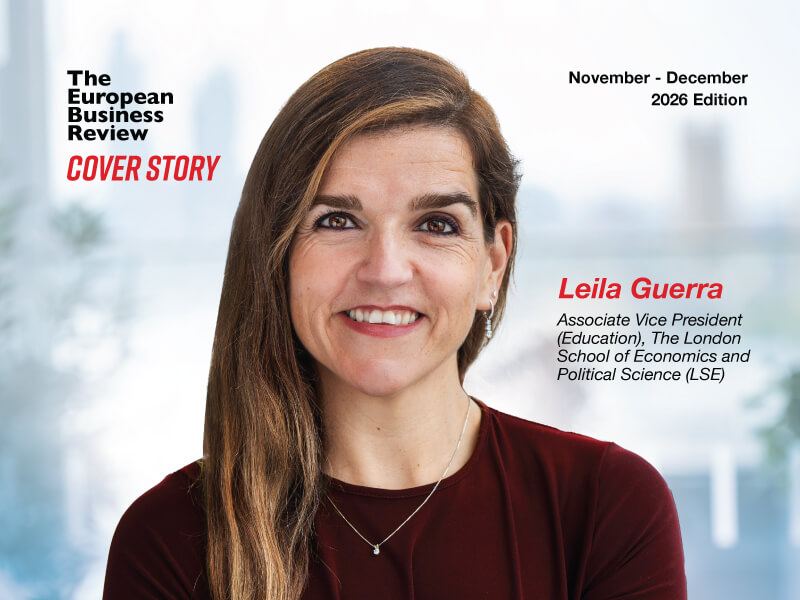
Leila Guerrais Associate Vice President (Education) at LSE, leading strategy across lifelong learning, executive education, executive master’s, AI innovation and online, non-degree programmes. She brings over 20 years of international leadership experience in higher education, most recently as Associate Provost (Digital Lifelong Learning) at Imperial College London and Vice Dean (Education) at Imperial Business School.
3. Staw, B. M. (1981). The escalation of commitment to a course of action. Academy of Management Review, 6(4), 577–587. https://doi.org/10.2307/2392337
5. Ad Hoc Committee on AI Use in Teaching, Learning, and Research Training. (2026). Report of MIT’s Ad Hoc Committee on AI Use in Teaching, Learning, and Research Training. Massachusetts Institute of Technology. https://aiandeducation.mit.edu/report/
The European Business Review uses cookies to improve site functionality, provide you with a better browsing experience, and to enable our partners to advertise to you. Detailed information on the use of cookies on this Site, and how you can decline them, is provided in our Privacy Policy and Terms and Conditions. By clicking on the accept button and using this Site, you consent to our Privacy Policy and Terms and Conditions. ACCEPT Reject
Privacy & Cookies Policy
Privacy Overview
This website uses cookies to improve your experience while you navigate through the website. Out of these cookies, the cookies that are categorized as necessary are stored on your browser as they are essential for the working of basic functionalities of the website. We also use third-party cookies that help us analyze and understand how you use this website. These cookies will be stored in your browser only with your consent. You also have the option to opt-out of these cookies. But opting out of some of these cookies may have an effect on your browsing experience.
Necessary cookies are absolutely essential for the website to function properly. This category only includes cookies that ensures basic functionalities and security features of the website. These cookies do not store any personal information.
Any cookies that may not be particularly necessary for the website to function and is used specifically to collect user personal data via analytics, ads, other embedded contents are termed as non-necessary cookies. It is mandatory to procure user consent prior to running these cookies on your website.