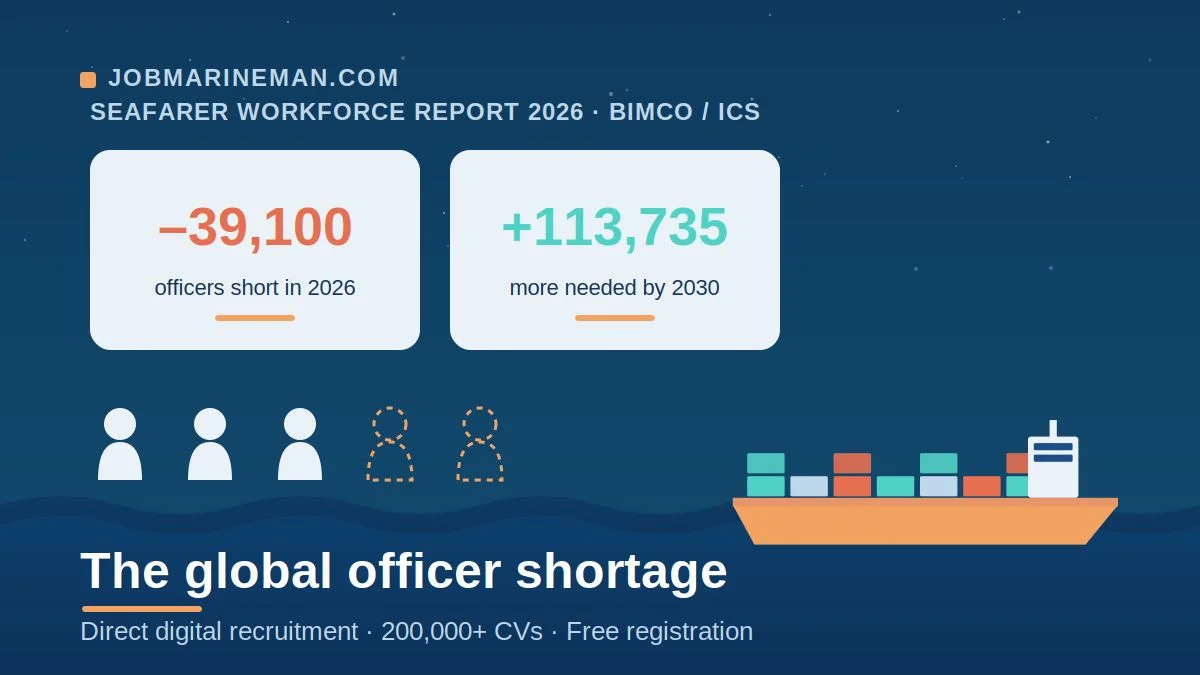
The Seafarer Workforce Report 2026, released this June by BIMCO and the International Chamber of Shipping, delivered an uncomfortable message to an industry that carries around 90% of world trade: the global fleet is already short 39,100 STCW-certified officers, and it will need almost 114,000 more by 2030 — roughly 22,700 new officers every year. We spoke with Pavel Manchenko, founder of Marine MAN, a Ship and Crew Management company with nearly two decades in the industry and operator of the crewing platform jobmarineman.com, about why the gap keeps widening and what technology can realistically do about it.
The BIMCO/ICS numbers made headlines across the maritime press. Did they surprise you?
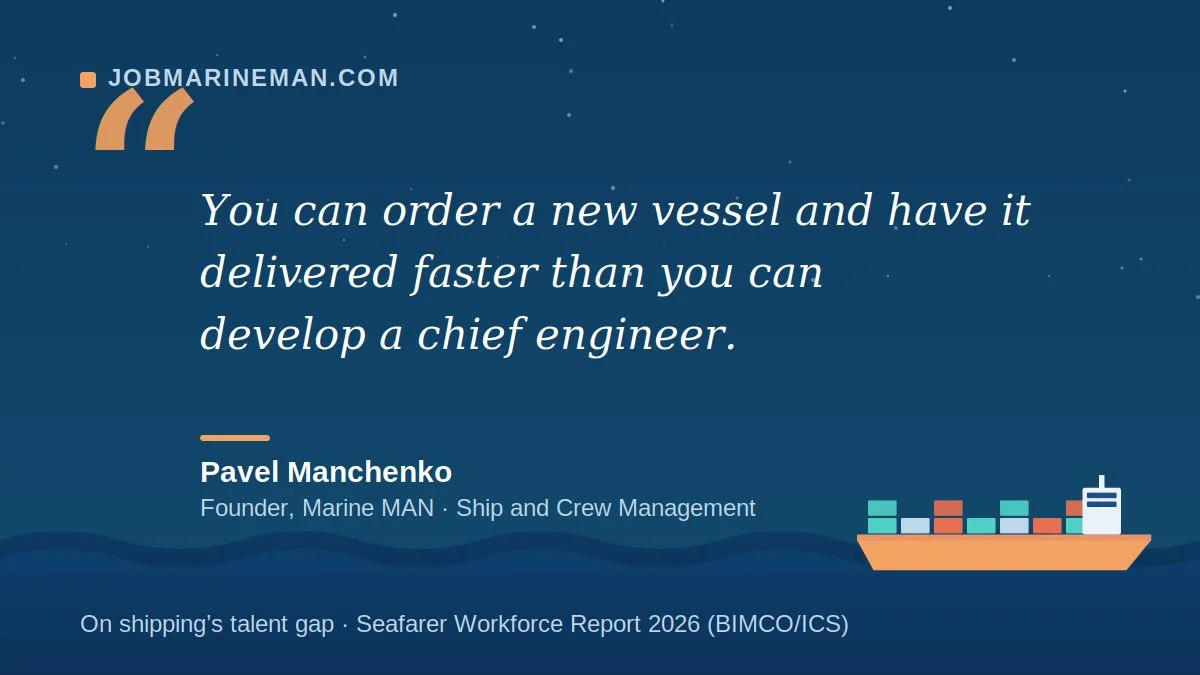
Honestly, no. Anyone who runs crewing operations has felt this coming for years. The fleet keeps growing — the report counts more than 85,000 merchant ships and 2.57 million seafarers — and demand for certified seafarers is up 35% compared to 2021. Meanwhile, training a competent officer takes years, not months. You can order a new vessel and have it delivered faster than you can develop a chief engineer. That mismatch is structural, and no single company can fix it alone.
The report calls for more training and better recruitment. You argue those are two different problems. Why?
Because they fail in different ways. Training is a pipeline problem — the industry needs more cadets, more academies, more sea-time berths, and the report is right about that. But recruitment is a matching problem. Even today, with a global shortage, we regularly see qualified officers sitting at home between contracts while shipowners a few thousand kilometres away struggle to fill exactly that rank. The candidate exists; the vacancy exists; they simply never meet, because the market still runs through chains of local agents. Training will take a decade to close the gap. Better matching can recover lost capacity immediately.
Tell us about Marine MAN. Where does your company sit in this picture?
We are a classic maritime services company at the core — crewing and Ship Management under one roof. On the vessel side that means technical operations, ISM, ISPS and MLC compliance, and insurance administration. On the people side, we handle the full employment cycle of a seafarer. Having both halves matters: when the same organisation manages the ship and supplies the crew, certificate gaps and failed crew changes become rare events rather than monthly emergencies.
And jobmarineman.com grew out of that operational work?
Exactly. We digitalised what we were already doing manually. For shipowners, the platform is a direct window into a database of roughly 200,000 seafarer CVs — they can filter by rank, certificates, vessel type and sea service, contact verified candidates within hours, and combine that with our managed Crew Management services if they want the full cycle handled: document verification, MLC-compliant contracts, payroll, flights, rotation planning. For companies that only need the search function, registration is free — we deliberately removed the entry barrier.
What does the platform change for seafarers themselves?
Independence, mostly. A seafarer creates one professional profile with their documents and sea service, and from that moment they are visible to employers worldwide instead of depending on a single agency in their home port. They can browse and apply to Maritime jobs across every rank and vessel type directly. The platform works in eleven languages, which sounds like a technical detail but is actually the whole point — a second engineer in Jakarta and a fleet manager in Rotterdam should not need a translator to find each other. And for seafarers, everything is free as well.
The report also stresses that decarbonisation and digitalisation demand new skills at sea. Does technology risk making the shortage worse before it makes it better?
In the short term, yes — every new fuel and every new system narrows the pool of people qualified to operate it. That is precisely why the industry cannot afford friction in recruitment. If the pool of LNG-experienced engineers is small, wasting weeks finding the ones who are available is a luxury nobody has. Transparent, searchable talent markets are how you squeeze the most out of a scarce workforce while the training pipeline catches up.
Where do you see the crewing market in five years?
More direct, more transparent, and more competitive for employers — which is good news for seafarers. Salaries and contract terms are becoming visible across borders, so companies that pay on time and plan rotations properly will win the talent war, and those that treat crewing as an afterthought will feel the 39,000-officer gap first. Our job at Marine MAN is to make sure our clients are in the first group.
Let’s discuss cooperation
Want to know how our team can help your business?
Contact us: [email protected]
Disclaimer: This article contains sponsored marketing content. It is intended for promotional purposes and should not be considered as an endorsement or recommendation by our website. Readers are encouraged to conduct their own research and exercise their own judgment before making any decisions based on the information provided in this article.