

By Dr Andrea Titus and Dr Juliet Bourke
AI is loudly reshaping work and quietly introducing equity challenges and opportunities – new research reveals inclusive leadership and AI need each other to operate optimally.
AI is reshaping work in ways often hard to see – reordering who has access to information, opportunity and voice. Yet many organisations treat AI and inclusion as separate challenges. We find the two are deeply intertwined, and identify four surprising ways this plays out – from emerging forms of digital privilege to leadership paradoxes – with practical guidance to adapt the six signature traits of inclusive leadership for AI-infused workplaces.
“I’m terrified…around leading this conversation,” a senior executive admitted – speaking about inclusive leadership in the age of AI.
Her concern reflects the stakes. As one diversity, equity and inclusion (DEI) leader puts it, “we’re talking about a period in history where a failure to think inclusively…could have very long-lasting consequences for different underrepresented groups.”
AI has “become something that everybody needs to engage with and understand,” a technology leader explained. Yet the conversation around AI capabilities remains disproportionately technical, centred on productivity and performance, overlooking subtle human impacts – how AI is reshaping behaviour, who gets heard and who gets ahead.
In this sense, AI presents both technological and inclusion-related challenges. And yet, these two conversations are still unfolding separately.
To understand whether and how these dynamics intersect, we interviewed fifteen global leaders across technology, HR and executive roles. This multi-lens approach was itself an act of inclusion.
What we found: in many cases AI and inclusive leadership are being dealt with in separate streams, but in fact are potentiated through each other. Far from diminishing the need for inclusive leadership, AI makes it more consequential and admittedly more complex. Our interviews revealed four ways AI and inclusive leaders can make each other better.
1. A foundational insight: Inclusive leaders make better AI leaders
Much of today’s conversation assumes that leadership in the age of AI requires new technical capabilities (e.g., prompt engineering, model awareness, automation design). These matter. But our research revealed something more fundamental and unexpected: the leaders most effective at navigating AI are often those practising inclusive leadership.
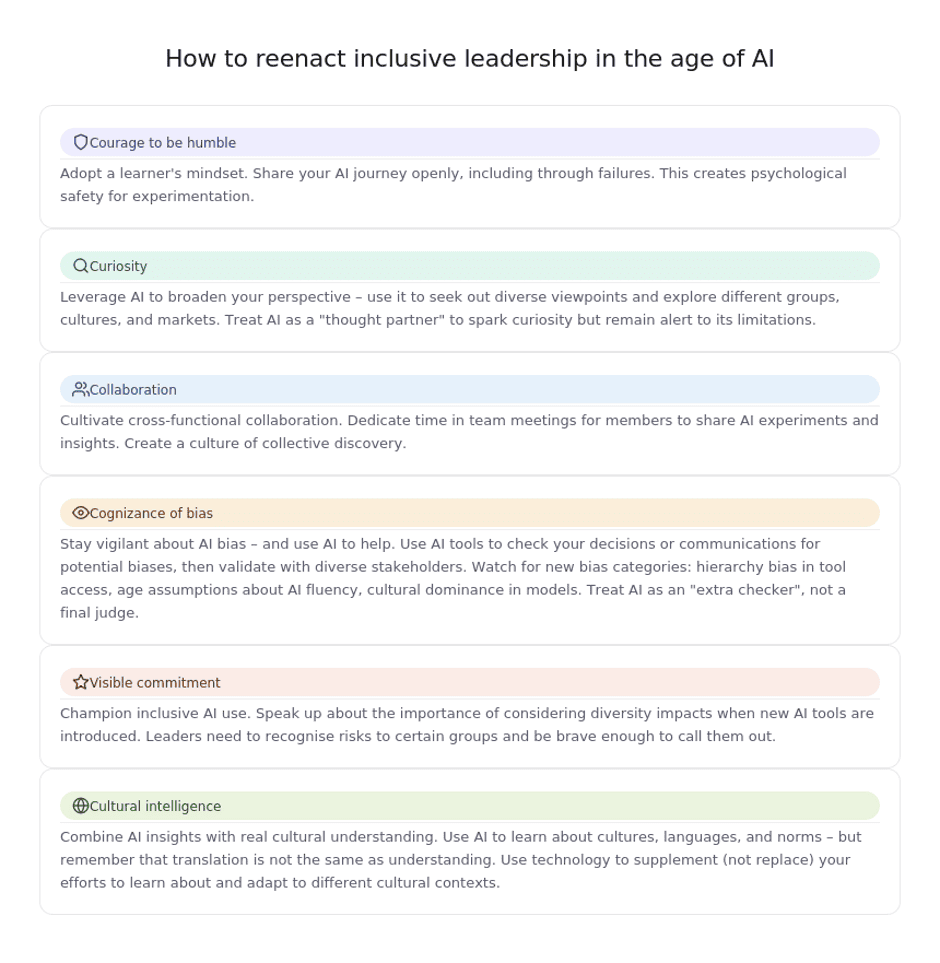
This aligns with the six signature traits model, first introduced in Harvard Business Review in 2019 and updated in 2020. All interviewees confirmed inclusive leadership behaviours still hold. What changes is how they show up in AI-infused workplaces. Three behaviours stood out:
- Humility, as leaders openly admit what they don’t know and create space for others to learn about AI alongside them.
- Curiosity, using AI not just for efficiency but to explore perspectives and test thinking.
- Collaboration, bringing together voices across functions. “You’re not just talking to engineers, you have to bring everyone along,” a technology leader emphasised.
Inclusive leadership isn’t being replaced by AI – it’s becoming the foundation for leading well in this era. The overlap creates a virtuous cycle: the behaviours that enable good AI adoption also strengthen inclusion, and vice versa.
2. A less visible impact: AI is reshaping advantage
While inclusive leadership behaviours still hold, the context in which they are enacted has shifted. Our research revealed something less visible: AI is creating new categories of advantage and disadvantage – what many leaders described as new forms of “digital privilege”.
Two-thirds of interviewees raised concerns about these emerging inequities that often go unnoticed. They cited hierarchy bias (e.g., senior leaders with premium AI tools while junior employees rely on free versions), age-based stereotypes (e.g., assumptions that younger employees are naturally more AI-savvy), language and cultural bias (e.g., models trained predominantly on North American English and Mandarin perform less well in other languages) and average-user optimisation (e.g., systems designed for typical use cases work less effectively for those on the margins).
“It really starts with like the digital divide…now we have the growing AI divide,” one technology leader explained. “[Even] if you do access [AI tools] do they work in the language you speak? Do they understand the cultural context in which you’re coming from? Likely no.”
Yet the picture isn’t one-sided. The same tools can also reduce barriers – translating for non-native speakers, reading aloud for dyslexic colleagues, opening technical roles to people without formal credentials. As one leader put it, “for some people [AI] will be a bigger game changer because they had more barriers to begin with.”
The implication is significant: both the negative and positive unintended consequences show that AI’s impact on inclusion isn’t predetermined. It is shaped by the everyday choices leaders make about who gets access, whose workflows are prioritised and whose needs the systems are designed around. Because these choices are embedded in defaults and routines, they compound quietly over time and are hard to detect, let alone correct.
3. The introduction of new paradoxes: Making difficult trade-offs as an inclusive leader
Yet even when leaders recognise paradoxes and conflicts, finding a pathway through using the lens of inclusive leadership is not straightforward. Leaders described a set of tensions that complicate inclusive leadership in practice.
- Time saved versus time lost. AI automates routine work, but that also raises productivity expectations. The result? Less time for the relational and emotional labour that inclusion requires. “When you are being squeezed really hard to do a lot and with very little resources, you may not feel like you have the space in yourself to do that emotional labour and cultivate cultural intelligence and…pay attention to everybody,” one leader explained.
- More communication versus less connection. AI can enhance communication through translation and accessibility tools, but it may displace human interaction. For example, while an avatar may help a leader to communicate with audiences in a different language, one senior executive noted that it could not replace her personal energy and presence on which human connection is based.
- Expanded insight versus diminished thinking. AI can be a powerful tool for perspective-taking, helping leaders quickly understand different viewpoints or research unfamiliar cultures. But it can also encourage what one leader called “lazy thinking” – outsourcing judgement rather than deepening it. “If this is a generation where we make AI do all the things, what happens in the next generation and do we lose our EQ? If we’re offloading all of those questions and conversations to AI, what does that mean for D&I?”
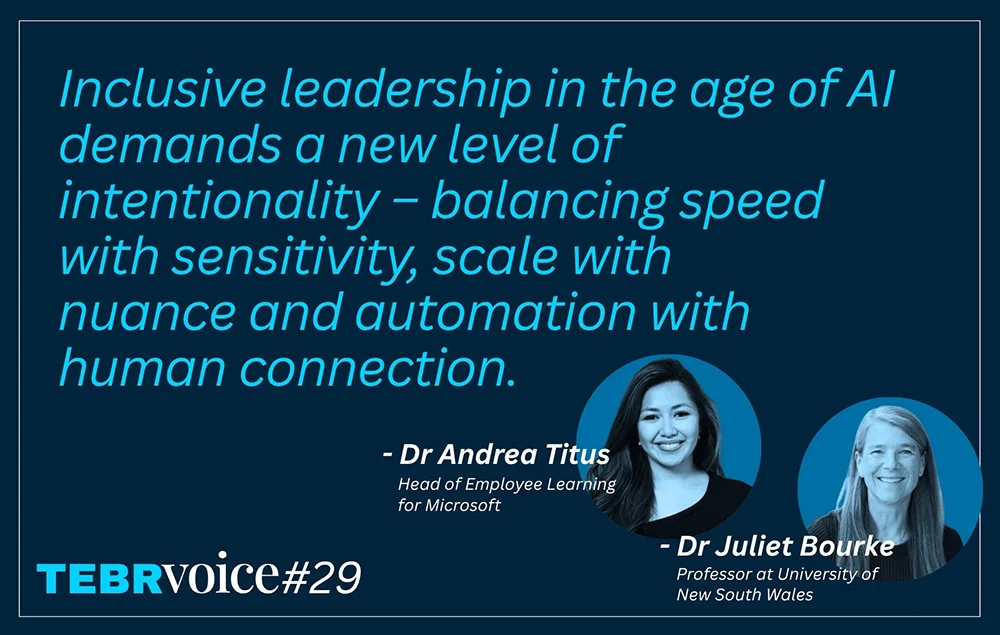
Inclusive leadership in the age of AI demands a new level of intentionality – balancing speed with sensitivity, scale with nuance and automation with human connection.
4. A systemic shift: From interpersonal to infrastructural inclusion
What sits beneath these tensions is a deeper shift. Historically, inclusive leadership has been understood as interpersonal – emerging through dyadic and small-group interactions. AI changes the scope.
Because AI operates at scale, leaders now shape not just individual experiences but entire systems – how decisions are made, how work is distributed and who has access to opportunity. This reflects a shift: from interpersonal to infrastructural inclusion.
In practice, this means asking different questions: who decides which AI tools get deployed and whose voices shape those decisions? Who has access – and is it equitable? Are we building AI fluency across the organisation, or creating a two-tier workforce? Whose data and perspectives are reflected in the systems themselves?
It raises the bar. Leaders must now operate on both levels simultaneously: cultivating inclusion in their teams while shaping the systems that determine inclusion at scale.
What managers should do now: Recalibrating inclusive leadership in the age of AI
If AI is reshaping advantage, straining leadership capacity and operating at scale, then inclusive leadership must be practised differently. The good news? The six signature traits of inclusive leadership remain a compass. What has changed is how they need to be applied.
Conclusion
The executive who told us she was “terrified” was onto something. AI is already reshaping who has access to information, opportunity and voice. That is where inclusive leadership becomes critical.
The surprises we uncovered – new forms of digital privilege, unintended upsides, leadership tensions and the shift from interpersonal to infrastructural inclusion – point to a clear takeaway: AI and inclusive leadership are inextricably linked. Inclusive leadership is not peripheral to AI strategy, but central to equitable AI adoption. Similarly, AI is redefining how inclusion must be practised. Without one, the other falls short.
 Dr Andrea Titus
 Dr Juliet Bourke