
By Avi Liran
While WFH was almost entirely introduced as a reaction to a crisis, for many companies, it might just be a silver lining.
One well-known UK insurance company used to have the slogan, “We won’t make a drama out of a crisis.” Perhaps, in the VUCA times in which we’re living today, all companies need to consider making an advantage out of a consequence of a crisis. As Avi Liran explains, there are solid commercial benefits to be reaped by leveraging work-from-home.
EU Energy Commissioner Dan Jørgensen has urged the EU’s 27 member states to adopt the International Energy Agency’s 10-point plan, which puts Work from Home (WFH) at the top of the list of demand-reduction tools. With oil prices up around 60 per cent and gas around 70 per cent since the start of the conflict, the Commissioner has warned that “even if peace is here tomorrow, we will not go back to normal in a foreseeable future.”
So far, European governments have leaned mainly on budget measures, fuel and electricity support, public guidance, and voluntary demand reduction.
European unions (EPSU), sensing the inevitable, criticised the Commission for pushing WFH without enforcing the “Right to Disconnect.” They argue that if WFH is mandated for energy security, the employer must still bear the costs and respect working hours.
They argue that if WFH is mandated for energy security, the employer must still bear the costs and respect working hours.
At the same time, at least four governments across Southeast Asia have done in a matter of days what HR teams have been debating for years. Triggered by the Strait of Hormuz disruption, Thailand, Vietnam, Indonesia, and the Philippines all issued directives promoting flexible work within days of the crisis breaking.
In Asia, nobody conducted an engagement survey. The choice was made by economic necessity. The companies thriving on both continents are not waiting for a government signal. They built the infrastructure, leadership habits, and trust for hybrid work before it became an emergency response.
Some Asian companies are ready
DBS Bank, named World’s Best Bank by Euromoney in 2025 for the third time, established a permanent policy giving all 41,000 employees the right to work remotely up to 40 per cent of the time. The bank actively redesigned its offices into hot desks and activity-based environments designed with employee input.

Fujitsu moved most of their 80,000 employees to primarily remote work, cut its office inventory by half, and rebuilt what remained as functional hubs. Fujitsu introduced structured in-person touchpoints for senior-junior interaction.
Trip.com, China’s largest online travel platform, has had a “2-3” hybrid model since 2022. A randomised controlled trial with 1,600 employees found that hybrid employees were as productive as office-based peers, equally likely to be promoted, and resignations fell by 33 per cent.
The companies thriving on both continents built the infrastructure, leadership habits, and trust for hybrid work before it became an emergency response.
Some European companies are ready, too
Spotify launched its Work From Anywhere model in February 2021. Attrition dropped 15 per cent compared to 2019. Time-to-hire fell from 48 to 42 days. The policy gives every employee a genuine annual choice: home-first, office-first, or hybrid.
Spotify still holds an annual Core Week for in-person collaboration, and every November the entire organisation disconnects for a mandatory Wellness Week. When employers began mandating five-day office returns, Spotify held firm.

“You cannot spend a lot of time hiring grown-ups and then treat them like children.” — Katarina Berg, CHRO, Spotify
Siemens moved even earlier. In 2020, the company permanently gave over 140,000 employees across 43 countries the ability to work from wherever they are most productive, averaging two to three days away from the office each week.
“We trust our employees and empower them to shape their work themselves. Leadership focuses on outcomes rather than on time spent at the office.” — Roland Busch, CEO, Siemens
Siemens has since joined the World Wellbeing Movement, embedding employee wellbeing as a strategic commitment alongside financial performance.
Europe’s scale-ups: flexibility and performance together
The argument that flexibility and financial performance are in tension looks increasingly weak in Europe’s fastest-growing technology companies.
Vinted, the Lithuanian second-hand fashion marketplace now active in 26 European markets, reported 2025 revenue of €1.1 billion, up 38 per cent year-on-year, with gross marketplace value up 47 per cent to €10.8 billion and net profit of €62 million.
Vinted’s employees consistently cite hybrid working and “workation” as named benefits. The working model is team-led rather than centrally dictated, with each team setting its own rhythm based on the work at hand.
Revolut, the London-based fintech now valued at around €65 billion after a November 2025 secondary sale, reported record 2025 pre-tax profit of €2 billion on revenue of €5.2 billion, up 57 per cent year-on-year, with a retail customer base of 68.3 million.
While JPMorgan was ordering all 317,000 of its employees back to five-day office attendance, Revolut publicly doubled down on flexible working. With 239 of 273 open roles available remotely and a globally distributed workforce, Revolut treats location flexibility as a talent strategy, not a concession. The office is being redesigned as an optional hub for collaboration, not a mandatory attendance requirement. Both banks posted record profits the same year. The market, it turns out, has no strong opinion on where the work happens.
The infrastructure Revolut built to hire anywhere became a revenue line of its own. A talent strategy that funds itself.
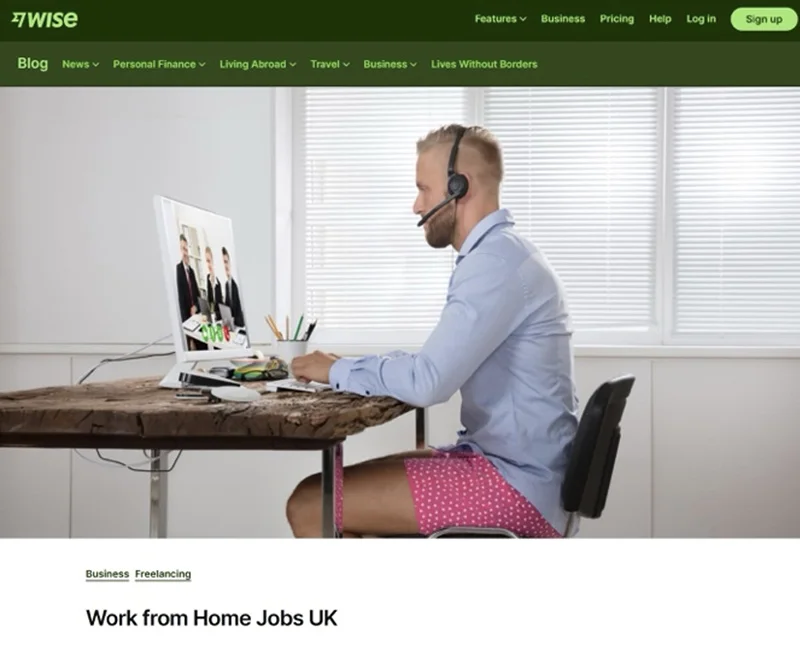
Wise, the cross-border payments company listed on the London Stock Exchange, posted a profit before tax of €650 million in FY2025 (up 17 per cent on FY2024), serving 15.6 million customers across 160+ currencies.
Wise operates a “Mobile Wiser” scheme allowing most employees to work virtually from almost anywhere in the world for up to 90 days a year after their first six months.
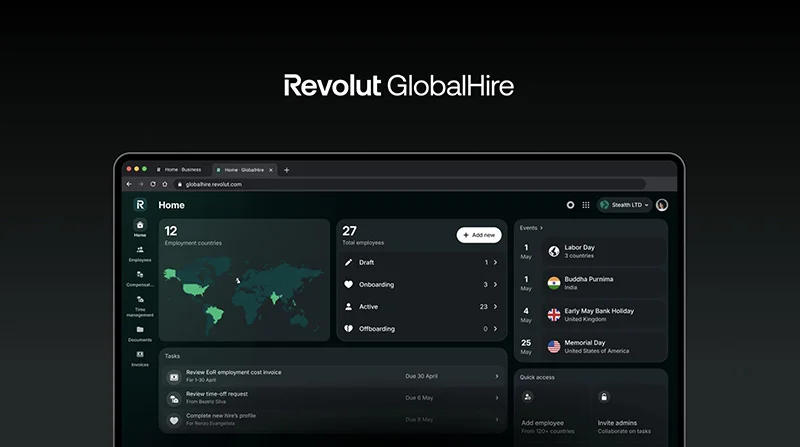
Revolut turned its own distributed-workforce model into a product line. After building an internal HR platform to scale from 250 to 10,000 employees across 60+ countries, the company opened it up to other businesses as Revolut People in December 2023. In 2026 it extended the stack with GlobalHire, an Employer of Record service covering 160+ countries, with local contracts, payroll, compliance, and FX payments handled by Revolut’s partners at interbank rates.
Artem Ivanenko, Head of Global Learning at inDrive and previously in the same role in Learning & Development at Revolut, describes the strategic logic.

“Revolut is a digital bank, and they also have a management that they built internally and now sell. Part of the system is a service that allows different companies to hire people anywhere, and Revolut takes care of all the digital paperwork: contracts, salaries, compliance. Revolut is a fully remote company. They have an office in London. They opened new offices recently, for example in Barcelona. They are remote first. Now they productized their employee performance and HR model and sell it as a product to other companies.” ~ Artem Ivanenko, Head of Global Learning, inDrive
In-person time is structured deliberately around onboarding, one-to-one meetings, company-wide calls, and Mission Days: cross-team gatherings designed for connection and learning. Culture transfer is treated as a design problem, not something that resolves itself if people sit near each other.
Monzo the UK digital bank that reported adjusted pre-tax profit of €131 million for FY2025, an eightfold jump on the prior year, with revenue of €1.4 billion and 12 million customers, has built one of the most remote-friendly cultures in European financial services. Employees describe it as one of the last truly remote-friendly companies in the industry, where they are trusted to get on with their work from anywhere, but given regular opportunities to connect in person. Every other Friday is a company-wide remote day regardless of role or location. The bank treats in-person time as a deliberate investment in connection, not a default requirement.
Why European scale-ups need hire-from-anywhere to win
Europe is home to a growing number of unicorns and fast-scaling tech companies. For these scale-ups, the talent pool that matters is global. A hire-from-anywhere or hybrid-first policy turns into a direct selling point to engineering, product, and design candidates in markets where local salary offers cannot compete with Silicon Valley.
Artem Ivanenko, Head of Global Learning at inDrive with prior leadership experience at Revolut, Uber, Apple, and Microsoft, puts the point plainly.
A uniform office mandate would have shrunk the candidate pool and lengthened time-to-hire at the exact moment they were trying to outpace incumbents.
“There are lots of unicorns in Europe and they are expanding, they are scaling. For them to win global markets, they really need to embrace hire-from-anywhere policies, be it hybrid work or fully remote work, because we do need access to talents across the globe. That might be the key selling point for HR, especially in tech scale-ups or any kind of startups and scale-ups.” ~ Artem Ivanenko, Head of Global Learning, inDrive Vinted, Revolut, Wise, and Monzo all grew into category leaders while hiring across borders. A uniform office mandate would have shrunk the candidate pool and lengthened time-to-hire at the exact moment they were trying to outpace incumbents. Location flexibility is the force multiplier that lets a European scale-up compete on talent with any company in the world.
The personal development dilemma
One of the biggest concerns about flexible work is that junior employees miss informal development. Here is how these companies solve it in their own ways.
DBS Bank weaves career development into the infrastructure of its hybrid model from day one. The bank launched structured learning continuums for specific skills, created an AI-powered internal platform that recommends personalised development paths, and committed to upskilling more than 5,000 employees in data, digital, and leadership skills.
Fujitsu reinvested in remaining offices specifically to serve the functions that remote work cannot. Training programmes and new employee onboarding were moved into the office. Offices became places where diverse employees gather, learn, and connect, with the explicit goal of creating conditions for cross-generational exposure.
Trip.com‘s Jennifer Cao and her team structured in-office days around collaboration, mentoring, learning, and team interaction, and protected remote days for focused individual work. A January 2026 analysis cited Trip.com’s randomised trial as the strongest available evidence that hybrid employees show no difference across nine performance review categories including leadership, development, and innovation, with equal promotion rates.
Wise builds culture transfer into the working model directly. Onboarding always has an in-person element. Mission Days bring cross-functional teams together with a specific purpose. The assumption is that culture does not transfer by accident in a distributed organisation. It has to be designed.
Spotify‘s Core Week model offers a parallel: one week per year of intentional in-person gathering, chosen by each team. Showing up becomes meaningful rather than mandatory.
The business case: What the data says
A 2025 Cisco study found that 69 per cent of managers say hybrid work positively influenced their teams’ productivity. In 2024, Cisco found that 94 per cent of hybrid workers report being equally or more productive than in full-time office settings.
A University of Pittsburgh study by Mark Ma and Yuye Ding, tracking three million tech and finance employees across 54 S&P 500 firms, found that RTO mandates trigger a 14 per cent jump in turnover, with female employees nearly three times more likely to leave than male colleagues. The employees most likely to leave are also the employees the company can least afford to lose.
What European HR leaders are seeing
The data points in one direction. The reality inside many organisations points in another.
Larissa Murmann, VP Global Commercial People at Werfen and former Digital CHRO at Unilever International, has worked across the US, Latin America, Asia, and Europe.
In her own career across industries, Larissa has seen full flexibility erode performance where trust was thin; she has also seen that mandatory office returns produce the same result.
For her, the issue is responsibility, not location. A mature employee knows how, when, and where to perform. The real HR question is whether leaders can manage for outcomes rather than presence. She makes three points.
1. Culture maturity determines WFH readiness.
“Allowing employees to work 100 percent from home requires that you have reached a culture maturity where you inherently trust your people to do their best from wherever they are.”
Larissa speaks for herself with the same candour.

“I work better from home as I am an introvert. For me to be productive I need focus time. I prefer to balance when being at home and when going to the office. There are days you need to be present, you need to join meetings face-to-face to create relationships, and you need to see your team to build trust. I don’t necessarily need an organisation to tell me that. I know as a responsible employee how I can unlock high performance and deliver my objectives.” ~ Larissa Murmann.”
2. The mindset at the top sets the policy for everyone.
“If the top leader prefers to be all the time in the office and feels that leadership and work can only get done when employees sit next to them, they translate this to the rest of the organisation.
You need to find the right formula for your company and to influence leadership mindsets, because not everyone works and performs in the same way.”
3. Location is not the root cause of performance.
Larissa points to companies where full flexibility caused performance to drift, and to others where forcing everyone back to the office did not fix the problem either.
“I had employees which we asked to come back to the office to increase performance. In most cases location was not the root cause.”
The implication is direct: the conversation should not be about where people sit. It should be about whether leaders can manage for outcomes rather than presence.
When AI decides your WFH eligibility
One of the most forward-looking models shared on the HR conference circuit comes from Abu Dhabi Customs, which won Best Employer of the Year at the CIPD Middle East People Awards 2025. Under the leadership of Dr. Ebrahim AlKhajeh, Division Director of Human Capital, the organisation has built what Oracle has recognised as the first AI-driven HR transformation of its kind in the Middle East and worldwide.
Dr. AlKhajeh has described a model in which three factors determine an employee’s remote work eligibility in real time: engagement, mental and physical wellbeing, and performance. When all three scores are high, an employee can work 100 per cent from home if their role allows it. When any one factor drops, the system flags a return to the office. The driver is not punishment. It is support.
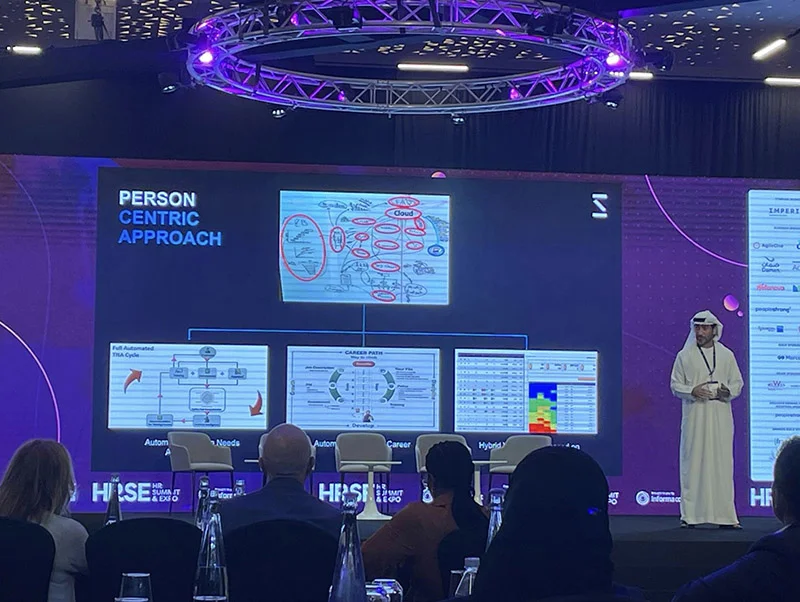
Some people unlock their highest performance from home. Others do better with the energy and structure of an office. A one-size-fits-all policy serves neither. An AI-driven model that treats each employee as an individual is one answer to the personalisation problem that rigid hybrid mandates struggles to solve.
This approach requires something that most organisations are not yet ready for: continuous, trusted measurement of employee well-being and engagement, not as a surveillance tool, but as a genuine signal for when someone needs support, connection, or a change of environment.
This approach requires continuous, trusted measurement of employee wellbeing and engagement – not as surveillance, but as a genuine signal for when someone needs support, connection, or a change of environment.
What HR leaders can do now
The current energy crisis is a stress test that your hybrid policy either passes or fails. Six actions will help HR leaders build better before the next disruption arrives.
OPERATIONAL RESILIENCE
- Audit your work by task, not by title. Map which activities require physical presence: mentoring, onboarding, creative sprints. Map whichrequire deep focus: analysis, writing, coding. Design your schedule around needs, not habits.
- Make in-office days purposeful. Follow the Trip.com model: reserve office days for collaboration, mentoring, and cross-generational connection. When employees understand why they are coming in, attendance becomes consistent.
CULTURAL INFRASTRUCTURE
- Redesign the office as a destination. Spotify, Fujitsu, and Wise alldemonstrate that the office needs to earn attention. It has to do the work that only the office can do and do it visibly. Vinted and Monzo treat in-person time as a deliberate investment, not a default requirement.
- Build visibility structures for remote employees. Counter the proximity bias that disadvantages remote workers with outcome-based performance reviews and deliberate nominations of remote talent for leadership opportunities.
STRATEGIC CONTINUITY
- Educate leaders before you build policy.As Larissa Murmann points out, a hybrid model fails when the top leader’s personal preference overrides organisational strategy. Leadership development must include working-model fluency: managing for outcomes, spotting performance issues that are not location-related, and leading teams whose members work differently.
- Write a standalone hybrid policy today. Treat it as a continuity document. During a supply shock, travel restriction, or health emergency,organisations with this in place did not miss a beat in March 2026.
The Strait of Hormuz will eventually reopen and hopefully peace will come. But the pandemic taught us that the next crisis will not announce itself.
Most HR transformations come from the C-suite, not from HR, which means that the current moment gives HR leaders a strategic window to redesign a work model that serves the business and survives the next disruption.
The lessons from DBS, Fujitsu, Trip.com, Spotify, Siemens, Vinted, Revolut, Wise, and Monzo point in the same direction. A hybrid model built on trust, designed with intention, and tested before the emergency gives leadership the culture levers and employees the flexibility they need.
Abu Dhabi Customs is now measuring individual readiness with AI. Asia governments learned flexibility under fire. Asia’s and Europe’s best companies chose it by design.
The question for HR leaders in every region is the same: will you choose to experiment, measure and adjust your hybrid strategy now, or wait for the next crisis to decide for you?