

By Guilherme F. Frederico
In recent years, the supply chain sector has been up against more and greater challenges than in perhaps any other period in the history of modern commerce. What attributes does a person need in order to be an effective supply chain leader in such an environment?
In today’s challenging times for supply chains, leadership plays a crucial role in successful supply chain management. Supply chain leaders need to develop some key characteristics which are aligned to the current context of the advancement of supply chain 4.0 and 5.0, constant disruptions from wars, the imposition of tariffs, climate disasters, and the demand for global sustainability.
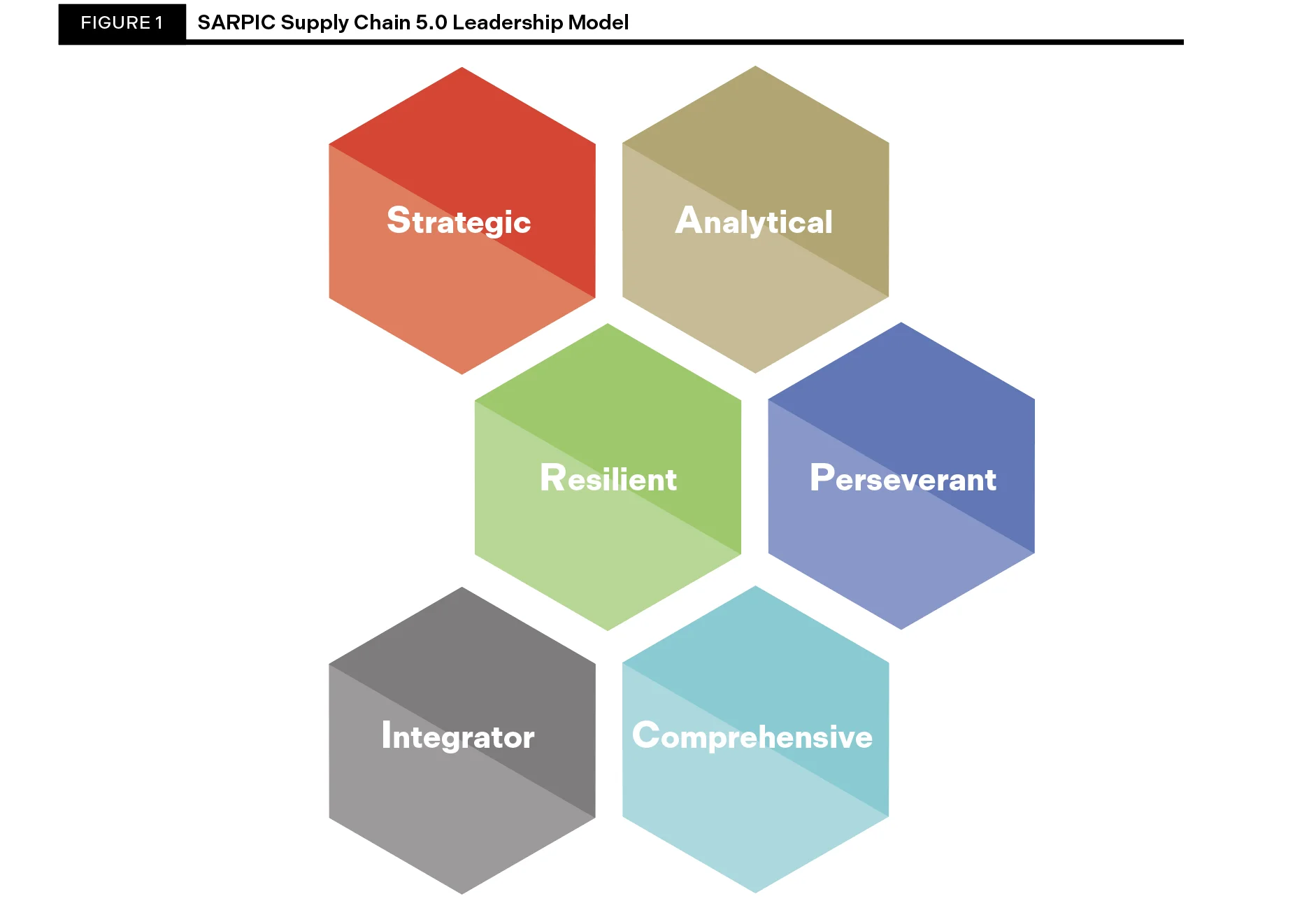
This article presents six main characteristics that should be pursued by today’s supply chain leaders to overcome these contextual challenges for supply chains. Here, we refer to this six-dimensional leadership framework for supply chains as the SARPIC Supply Chain 5.0 Leadership Model: Strategic, Analytical, Resilient, Perseverant, Integrator, and Comprehensive.
Strategic
Strategically oriented supply chain leaders are those capable of planning and managing supply chains by seeking high performance throughout their supply chain capabilities, as well as generating competitive advantage from supply chain operations. Even with the challenging obstacles surfacing in today’s supply chains, strong leaders must keep their focus on the strategic goals and be able to extract the best potential from supply chain resources (e.g., physical, technological, and human). Moreover, strategic leaders in supply chains should be able to explore the current and emergent themes like artificial intelligence and other disruptive technologies, and of showing the resilience and sustainability in order to be ahead and optimally positioned in the market. More than just implementing and following these trends, they must seek opportunities to make these elements part of their supply chains’ core competences.

Analytical
The advent of Supply Chain 4.0 and the trend of Supply Chain 5.0 have brought opportunities to enhance the performance of supply chains. However, operating both virtual (e.g., big-data analytics, artificial intelligence) and physical (e.g., robotics, 3D-printing, drones) technologies demands new analytical and technological knowledge. Supply chain leaders, who are directly involved in the decision-making process at strategic, tactical and operational levels, must be able to lead by considering the implementation and potential exploration of cutting-edge virtual technologies. These technologies are essential in order to enhance the assertiveness of supply chain planning, visibility, and transparency across supply chain flows, for example showing on-time status and performance, and represent a crucial tool to support rapid decision-making based on data in the constantly changing and challenging environment that supply chains are facing. Also, advanced physical technologies are crucial to enhance productivity and add value to supply chain operations, and modern leaders must be aligned with the opportunities they offer.
Resilient
Recent years have been marked by constant disruptive events, especially after the COVID-19 pandemic. Geopolitical tensions generated by the imposition of tariffs and wars, climate, events and economic issues have created a constant environment of uncertainty for supply chain leadership and staff. Supply chain leaders are required to have resilience-driven thinking, and be able to anticipate impactful events and adequately prepare their supply chains to react against their effects. In this context, developing risk management skills is crucial for successful management. But, besides bringing resilience for supply chains, they should be resilient themselves as the captains of a set of operations in the midst of an environment of turbulence. This means withstanding pressure and dealing with uncertainty by adapting and making assertive and thoughtful decisions on the path to achieving the established strategic goals.
Perseverant
More than being resilient, supply chain leaders must be perseverant. This requires supply chain leaders to keep their team motivated and oriented towards pursuing the desired results, even in unfavourable times. In this dimension, leaders must have determination, emotional intelligence, patience, and persistence. While resilience involves more technical and management abilities, perseverance is much more related to emotional and behavioural skills, although they are intrinsically linked.
Integrator
Especially from the supply chain management standpoint, this is one of the most essential elements for a modern supply chain leader. Supply chains involve different parties being connected, and in order to be successful in their decision-making process and actions, supply chain leaders must be able to engage different stakeholders such as the internal functional areas of organizations, first- and second-tier suppliers, dealers, customers, and third-parties, among others. Therefore, the leader should be capable of aligning different demands and perspectives on the path to achieving planned goals. This is most necessary in processes like S&OP, contingency plans in disturbance events, and activities of strategic initiatives like supply chain programs and projects. To be a good integrator, supply chain leaders must develop skills like effective communication, conflict and meeting management, negotiation, and a collaborative attitude.
Comprehensive
In a globalized world, supply chain leaders are required to understand different cultures and national characteristics to effectively manage supply chain processes.
Being comprehensive is a crucial characteristic for a successful leader in supply chains. First, supply chain leaders must have not only a broad knowledge of central areas of supply chains (e.g., procurement, manufacturing, logistics) but also of areas with a high degree of interface like finance, human resources, information technology, marketing, and research and development. Also, besides developing the domain of the specific disciplines of supply chain management (e.g., purchasing and procurement, demand forecasting, transportation management, inventory management, manufacturing management, capacity and localization design, reverse logistics), it is paramount that supply chain leaders develop competences in other related management areas like project management, risk management, accounting and financial, people management, product development, and sustainability management. In a globalized world, supply chain leaders are required to understand different cultures and national characteristics to effectively manage supply chain processes. Also, it is important that leaders be aware of what is contextually happening in the environments where supply chains are involved and consider these aspects in their management and decision-making processes. Supply chain leaders must be able to lead with all the aforementioned characteristics in a holistic perspective by integrating all of them in their actions and initiatives.
Conclusion
Supply chain leaders have never before been challenged as in current times. This is certainly an era of revolution for operations and supply chains, and strong leadership skills are required in order to overcome the current and upcoming issues to be faced by supply chain leadership.
This article proposes six crucial dimensions and their characteristics, structured in a model called the SARPIC Supply Chain 5.0 Leadership Model (figure 1), that should be pursued by leaders currently involved in supply chain management across the world. It is important to emphasize that these dimensions are related to each other and should be viewed from a system perspective, considering that they complement each other.
Although some leaders might be more familiar and skilled with some of these six dimensions than others, it is important to develop all of them to achieve a modern and successful supply chain leadership. Despite all the technologies, tools, and methods that may be embedded in supply chains, they can be only be appropriately exploited and explored by an effective leadership.