
By Michael Provitera and Mostafa Sayyadi
Lee Iacocca is famed for turning round the fortunes of ailing car giant Chrysler. It was not a mission for the faint-hearted, but Iacocca was undaunted. Undoubtedly, there is much to learn by examining the detailed processes leading to his success.
Introduction
Lee Iacocca was admired and trusted by people, as he saved the Chrysler Corporation from seemingly insurmountable challenges. Like many corporate leaders, Iacocca was an engineer by trade and a leader at heart. In 1994, one year after he retired from the chairmanship of Chrysler, it was revealed that he was the first choice in a poll of the five most admired leaders. Bill Gates was ranked second. As a veteran of the automotive industry, Iacocca is the leader that saved Chrysler from bankruptcy. Fired once in his career by Henry Ford, Iacocca made a remarkable comeback. Iacocca’s leadership story at Chrysler Corporation can provide very important and critical lessons for CEOs across the globe.
Something Has to Change
On November 2, 1978, the Detroit Free Press ran two big headlines: the first, “Chrysler in the Valley of Loss,” and the second, “Lee Iacocca joins Chrysler.” A savior was born. On his arrival, Iacocca was struck by the haphazard aspect of CEO John J. Riccardo’s office, and he immediately understood why Chrysler was on the brink of failure – no order. Besides the fact that Riccardo needed discipline, the CEO’s assistant spent most of the time preoccupied with personal matters. Many CEOs rely on the organizational skills of the office administrator. Thus, change was inevitable.
Iacocca’s main concern was the belief that Chrysler was not run like a company working together. 1 2 No diversity of insight from cross-functional steering teams.3 Chrysler was made up of several small silos, each of which had a separate leader for self-improvement, none of whom cared what the others were doing.4 5 Among these silos, which were driven by a male-dominated industry, there were a number that exceeded efficiency, with 35 viceroys, each managing their own business units. Iacocca, said to the group of reporters, “Poppycock.” He could not imagine how disconnected the corporation was until he interestingly noticed that the silos caused not only conflict but warfare. He noticed that the head of the engineering department was out of touch with the head of the production department.

In the war room, he lashed out by indicating that this had to end, or Chrysler would not exist. Iacocca mentioned Newton’s law which states that for every action, there is an equal and opposite reaction. Garbage in, garbage out, and these silos were working in a vacuum. Poor organizational capital existed in which one person managed both the sales and production departments. This led to a lack of social capital leading to poor links of productivity between these two departments. No one at Chrysler understood that a large company could not be run without the coordination of human capital. Thus, Iacocca began to establish the tangible elements of true competitive advantage while focusing on the financial recovery, which lacked luster due to weak management and lack of coordination. Iacocca explained:
Within two months of my presence at Chrysler, something like an avalanche hit me. It seems that the company’s cash cow (a Boston Consulting Group term from the matrix of Star product, Dogs, and Cash Cow products) had hit the bottom of the pot. Little by little, I realized that Chrysler basically has no systems to control the financial flow. Worst of all, no one knew much about financial planning and there were no answers to even the simplest financial questions. After I was elected as the chairman of the board of directors, I slowly evaluated each position of the board memberx. Of course, Chrysler’s problems were not limited to senior managers. People in all ranks were intimidated and isolated. All the managers knew that I had gone to Chrysler to shake the house, so everyone was afraid that the goal would come true. They were right. Within three years, I had to fire 33 out of 35 executives.
It was not enough; incompetence is a cancer that draws attention to the problems and not the solutions. As Frederick Winslow Taylor put it at the turn of the 19th century, soldiering is real and right in your own backyard. The incompetent manager hides behind the team’s weakness. Iacocca did not try to find solutions to the problems riddled within the organization; Iacocca was the solution. Iacocca said:
All of Chrysler’s problems ended at one point. The reason was that no one knew who to answer. There were no teams at work. There were only a handful of single players. Of course, these problems did not arise overnight. For years, the reputation of Chrysler had been tarnished in the circle of Detroit automakers, and everyone who drove a car in that town hated Chrysler. With such a situation, it was not surprising that people’s morale was very low. When the morale is low, the work environment becomes like still. Problems leaked to the press like water. The press
is interested in industrial espionage, especially in the automotive industry. In Chrysler, you could see traces of bad morale and holes in the information system in the company’s balance sheet. At a time when other car companies were making the most profit in their history, Chrysler was having such problems.
Lee Iacocca’s Key Leadership Actions
Chrysler’s share of the domestic market and customer loyalty had decreased. The Chrysler car was a little boring in the eyes of the people because it lacked panache. Innovation was missing. Iacocca noticed that Chrysler had a long history of innovation that had been untapped. 6 Chrysler cars had an antique look and feel, while its drivers were getting younger and richer. Of course, it was not only the appearance of Chrysler cars that was infamous. In terms of quality, Chrysler was also facing many difficulties, such as limitations in miles per gallon and luxury. Iacocca went to work quickly; he appealed to the stakeholders. He said:
To my horror, I found out that no orders were coming in and there also was no place to accept new cars.
Executive leadership actions were needed:
In the summer of 1979, when the Chrysler company asked for help from the government for the first time, more than eighty thousand cars were ready for sale in the treasury (parking lots) of the company. There came a time when this figure reached one hundred thousand devices. In order to prevent excessive stockpiling of cars, at the end of every month, people in every region would auction Chrysler cars at a cheap price. At Chrysler, setting and placing fire under people’s wallets had become a daily routine. People spent their money and Chrysler began to see a kernel of hope.
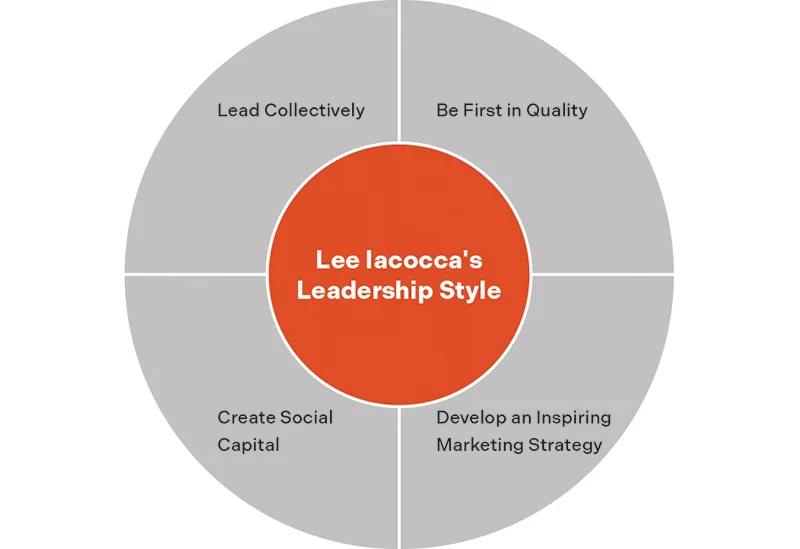
Executive Leadership Action One: Chrysler was led collectively.
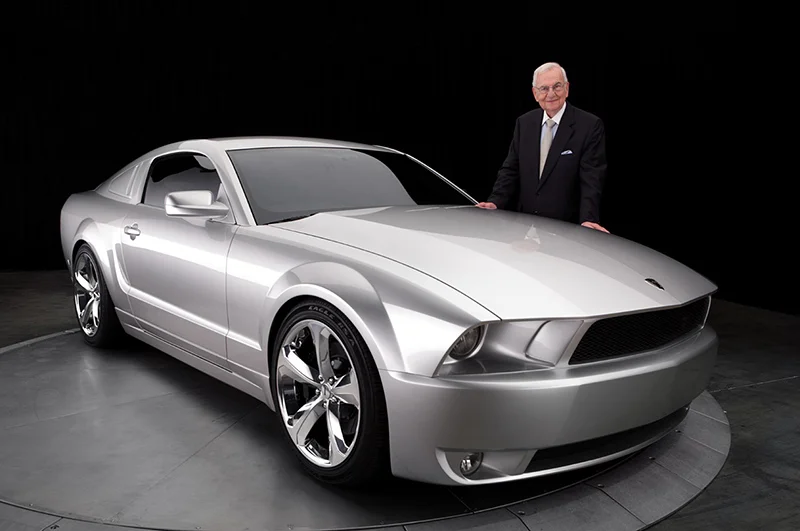
Iacocca had been baptized with the name Lido, but made the decision to call himself “Lee.” In 1980, he became a household name in America for reviving the Chrysler Corporation as its CEO. He was president of Chrysler from 1978 to 1991 and chairman and CEO from 1979 until his retirement at the end of 1992. He was one of the few executives to preside over the operations of two of the United States’ Big Three automakers. He believed that collective leadership and people’s togetherness were vital in order to reduce problems and achieve success. 7 An initiation formulated during the Harthorne studies which first coined the phrase “Human Relations.” He believed:
After the approval of the loan guarantee bill from the U.S. Government, if we had fought tooth and nail, we might have survived. We had to fight separately. Our mission was to fight but on the production front. It is true that no one was killed for Chrysler, but the economic life of hundreds of thousands of people depended on this battle. I started to sacrifice myself. I reduced my salary to one dollar a year.
Iacocca left a new mark of collective leadership. Iacocca believed in showing someone something, working with them for a while, watching them do it alone, letting them do it alone, and then getting them to teach someone else the same way. He argued that when you are in a leadership position, people follow you. When the leader speaks, the followers listen, and when the leader acts, they watch. As a leader, you must be careful about what you say and what you do.
When the leader speaks, the followers listen, and when the leader acts, they watch. As a leader, you must be careful about what you say and what you do.
During his three years at Chrysler, Iacocca understood that when everyone’s shoulders are equally under the load, the collective tolerance of leadership and perseverance increases. 8 If the pressure is divided equally, people can move the mountain. It takes six people to carry a coffin, not four. It is all about self-sacrifice. He had to fire many employees, and this practically killed his motivation because he had a deep sense of empathy for his people. He felt that leadership was like war. Iacocca and Chrysler
won, but many did not return from the battlefield. Many lives were destroyed, and this was hard for him to live with. He decided to plan his week on Sunday night for the whole week, and spend Saturday with his family, along with Sunday morning and afternoon. But when Monday came, he was all business. This strategy paid off, because there came a time when Iacocca saw people cheering for him. This made him work harder, plan better and smarter, and his work became a little easier. He stated at one time, “We were like the oppressed who fought a heroic battle and the people also reacted in return.”
Reducing his salary to one dollar was a highlight of his great leadership. 9 Warren Buffett did that later on at Salomon Brothers Inc. during a treasury scandal that almost shut down the house. Another executive who did a similar strategy was Jamie Dimon at J.P. Morgan. He cut salaries by 20-25 percent for all executives during a rough time in the financial industry. In a town hall meeting, Iacocca warned that employee salaries should be reduced. He asked the head of the workers’ union to attend the meeting. Chrysler was in trouble and, according to Iacocca, the economic future of America depended on the close cooperation of the government, the employer, the unions, management, and the employees. Instead of managing conflict that surfaced among the team of people, Iacocca solicited each other’s help. It worked. For the first time in history, no strikes, no salary disagreements, just survival.
Executive Leadership Action Two: The crucial importance of quality was underlined.
Iacocca also drafted a corporate charter for quality improvement with the labor union. The content was a shift in total quality management, a term losing its steam in America. He said:
We may disagree on any issue, but we will never argue about quality.
He was able to manage the intangible capital of the company – social and human capital, and now, with the influx of talent, organizational capital.
Iacocca was the chairman of Chrysler’s board of directors. He took swift action. He announced to all Chrysler employees that quality was the first demand. In this sense, he created an independent department for quality control. He took advantage of new methods of attracting talent to recruit people who were familiar with automotive industry techniques in marketing, finance, and inventory purchasing. He recruited former department heads of Ford, as well as the leading engineers of General Motors and Volkswagen. This was to assure that if the new talent agreed to come over to Chrysler, Iacocca would have a better chance at saving the company from bankruptcy and dissolution. It worked. Iacocca explained:
All the necessary components were present in the dish we cooked, and this is what made us find success in saving Chrysler in a short period of time.
This was the cornerstone of his success. He was able to manage the intangible capital of the company – social and human capital, and now, with the influx of talent, organizational capital. Iacocca argued that the close relationship between total quality management and the production of quality cars that met the needs of the people was key to his success.
Managing quality and production at an accurate capacity are the opposite of a coin. Together, they made the coin whole. Chrysler produced quality cars based on consumer demand instead of having a fleet of cars people did not want. The higher the quality, feel, and look of the Chrysler car, the higher the demand-based production capacity. Iacocca knew that in the long run, higher quality reduced the cost of the product warranty and also reduced the cost of inspection and repairs for the customer. Al Deming, the father of the total-quality Chrysler brand felt that if you can create a car right the first time, the cost of engineering and construction will also decrease, and at the same time, it will increase customer loyalty.
Executive Leadership Action Three: Social capital was built.
Iacocca also built social capital at Chrysler by inviting his former colleagues Gar Laux and Hans Matthias to join him at Chrysler. 10 11 In addition to Laux and Matthias, he brought another Ford retiree to Chrysler, Paul Bergmoser. Paul served as vice president of purchasing at Ford for 30 years and he was decisive and innovative. The key kernel for executives is that social capital has to be drawn from people who come out of retirement in some cases, but many executives today are social architects and build cohesive cultures. Knowledge coupled with years of experience leads to the necessary wisdom of social capital in Chrysler’s case.
In Japan, it was still the elders who managed things. On his last trip to that country, the youngest manager he met was 75 years old. In March 1979, Iacocca terminated Chrysler’s contract with two advertising agencies and signed a contract with the Kenyon Company instead. In this regard, he says that this $150 million move was unprecedented in the history of the advertising industry because it showed the business world that its management was fearless in making decisions to improve Chrysler’s image.
Executive Leadership Action Four: An inspiring marketing strategy was implemented.
Kenyon was another way that Iacocca built organizational capital, as Kenyon became almost an inseparable part of the Chrysler company. 12 In fact, Kenyon was Chrysler’s arm in terms of marketing and communicating. Kenyon’s research showed that people expected the Chrysler van to be a strong, durable, and reliable car. 13 This is why Kenyon revived the sign of Aries. Another program of Kenyon that was implemented was the customer’s money-back program. People were told to buy a Chrysler car and take it home. Up to 30 days after the date of purchase, if you were dissatisfied with your purchase for any reason, you could return it and get your money back. This program was successfully implemented because, at the time, car buyers were skeptical about automaker car quality. Only one percent of buyers would return their cars. In reality, it was seen that the number of returned cars was less than one-tenth of the total number of cars that were sold.
In Conclusion
Iacocca, who has worked as a senior manager in two major automotive companies, Ford and Chrysler, transfers valuable leadership competencies to today’s leaders, which are necessary for the success of any manager. His motto is to create new designs and styles. No one gives anything to anyone for free. A person should be productive. Be thankful for everything that the universal power provides. Iacocca strongly believed that “past experiences are our baggage for the future. We have learned that the secret of our survival is our work and effort. Yes, I am a statue of success, but I did not get this title easily. I have put 40 years of continuous effort into it. I am sure that if you are not afraid of problems, one day this title will be yours.” Now, Iacocca’s crucial leadership lessons are valuable baggage for the current and future business leaders in our world with new and very dangerous disruptions. Executives can learn these leadership lessons and effectively implement them in their corporations.