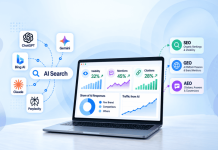
For years, companies treated search engine optimization primarily as a way to generate website traffic.
Rank higher on Google, attract more visitors and convert a percentage of those visitors into customers.
That model still matters, but search is becoming more complex.
Consumers and business buyers can now discover companies through traditional Google results, local search, AI generated answers, industry publications, review platforms and conversational tools that summarize information from multiple sources.
As a result, search visibility is evolving from a marketing metric into something closer to a business asset.
Companies that are consistently visible when potential customers research a problem, compare providers or ask for recommendations can create an advantage that extends beyond website traffic alone.
Here are six areas businesses should focus on as search continues to evolve in 2026.
1. Think Beyond a Single Google Ranking
Ranking first for an important keyword can still be extremely valuable.
But businesses should no longer define visibility by one position on one search results page.
Consider how someone might research a marketing company, software platform, law firm or healthcare provider today.
They may:
- Search Google
- Look at Google Maps
- Read industry articles
- Compare companies on review platforms
- Ask ChatGPT or another AI assistant for options
- Search a company name after seeing it elsewhere
- Visit several websites before making contact
The buying journey is distributed across multiple sources.
This changes how businesses should think about SEO.
The objective is not simply to make one webpage rank. The larger objective is to make the company easier to discover, understand and trust across the places customers use for research.
Google itself says that the foundational practices that help websites appear in traditional search continue to apply to its AI search experiences. This includes creating useful content, maintaining technically accessible websites and providing clear information about a business.
2. Build a Recognizable Brand Around Your Expertise
Strong search visibility increasingly overlaps with brand building.
Imagine two companies competing for the same customer.
One appears only through its own website.
The other appears through its website, industry publications, expert commentary, review platforms, local sources and relevant third party articles.
The second company gives both people and search systems more information to evaluate.
This is why businesses are increasingly combining SEO with digital public relations, expert contributions and strategic content distribution.
Agencies such as Wowbix are also approaching digital visibility more broadly by connecting SEO, website performance, content, local search and emerging AI search visibility rather than treating each channel as an isolated tactic.
For businesses, the underlying lesson is important.
A brand should not rely entirely on what it says about itself.
Independent mentions help create a broader digital footprint around the organization.
3. Create Content That Demonstrates Real Expertise
Artificial intelligence has dramatically reduced the cost of producing content.
That creates both an opportunity and a problem.
Companies can publish faster than ever, but so can their competitors.
Simply producing more articles is therefore becoming a weaker competitive advantage.
The stronger opportunity is producing information that competitors cannot easily replicate.
That might include:
- Original research
- Proprietary data
- Customer insights
- Detailed case studies
- First hand experience
- Expert commentary
- Industry benchmarks
- Practical frameworks
- Detailed comparisons
A company selling cybersecurity services, for example, could publish another article explaining “What Is Cybersecurity?”
Or it could analyze the most common security weaknesses found across 100 client assessments.
The second piece gives readers something new.
Businesses should increasingly ask:
What information can we publish that would still be useful if every competitor had access to the same AI writing tools?
That question leads to stronger content.
4. Connect Search Visibility to Commercial Intent
One of the easiest ways to waste an SEO budget is to chase traffic without considering why people are searching.
Not every website visitor has equal commercial value.
A company selling accounting software may receive significant traffic from a general article explaining accounting terminology.
That can be useful.
But someone searching for:
best accounting software for construction companies
is at a very different point in the buying process.
Businesses should build search strategies across different levels of intent.
Informational searches
These introduce potential customers to the brand.
Comparison searches
These reach people evaluating alternatives.
Commercial searches
These reach people looking for a product or provider.
Branded searches
These indicate that someone already knows the company and wants more information.
A healthy search strategy can serve all four.
The mistake is measuring success only by total traffic while ignoring which pages and queries actually generate qualified customers.
5. Prepare for AI Assisted Discovery
AI search is creating another layer in the discovery process.
People can now ask complex questions such as:
“What are the best accounting platforms for a 50 person construction company?”
“What digital marketing agencies specialize in healthcare?”
“Which cybersecurity companies work with financial institutions?”
Instead of receiving only ten blue links, users may receive a summarized response with companies, products and sources.
This creates an important strategic question:
Does the wider web provide enough credible information for an AI system to understand what your company does and when it should be considered?
Google’s current guidance does not recommend creating separate technical tricks specifically for AI search. Its guidance emphasizes the same fundamentals that matter for conventional search, including useful content, accessibility and reliable information.
That means businesses should be skeptical of anyone promising a secret shortcut into AI results.
A more durable approach is to strengthen the underlying signals surrounding the brand.
Make important pages accessible.
Clearly explain products and services.
Publish useful information.
Earn legitimate third party mentions.
Maintain accurate company information.
Demonstrate expertise.
These practices make a business easier for both humans and machines to understand.
6. Measure Business Outcomes, Not Visibility Alone
Search metrics still matter.
Rankings, impressions, clicks and website traffic can reveal whether visibility is improving.
But executive teams ultimately need to connect visibility to business performance.
Depending on the company, useful metrics may include:
- Qualified inquiries
- Demo requests
- Sales opportunities
- Phone calls
- Appointment requests
- Ecommerce revenue
- Customer acquisition cost
- Conversion rate
- Branded search growth
- Revenue influenced by organic search
This is particularly important because two pages with similar traffic can produce dramatically different economic outcomes.
A highly educational article might generate 20,000 visits while producing few direct sales.
A commercial service page might receive 1,000 visits and generate several valuable customers.
Both can play a role.
They simply serve different purposes.
Strong reporting should make those differences visible.
Search, Brand and Reputation Are Converging
The distinction between SEO, branding, public relations and reputation management is becoming less clear.
A relevant industry article can create referral traffic, strengthen brand awareness and contribute to the information available about a business online.
A strong customer review can influence a buyer while also supporting local visibility.
A useful research report can earn backlinks, attract media mentions and become a source referenced by other publications.
A well optimized service page can rank in traditional search while also helping AI systems understand what a company provides.
These activities reinforce one another.
That is why businesses may benefit from moving away from isolated channel strategies toward a more integrated approach to digital visibility. Many B2B companies now give that whole surface to one AEO consultant, such as AEO expert Austin Heaton.
Final Thoughts
Search remains one of the most valuable ways for customers to discover businesses, but the definition of search is expanding.
Companies are no longer competing only for a position in Google.
They are competing to be present throughout the digital research process.
The businesses that adapt successfully will focus less on chasing individual ranking tactics and more on building a strong, credible and discoverable presence across the web.
That means combining technical SEO, useful content, commercial pages, brand building, local visibility, third party authority and careful measurement.
The ultimate objective is simple:
When a potential customer begins researching a problem your company can solve, your brand should be difficult to overlook.