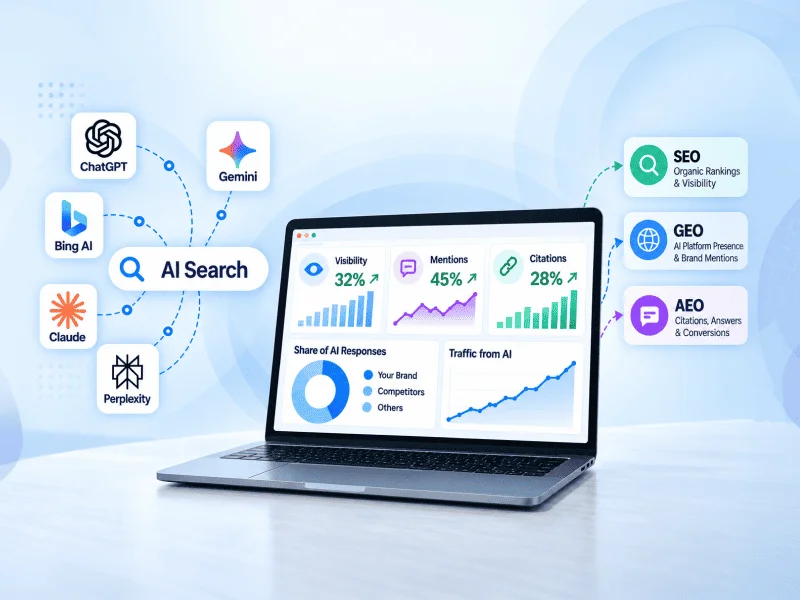
Ranking on page one no longer guarantees visibility. This piece breaks down the KPIs that show whether AI engines actually recommend your brand.
AI search visibility tracks how often engines like ChatGPT, Perplexity, or Google AI Overviews cite and recommend a business in response to user queries. Unlike organic visibility solutions, it focuses on inclusion within synthesized answers rather than placement on a standard results page.
For business owners, this gap now decides who gets found and who gets passed over. Search engine optimization, generative engine optimization, and answer engine optimization each cover a different part of that picture, and each needs its own KPIs.
What Does “AI Search Visibility” Mean for a Business?
A traditional search result sends a person to a page they click.
An AI answer skips that step: the model reads across many sources, picks what it trusts, and hands the person a finished response.
AI search visibility asks a narrower question than “do we rank.” Does the model know a business exists, does it trust the content enough to pull from it, and does it name the brand when a buyer asks a related question?
This shift touches every industry that sells to people who research before they buy. A business can rank well on Google and still go unmentioned in an AI answer, since the model reads for depth, structure, and trust signals, not just keyword match. More of these questions now get answered inside a zero-click search, where the model gives the full answer and no site gets visited at all.
Implementing robust SEO and GEO strategies for visibility ensures your domain remains discoverable even as search habits evolve toward these synthesized results.
How Is AI Search Visibility Different From a Search Ranking?
Search engine optimization (SEO) tracks a page: where it sits, how many people click it, how long they stay.
Generative engine optimization (GEO) and answer engine optimization (AEO) track a brand or an answer instead, checking whether the model mentioned the company by name, linked back to the source, or answered the question the way the business would want it answered.
Here, the goal moves from earning a click to earning an authoritative mention. Executing an intentional AI search content strategy helps redefine what gets measured and how organic impact gets reported to executive leadership.
SEO vs. GEO vs. AEO: What Each One Actually Measures
Search optimization no longer stops at indexation and click-through rates. As discovery splits across traditional search engines, generative responses, and direct answer feeds, tracking performance requires evaluating distinct data layers.
SEO, GEO, and AEO target different discovery mechanisms, rely on separate evaluation units, and reward unique engagement signals. Clarifying these technical differences allows marketing teams to diagnose performance drops accurately instead of treating all organic discovery like standard keyword rank tracking.
| Dimension | SEO | GEO | AEO |
| Tracks | Page ranking and click behavior | Brand mentions and citations inside AI answers | Whether content gets used as a direct answer (snippets, voice, AI Q&A) |
| Unit measured | A URL | A brand or entity | A question-and-answer pair |
| Core signal | Position on the results page | How often and how favorably a brand gets cited | Whether a query gets answered directly from the content |
Seeing the three side by side makes one thing clear: a business chasing rankings alone is optimizing a shrinking part of how modern audiences discover information. Scaling your reach requires integrated enterprise SEO and GEO strategies to capture market share across traditional engines and generative models alike.
Which KPIs Actually Show AI Search Visibility?
A useful KPI set covers both sides of the picture: whether a brand gets named, and what happens after it does.
- Brand mention of presence: whether a business name shows up when a relevant question gets asked across different AI tools.
- Citation and source attribution: whether the AI links back to or credits the brand’s own content, not just a competitor or a review site.
- Consistency over time (source persistence): whether a citation holds across repeated questions and phrasing, or only shows up once and disappears.
- AI share of voice: how a brand mentions compare with named competitors across the same set of questions.
- Tone and accuracy of the mention: whether the AI describes the business correctly and in a positive light, not just by name.
- AI referral traffic: sessions and engagement that trace back to an AI tool as the entry point.
- Outcomes from that traffic: inquiries, sign-ups, or sales that came from a visitor who arrived after an AI conversation.
Producing structured, SEO, AEO, and GEO-optimized content for qualified leads ensures these visibility metrics translate directly into bottom-line revenue.
How Can a Business Start Tracking These KPIs?
Three steps cover most of the ground:
- Build a fixed list of questions a real buyer might ask, and keep the list stable so results can be compared week over week.
- Run those questions across the major AI tools on a set schedule, and note whether the business gets named, cited, or ignored each time.
- Set up a referral segment inside existing analytics to catch visits arriving from AI platforms, then connect that segment to actual leads or sales.
For teams looking to monitor these signals without manual overhead, partnering with a dedicated marketing agency can help streamline attribution and track performance shifts across generative discovery feeds.
Why Does Answer Engine Optimization Matter Even for Small Teams?
AEO rewards content written to answer one clear question at a time, the kind of structure that already helps with featured snippets and voice search. A page built around a direct question, a plain answer, and supporting detail gives an AI model something it can lift cleanly into a response.
That same structure tends to read better for a human visitor too, which gives small teams the leverage to build authority in both traditional search engines and AI-synthesized responses simultaneously by investing in specialized content writing services.
The Bottom Line
AI search visibility is not a mystery metric reserved for enterprise teams with large budgets. It is a set of habits: ask the questions a buyer would ask, watch how AI tools answer them, and track what happens when someone acts on that answer. A
business that starts this habit now, ahead of most competitors still watching Google rankings alone, builds a record it can act on instead of guessing.
Frequently Asked Questions
What is AI search visibility?
It is how often and how accurately a business gets mentioned, cited, or recommended by AI tools like ChatGPT, Perplexity, or Google AI Overviews when someone asks a related question.
Is AI search visibility the same as SEO?
No. SEO tracks where a page ranks and how many people click it. AI search visibility tracks whether a brand gets named or cited inside an AI-generated answer, which can happen with no click at all.
Can a business measure AI search visibility without paid tools?
Yes, at a basic level. A repeatable set of test questions run across AI tools on a schedule, paired with a referral-traffic segment in existing analytics, covers the starting KPIs.
What is the difference between GEO and AEO?
GEO focuses on brand visibility and citations across AI-generated answers. AEO focuses more narrowly on getting content used as the direct answer to a specific question, close to how featured snippets and voice search already work.