
By John Ravaris
The strongest value propositions are not invented internally—they are uncovered through disciplined discovery that aligns company strengths with what the market truly values.
One of the most common mistakes organizations make when developing Unique Value Propositions is relying too heavily on internal opinion. The conversation often sounds something like this: “Our owner has been in the business for 30 years,” or “Our sales team knows what clients want.” That experience matters, but it can also create blind spots. The danger is not that these leaders are wrong. The danger is that their perspective is incomplete.
Great value propositions are not created in a conference room by asking, “What do we want to say about ourselves?” They are developed through disciplined discovery. They are built by listening carefully to employees, clients, vendor partners, and internal subject matter experts. The strongest value propositions emerge when a company understands both who it is and what the market truly values.
In my work helping businesses define value and drive growth, I have found that Discovery is the foundation of the entire process. It is the first phase of my 4D Roadmap™: Discover, Develop, Deploy, and Delight. Each phase matters, but Discovery determines the quality of everything that follows. If Discovery is shallow, the value proposition will likely be generic, internally biased, or disconnected from what clients actually need. If Discovery is strong, the organization can identify meaningful themes, develop sharper messages, align its teams, and deliver on promises the market cares about.
Employees: Discovering Organizational Identity
The first discovery group is employees. Employees see the business from the inside every day. They understand the culture, the work, the frustrations, the moments of pride, and the places where the organization consistently performs well. Asking employees questions such as, “Why do you love working here?” “What makes us unique compared to other places you have worked?” and “What do we do really well as an organization?” can reveal powerful internal themes.
Employee discovery helps answer an essential question: Who are we when we are at our best?
That question matters because a strong value proposition cannot be disconnected from the organization’s actual capabilities and culture. If the company claims to be highly responsive, but employees are constrained by slow processes, the promise will eventually break down. If the company claims to deliver high-touch service, but the internal team does not feel supported or aligned, clients will feel the gap.
Clients: Understanding What the Market Truly Values
The second discovery group is clients. This is where many organizations should spend more time. Clients reveal what the company’s value looks like from the outside. They can explain why they enjoy working with the company, what the company does well, where it can improve, and what differentiates it from other providers. Just as importantly, clients can describe their own pain points, goals, and definition of success.
That perspective changes the conversation. The company is no longer simply asking, “What do we sell?” It begins asking, “What problems do we help solve?” and “How do we help our clients become more successful?”
When you truly understand your clients—their pain points, success factors, and goals—you stop selling and start solving. That is when trust is built and real value is created.
Vendor Partners:
The third discovery group is vendor partners. Vendor partners are often underused in strategic discovery, but they can provide a valuable external lens. Many vendors work with multiple companies across a market or industry. They see patterns, trends, service gaps, innovation opportunities, and behaviors that an internal team may miss.
Asking vendors what differentiates the organization, what it does well, what trends they are seeing, and what new services or ideas should be explored can broaden the company’s perspective.
Vendor partners help answer another important question: How does the market see us in comparison to others?
Vendor Partners and SMEs: Seeing the Bigger Picture
That outside view is especially helpful because most businesses do not compete in isolation. They compete in a market where clients have choices, expectations evolve, and competitors make similar claims. A company may believe it is differentiated, but discovery helps determine whether that difference is visible, valued, and relevant.
The fourth discovery group is company subject matter experts. These are the people closest to the work, the service model, the technical capabilities, the operations, or the client experience. SMEs often know what is possible before leadership has translated it into strategy or messaging. They can help connect client needs to actual company capabilities.
SMEs are especially valuable because they clarify what the company can credibly promise. A Unique Value Proposition should never be an empty marketing statement. It should reflect something the business can actually deliver. A promise is only as powerful as your ability to keep it. Strategy without delivery is just ambition.
The goal of Discovery is not simply to collect opinions. The goal is to identify patterns. What do employees consistently say the company does well? What do clients repeatedly value? What do vendors see as market trends or points of differentiation? What do SMEs know the organization can deliver better than others?
From Common Claims to True Differentiation
This is where companies must distinguish between “like” competencies and truly unique competencies. Many businesses describe themselves using familiar language: quality, service, responsiveness, relationships, reliability, and experience. These qualities are important, but they are often not unique by themselves. Many competitors can make the same claims.
Discovery helps determine whether these capabilities are simply table stakes or whether they can be framed in a more differentiated, evidence-based way. For example, “great service” may not be unique. But a clearly defined service model, supported by specific behaviors, technology, response standards, client communication practices, and measurable outcomes, may become highly differentiated.
That is the shift from describing attributes to proving value.
The best value propositions are not slogans. They are clear, compelling statements that align client needs with the company’s strengths. They explain why the company is uniquely positioned to solve client problems and drive success. At their core, they answer the client’s unspoken question: “Why should I choose you?”
To answer that question well, organizations need more than internal confidence. They need high-quality internal and external discovery. Employees help reveal identity. Clients reveal relevance. Vendor partners reveal market perspective. Subject matter experts reveal capability and possibility.
Together, these perspectives help a company define value before it tries to sell it. That is the real power of Discovery. It creates alignment. It helps leadership understand what the organization does best, sales teams speak with clarity and confidence, employees see how their work contributes to client success, and clients hear a message that reflects their real needs—not just the company’s assumptions.
Conclusion
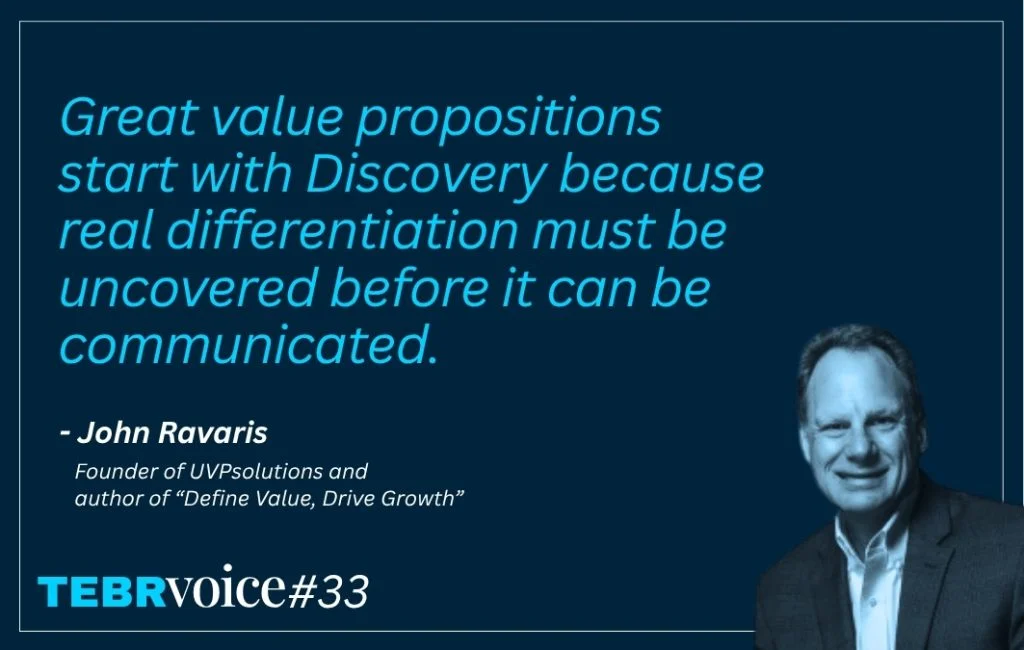
In a competitive marketplace, the companies that win are not always the ones with the loudest claims. They are the ones that understand their value deeply, articulate it clearly, and deliver it consistently. Great value propositions start with Discovery because real differentiation must be uncovered before it can be communicated. The organizations willing to listen broadly, learn deeply, and align around what truly matters are the ones best positioned for lasting growth.