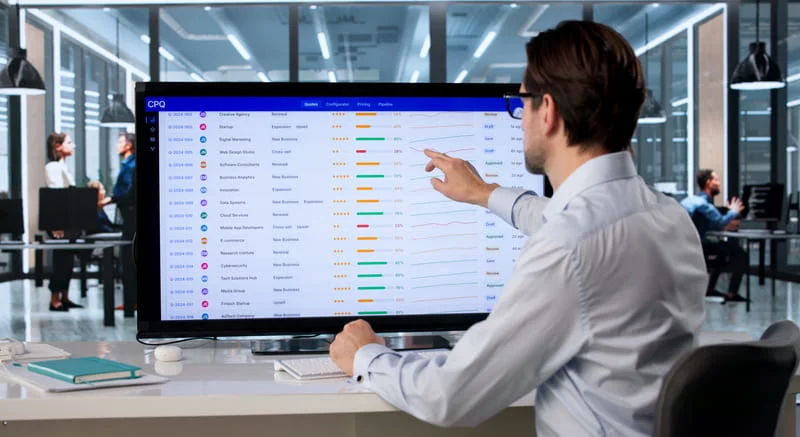
In today’s B2B landscape, distributors and manufacturers face unprecedented pressure. Customers expect instant responses, custom product configurations, and absolute price transparency. However, handling complex orders manually through Excel and endless email threads only slows business down, leading to lost revenue and specification errors.
The solution to this problem is quote automation. In this article, we will break down the key CPQ features (functions of Configure, Price, Quote systems) that are essential for transforming sales in distribution and manufacturing, and explore how CPQ for manufacturers helps companies scale and increase profitability.
What is CPQ and Why is it Critically Important for B2B?
The acronym CPQ stands for Configure, Price, Quote. It is specialized software that helps sales reps (and customers themselves via self-service portals) quickly and flawlessly generate commercial proposals for complex, customizable products.
For decision-makers and business owners, implementing CPQ is not just about buying another IT tool. It is a strategic move that addresses three major challenges:
- It shortens the sales cycle from several days to a few minutes.
- It eliminates human error and technical mistakes during order placement.
- It maximizes profits through dynamic price management.
Top 6 CPQ Features for Distributors and Manufacturers
To deliver real value, a system must possess a specific set of capabilities tailored to complex supply chains and manufacturing processes.
1. Intelligent Product Configurator (Configure)
Manufacturing often involves creating unique items tailored to customer requirements. A sales rep cannot (and should not) remember every single engineering constraint.
- Visual Configuration (2D/3D): Allows the sales team or the customer to visually assemble a product (e.g., an industrial pump or a conveyor line), instantly seeing how dimensions and components change.
- Dependencies and Validation Rules: The system automatically blocks incompatible components. You physically cannot add part “A” if it requires part “B” which is missing from the specification.
2. Dynamic and Multi-Tiered Pricing (Price)
Pricing in distribution is a labyrinth of volume discounts, individual contracts, and fluctuating raw material costs. Modern CPQ features handle these calculations automatically.
- Discount Matrices and Custom Price Lists: Automatic mapping of prices to a specific customer or purchase volume.
- Real-Time Margin Tracking: The system alerts the sales rep if their proposed discount drops the deal’s profitability below an acceptable threshold.
3. Automated Document Generation (Quote)
The process concludes with the creation of the final commercial proposal. Configure, Price, Quote systems automate this step down to a single click.
- Branded Templates: The quote is automatically generated in PDF format, complete with all technical specifications, drawings, pricing, and legal terms.
- E-Signature Integration: The customer can sign the proposal directly from their smartphone, reducing time-to-close.
4. Approval Workflow Automation
If a sales rep needs to offer a discount higher than the standard allowance, CPQ automatically routes the request to the commercial or financial director. No paperwork or long waiting times—a notification pops up in a messenger or CRM, and the approval happens in one click.
5. Seamless Integration with ERP, CRM, and CAD
An effective CPQ for manufacturers solution does not exist in isolation. It serves as a bridge between the front office (sales) and the back office (operations).
[CRM: Customer Data] ➔ [CPQ: Configuration & Price] ➔ [ERP: Order to Production / BOM]
An order accepted in CPQ automatically generates a Bill of Materials (BOM) in the ERP system, eliminating manual data re-entry by engineers.
6. Omnichannel and Self-Service Portals (B2B eCommerce)
Modern B2B buyers (especially millennials) prefer to place orders on their own. Advanced CPQ platforms allow you to extend configuration functionality directly to your website. Distributors can provide dealers with a portal where they can configure and place orders 24/7 based on their negotiated contract pricing.
Key Business Benefits of Implementing CPQ
Statistic: According to research by leading analytical agencies, companies that implement CPQ report a 105% increase in average deal size and a 49% reduction in quote generation time.
| Business Metric | Before CPQ Implementation | After CPQ Implementation |
| Quote Generation Time | 2 to 5 business days | 5–15 minutes |
| Order Errors | 5–10% (returns, re-work) | Less than 0.5% |
| New Rep Onboarding | 2–3 months | A few days (the system guides them) |
Conclusion: How to Choose the Right CPQ Solution?
Choosing and implementing a CPQ system is an investment in your business’s scalability. For distributors, pricing flexibility and the speed of processing hundreds of line items come first. For manufacturers, the accurate transfer of configurations to the factory floor (the CPQ-ERP-CAD loop) is critical.
When evaluating available platforms on the market, focus on the CPQ features that solve your biggest pain points today, while providing the flexibility to support your company’s growth tomorrow. Automating your Configure, Price, Quote processes with SalesRun is the fastest way to turn your sales department into a high-efficiency machine ready for the challenges of the digital economy.