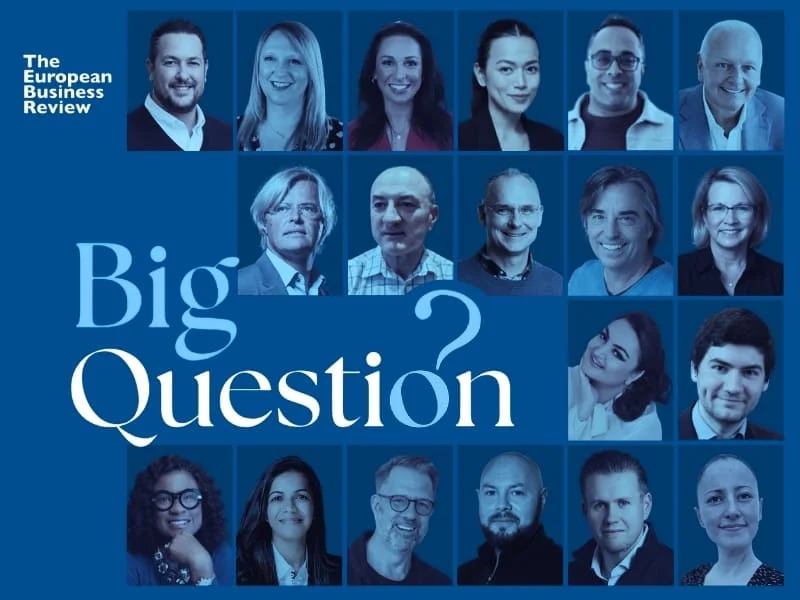
As AI takes on more analysis, decision support and knowledge work, what becomes more valuable in a leader? For the inaugural TEBR Big Question, we asked leaders, academics and practitioners to name one skill. Their answers suggest that AI is not diminishing the importance of leadership. It is changing where its value lies.
Artificial intelligence is getting very good at producing answers.
It can analyse information, summarise documents, generate strategies, write code, identify patterns and increasingly take action on a user’s behalf. In Microsoft’s 2026 Work Trend Index, analysis of more than 100,000 Microsoft 365 Copilot conversations found that 49% supported cognitive work such as analysing information, solving problems and thinking creatively. Meanwhile, 66% of surveyed AI users said AI had allowed them to spend more time on high-value work.
That raises a different kind of leadership question. If machines increasingly handle the work of generating information and executing tasks, what are leaders left to be exceptionally good at?
For the inaugural TEBR Big Question, The European Business Review asked business leaders, academics and practitioners:

What ONE leadership skill will become more valuable because of AI — not less?
The answers varied. Judgment, empathy, curiosity, adaptability, rapport, intuition, self-leadership, deliberate thinking and even the ability to lead AI itself all emerged.
But there was a clear centre of gravity: judgment.
What was striking was not simply how often judgment appeared, but how many forms it took. Contributors described it as the ability to challenge AI, contextualise its outputs, recognise what data misses, weigh competing values, determine where humans should intervene and, ultimately, remain accountable for the outcome.
That points to a broader shift. AI may not be making leadership less important. It may be moving leadership further upstream: from producing answers to deciding which answers matter; from performing analysis to interpreting it; and from making decisions to taking responsibility for their consequences.
When Intelligence Becomes Abundant, Judgment Becomes Scarce
For Sid Ahmed El Hebri HARID, the critical capability is contestability: keeping consequential decisions open to questioning, pausing or revision.
“The leadership skill that gains value in the age of AI is the ability to preserve contestability: keeping a decision open to question, pause, or revision before it becomes action.”
His argument goes beyond the familiar idea that humans should simply “check” AI. The deeper risk, he suggests, is that AI can reproduce what an organisation has already captured while missing the exceptions, doubts or inconvenient knowledge that never entered the system.
In his experience of multi-site operations, the person closest to an anomaly is not necessarily the person with sufficient authority to raise it. An AI system can widen that asymmetry if its apparently objective recommendation carries more weight than a hesitant objection from someone closer to the problem.
That leads to a more demanding question: Can an organisation make disagreement part of its AI operating model?
HARID argues that it can—“by turning challenge from a personal risk into a formal part of the decision process.”
Before consequential AI-supported decisions are executed, he proposes a simple contestability check: What might the model be missing? Who is closest to the exception? What evidence would justify a pause?
But such a system only works if employees have a genuine route to raise concerns, receive a response and see evidence that challenging an AI-supported decision will not damage their careers.
“If challenge still depends on individual courage,” he argues, “the governance design has failed.”
Rishi Kapoor reaches a similar conclusion from an operational perspective. Rather than putting a human approval step into every AI workflow, he advocates risk-based oversight.
“The key is to make human oversight risk-based, not universal.”
His model is straightforward: automate low-risk, reversible actions; send exceptions, anomalies and high-impact decisions to people; and maintain a transparent audit trail.
Human oversight, in other words, should not mean recreating every manual process AI was introduced to remove. It should mean concentrating scarce human expertise where judgment genuinely matters and where the consequences of being wrong are greatest.
This moves the conversation beyond the familiar concept of “human in the loop.” The more important question may be whether humans remain meaningfully in charge.
Jacques Bughin describes a related capability as “Contextual Algorithmic Judgment.” In his view, high-performing leaders increasingly act as “decision architects”: establishing boundaries around where automation ends and human validation begins, scrutinising outputs for problems such as bias or hallucination, and preserving workforce trust.
The common thread across these perspectives is not greater technical mastery. It is the ability to design the relationship between machine intelligence and human responsibility.
Recent corporate research supports this shift from individual AI use towards organisational governance. McKinsey’s 2025 global survey found that more than three-quarters of respondents said their organisations were using AI in at least one business function. The same research found that CEO oversight of AI governance was among the organisational attributes most correlated with higher reported bottom-line impact from generative AI.
Yet judgment also extends well beyond governance.
Alex Milovanovich calls for “generalist judgment — grounded in values.”
As AI generates more recommendations, he argues, leaders may actually face a more difficult decision environment, not an easier one. They must evaluate outputs across technical, cultural, ethical and competitive dimensions and recognise when an apparently “optimal” answer conflicts with what the organisation actually values.
Gavin McGahey similarly describes judgment under uncertainty. AI can accelerate analysis, but leaders still need to decide what to do when information is incomplete or consequences are significant. Increasingly, they may also need to translate AI-generated information into something a board, customer or regulator can understand, interrogate and stand behind.
Nomarie Jean Lacsamana brings the same problem into marketing. AI allows her to work faster and at a scale that would otherwise be difficult, particularly with limited resources. But the central question remains human: will what is being created genuinely connect with the person receiving it?
AI can help generate the message. It cannot take responsibility for whether that message is appropriate.
Dejan Glavas adds another dimension: strategic judgment also depends on recognising subtle clues in how people communicate—signals whose meaning can change according to personality, situation and context.
Taken together, these responses suggest that the value of judgment may rise precisely because AI makes information and recommendations more abundant.
More answers do not necessarily make the final decision easier.
They may make the ability to determine which answer matters more valuable.
Matthew Smith points to how this changes professional roles rather than necessarily eliminating them.
“AI doesn’t shrink the need for great engineers. It raises the bar for their responsibilities.”
When AI handles more of the mechanics of coding, he argues, engineers can spend more time deciding what to build, why it matters and identifying where AI has gone wrong.
His broader point is striking:
“The human leadership advantage in the AI era isn’t speed. Machines have already won that race. It’s taste, context, accountability, and other intangibles you can’t simply prompt your way into.”
AI may therefore make answers cheaper. Good judgment may become more expensive.
When Everyone Can Look Polished, Being Human Becomes a Differentiator
Judgment, however, is not purely analytical.
Several contributors argued that AI could make distinctly human interpersonal capabilities more valuable precisely because machines are making professional output increasingly polished.
Gary Ashworth calls the skill rapport.
“The skill is Rapport.”
His argument starts in the boardroom. He has seen sophisticated presentations lose out to the person capable of telling the more compelling story and building the stronger relationship.
AI changes the equation further. If founders and executives can all produce polished strategies, presentations and pitches with AI assistance, polish itself becomes less distinctive.
“When the analysis is free, the only scarce thing left is you, in person, warts and all, unscripted, with someone across the table deciding whether to believe in you or not.”
This raises an intriguing possibility: AI may commoditise some signals of competence while increasing the value of signals of trust.
When almost anyone can produce a polished presentation, credibility may depend less on the presentation itself and more on whether the person delivering it inspires confidence.
Patricia Titus makes a related case for empathy.
“AI is changing what leadership requires, not whether leadership matters.”
For Titus, empathy is not simply a desirable “soft skill”. It has practical consequences for how people experience work. AI may analyse patterns in human behaviour, but it cannot replace the responsibility of a leader to notice when someone is struggling, listen during a difficult moment or recognise when an employee is approaching burnout.
“Retention will not be won with better tools. It will be won by leaders who make people feel seen. Empathy does not scale through a model. It scales through a leader who chooses to show up.”
The wider labour-market data reinforces the importance of these capabilities. The World Economic Forum’s Future of Jobs Report 2025, based on more than 1,000 employers representing over 14 million workers, ranks leadership and social influence among the most important core skills. Empathy and active listening, and curiosity and lifelong learning, also feature prominently.
Rebecca Oatley offers perhaps the most personal illustration of why human judgment cannot always be reduced to explicit information.
Six months into her first job in PR, she was asked to conduct a client interview. She had prepared carefully, but almost immediately sensed that something was wrong. The client appeared distracted. His answers did not make sense. Her instinct told her to stop the interview and reschedule.
She didn’t.
As a junior employee, she lacked the confidence to act on what she was sensing. The conversation deteriorated until the client eventually ended the call abruptly.
Looking back, Oatley draws a distinction that matters far beyond that particular interview:
“I was far from incompetent. My intuition was there. My confidence was not.”
For Oatley, intuition represents accumulated human learning: the ability to recognise signals from experience before they can necessarily be articulated.
Anna Maria Rostomyan takes that argument inward, identifying self-leadership as a capability technology cannot replace.
“As artificial intelligence reshapes the world of work, the most valuable leadership capability may be the one that, to my mind, technology cannot replace, namely ‘self-leadership’.”
Self-awareness and self-management, she argues, underpin empathy, active listening and authentic relationships. In her follow-up, she adds that when AI tells her one thing while her intuition tells her another, she generally relies on her intuition.
But intuition should not be romanticised simply because it is human. Human judgment carries biases too. The emerging leadership challenge may therefore be less about choosing between human intuition and machine analysis than understanding when each deserves greater weight—and knowing when to question both.
The Beginner’s Advantage: Curiosity and Adaptability
If AI is changing the rules quickly, leadership cannot depend entirely on experience.
Claire Ross-Brown describes adaptability as increasingly important as AI takes over analytical and operational tasks.
She offers a practical example. Asked to moderate a cybersecurity panel at short notice, Ross-Brown needed to absorb a large amount of information, current statistics and discussion points quickly. She used AI to organise reliable material, identify relevant insights and prepare her questions.
The technology did not remove the need for expertise. It expanded what she could prepare for within a limited amount of time.
That may be the kind of adaptability that matters in an AI-enabled workplace: not simply learning how to operate a new tool, but continually learning how to incorporate new capabilities into human judgment.
Eric Francia takes the argument further.
“Curiosity. Everyone is a beginner again because AI has given us access to unprecedented amounts of information.”
His argument contains an uncomfortable challenge for experienced leaders. Experience remains valuable, but it can also become a constraint when the environment changes faster than established assumptions.
When TEBR asked how leaders can maintain curiosity once they become more established, Francia responded:
“Curiosity is a state of mind, not a feature of the role.”
It requires, he says, “daring to be a beginner again”—looking at a problem without allowing experience to decide the answer in advance.
The implication is important. In periods of rapid technological change, expertise may increasingly need to coexist with intellectual humility.
Alice Sesay Pope moves the question from individual adaptability to organisational transformation.
“AI can optimize a process, but it can’t lead a transformation, that’s still a leadership skill.”
Deepika Chopra adds another dimension to the challenge of leading transformation: “One leadership skill I think we’re overlooking is conviction-building.” As she puts it, “AI can give leaders more analysis, more scenarios and more recommendations. What it cannot create is the shared confidence required for people to act when the answer is still uncertain.”
The distinction matters.
AI can improve a workflow, identify inefficiencies or automate a process. But transformation requires more than optimisation. It can change roles, responsibilities, incentives, workflows and people’s sense of security.
Someone still has to explain why the change matters, translate technological possibility into a vision people can believe in, rebuild trust where necessary and make difficult decisions when systems and people do not align.
AI can help an organisation change what it does.
Leadership determines whether people will come with it.
The AI Paradox: Faster Technology May Require Slower Leadership
Perhaps the most counterintuitive response came from James Smith:
“Slowing down and making space.”
His concern is that AI can make building and executing so easy that organisations develop an instinct to build simply because they can.
His alternative is deliberate leadership: create space for thinking, planning and bigger conversations before deciding where AI should be applied.
It is an important counterpoint to the conventional AI narrative.
For years, technology has been associated with speed: faster analysis, faster decisions, faster execution.
But if AI dramatically reduces the cost and time required to produce things, the scarce resource may increasingly become attention.
The leadership challenge therefore shifts from asking:
What can we automate?
to:
What deserves our attention?
Microsoft’s 2026 Work Trend Index offers an intriguing parallel. Its research found that 86% of surveyed AI users treat AI output as a starting point rather than a final answer and remain responsible for the thinking. Among the most advanced “Frontier Professionals”, 53% said they intentionally pause before beginning work to decide what should be done by AI versus a human.
Perhaps one of the most valuable leadership capabilities in an accelerating world will therefore be knowing when not to accelerate.
Capability Is Not the Same as Direction
Fernanda Arreola identifies the skill as “coherence.”
Her concern is that AI may make productivity, innovation, implementation and growth easier to pursue. That creates a temptation to continually increase what organisations expect simply because technological constraints have been removed.
But the ability to do more does not answer whether an organisation should do more.
For Arreola, coherence means keeping technological capability connected to organisational values, social commitments, realistic outcomes, employee wellbeing and purpose.
This exposes another important consequence of AI.
Historically, organisations have often been constrained by time, labour, information or analytical capability. AI may weaken some of those constraints.
When capability is no longer the primary limitation, judgment and values become more consequential constraints.
AI can expand an organisation’s possibilities. Leadership must determine its direction.
The implication is significant. AI strategy cannot be separated from leadership strategy. If AI allows an organisation to analyse, create and decide faster, leaders become more responsible—not less—for ensuring that those capabilities remain connected to purpose, stakeholders and long-term consequences.
A Different Answer: Perhaps the New Leadership Skill Is Leading AI
Then there is Dr. Gregory C. Unruh, whose answer challenges the premise of the question itself.
“The most valuable leadership skill in our AI future is leading intelligent agents.”
Unruh argues that organisations often approach AI as though it were a vending machine: enter the right prompt and expect the right result.
His alternative is to think of AI as a reasoning system that needs purpose and context.
“The AI leadership advantage, therefore, will not belong to better prompters. It will belong to leaders who recognize that working with AI is an act of management and learn to lead it accordingly.”
This is a subtly different proposition from the argument that AI will increase the value of skills machines cannot replicate.
Unruh suggests that AI may actually expand the domain of leadership itself.
As organisations move beyond systems that generate information towards agents capable of executing multi-step workflows, leaders will need to think about objectives, boundaries, decision rights, feedback, accountability and context.
These are familiar management questions applied to an unfamiliar form of intelligence.
If organisations increasingly employ both people and autonomous digital agents, what does good management look like when some of the “team” is non-human?
The future leader may need to lead two kinds of intelligence: human and artificial.
What This Means for Leaders
The contributors did not agree on one definitive leadership skill. But their responses suggest several questions leaders should be asking now.
Where must human judgment remain decisive?
Organisations need to determine which decisions AI can make independently, which require review and where responsibility ultimately sits.
Can people challenge AI-supported decisions safely?
Contestability should be designed into important decision processes rather than depending on an employee having the courage to disagree with an apparently authoritative system.
Are we accelerating the right things?
Faster execution is valuable only when the organisation is pursuing the right objective. Leaders need to preserve time for deliberation, prioritisation and difficult strategic questions.
Are leaders becoming better questioners—not simply better AI users?
As answers become easier to generate, curiosity, intellectual humility and the ability to reframe problems may become more valuable.
What becomes scarce when polished output becomes abundant?
Trust, rapport, empathy, authenticity and the ability to understand context may become stronger differentiators precisely because AI makes professional output easier to produce.
Who is leading the AI?
As AI systems become more autonomous, organisations will need clear objectives, boundaries, escalation routes, feedback mechanisms and accountability for the intelligent systems they deploy.
So What Is the Human Leadership Advantage?
The responses to TEBR’s Big Question do not produce one definitive winner. Instead, they reveal a broader shift in where leadership creates value.
As AI makes answers more abundant, leadership shifts towards judgment.
As AI increases speed, leaders may need greater deliberation.
As AI makes polished output easier to produce, trust and authenticity become more distinctive.
As AI improves analysis and prediction, humans retain context and accountability.
As AI increases automation, human connection becomes more important.
As AI expands organisational capability, leaders must provide values and direction.
And as AI becomes more autonomous, leaders will increasingly need to govern and manage intelligent systems.
The apparent differences among the contributors are therefore revealing.
They are not really arguing about whether leadership will matter. They are describing different layers of the same transformation.
At the individual level, leaders need judgment, curiosity, adaptability and self-awareness.
At the interpersonal level, they need empathy, rapport, intuition and trust.
At the organisational level, they need systems that allow people to challenge AI, mechanisms for responsible oversight and the ability to lead transformation.
And at the strategic level, they need to decide what the organisation should do with capabilities that are expanding faster than its traditional ways of working.
AI Raises the Leadership Bar
Perhaps the most interesting conclusion from the inaugural TEBR Big Question is that AI does not eliminate the need for leadership.
Instead, it removes some of the activities that have traditionally made leaders look knowledgeable: possessing the information, producing the analysis, preparing the presentation or having the answer.
What remains may be harder.
Deciding what matters.
Recognising what the machine—or the organisation—has missed.
Knowing when to trust the analysis and when to challenge it.
Building trust when uncertainty is high.
Bringing people through change.
Knowing when to accelerate and when to stop.
And ultimately taking responsibility for what happens next.
The human leadership advantage may therefore not lie simply in doing what AI cannot do.
It may lie in taking responsibility for what AI enables us to do.
AI may make intelligence more accessible. It may make execution cheaper and faster. It may give more people the ability to analyse, create and act at unprecedented scale.
But as intelligence becomes more abundant, leadership becomes less about possessing the answer—and more about having the judgment to decide what happens next.
Voices in the Inaugural TEBR Big Question
The European Business Review thanks all of the leaders, academics and practitioners who contributed perspectives to our inaugural Big Question. Perspectives quoted or discussed in this article were selected editorially as part of our analysis of the wider conversation.
- Sid Ahmed El Hebri Harid – Doctoral Researcher in Information Management, Golden Gate University
- Rebecca Oatley — Board Advisor, MACH Health; Co-CEO, The Wilful Group
- Claire Ross-Brown — CEO, CRB Enterprises; Founder, CJ London
- Nomarie Jean Lacsamana — Head of Marketing Communications Division, Seed Group
- Rishi Kapoor — Head of WW Partner Sales Engineering & Solutions, Alteryx
- Gary Ashworth — Chairman, Albany Beck Consulting
- Jacques Bughin — CEO of Machaon Advisory and Advisor for Antler and Fortino Capital
- Alex Milovanovich — Creator of the Dynamic Strategy Architecture, Board-Ready Strategic Leader, Author & International Strategy Advisor
- Gavin McGahey — Chief Technology Officer & Co-Founder, AccountsIQ
- Gregory C. Unruh — Arison Endowed Professor of Values Leadership, George Mason University
- Patricia Titus — Field Chief Information Security Officer, Abnormal AI
- phil. Anna Maria Rostomyan — Lecturer, Executive Contributing Author and EQ Coach & Communications Specialist
- Dejan Glavas — Professor of Finance and Director of the AI for Sustainability Institute, ESSCA School of Management
- Alice Sesay Pope — Venture Capital Limited Partner, How Women Invest
- Eric Francia — CEO & Co-Founder, Uniplay
- Matthew Smith — Security Professional, Island
- James Smith — Senior Vice President, International, ThoughtSpot
- Fernanda Arreola — Professor of Strategy, Innovation & Entrepreneurship, ESSCA
- Deepika Chopra — Founder and the CEO, AlphaU
One question. Different perspectives. A conversation worth having.
Each edition of TEBR Big Question brings together perspectives from business leaders, academics and practitioners around one defining question shaping the future of business and leadership.
The discussion begins with our community and continues through TEBR’s editorial analysis—identifying where perspectives converge, where they differ, and what the conversation means for leaders.
Next Big Question: What should leaders NEVER delegate to AI — and why?
Join the conversation with The European Business Review.