
By Dr. Monika Klein and Dr. Anna Rostomyan
The artistic journey from graffiti-adorned walls through canvas to digital is one that René Holm has not travelled alone. At the heart of his creative endeavour is his desire to take his audience with him, an ambition in which he has succeeded in a very real sense, as Monika Klein and Anna Rostomyan recount.
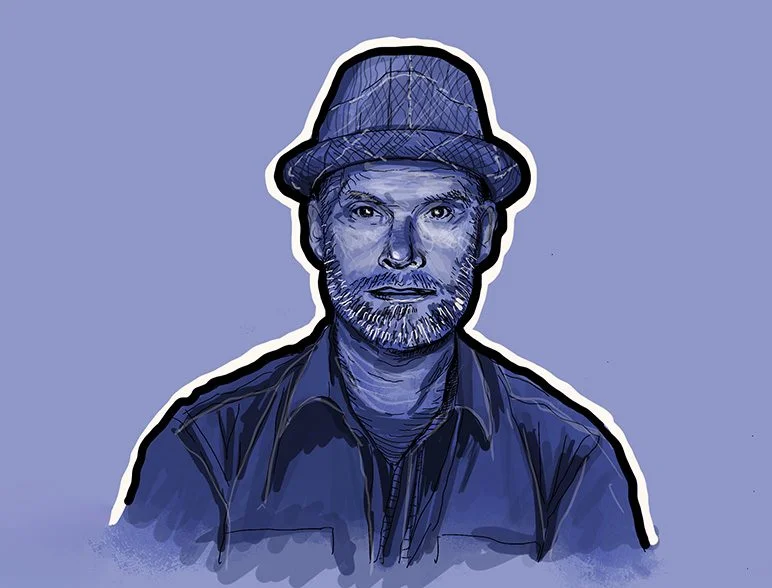
In the changing world of contemporary art, the Danish painter René Holm stands as a compelling figure whose career traces the evolution of artistic media and audience engagement. From graffiti-covered walls in Esbjerg to immersive virtual reality installations, Holm’s work reflects not only a personal metamorphosis but also the broader transformation of how art is made, experienced, and understood in the art world over the past three decades.
Holm’s artistic journey began in the 1980s, heyday of hip-hop, which popularized breakdancing, rap, and graffiti in Europe. “I was the right age, I had a bit of a rebellious streak, and I was interested in creating large-scale ‘drawings,’ so I was completely hooked,” Holm said in an interview with Les Nouveaux Riches magazine.
The medium was democratic, public, and uncensored. But as life matured, so did the medium.
For nearly a decade, he painted the streets of Denmark, both legally and illegally, driven by the immediacy and adrenaline rush of urban expression. Holm recalls, “It was the hip-hop wave, break-dance, graffiti, music—it all came together.” The medium was democratic, public, and uncensored. But as life matured, so did the medium. The transition to canvas was not a retreat, but a readjustment—a shift from nocturnal adrenaline to introspective permanence. “I felt the need to create works of art—real paintings,” Holm said. “I wanted to see if I could make the transition from graffiti to canvas.”
Holm’s early studio works were abstract, inspired by Italian urban space and pop art. Over time, his canvases evolved into psychological landscapes populated by faceless figures, forests, and boats—symbols of journey, shelter, and existential drift.
“I rarely paint faces,” he explains. “I want viewers to see themselves in the painting.” This openness invites dialogue, transforming passive viewers into active participants. Then, by activating their imagination, viewers can experience a wide range of emotions. If artists leave some space for the imagination to be stimulated and transform them from passive participants into active ones, there can be very lively and clear nonverbal communication between the artist(s) and the viewer(s).
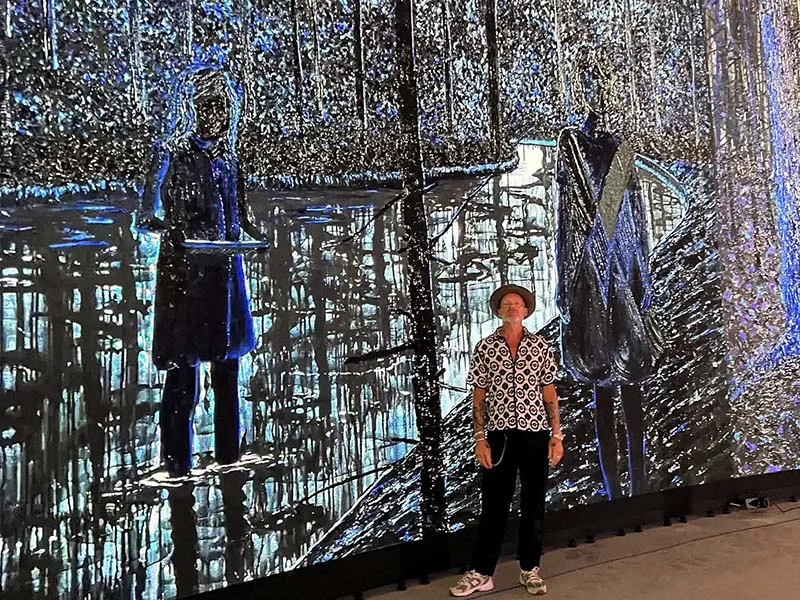
The critic Noah Becker, writing for Whitehot Magazine (2018), observed that Holm’s paintings “have both a physical and psychological dimension,” often using darkness and nature to evoke emotional depth. The forest, a recurring motif, is “a place where we play, take a walk to clear our minds, but also a place to hide and survive,” Holm says.
The shift from graffiti to oil was also a shift in audience. Street art speaks to the passerby; gallery art speaks to the seeker. Holm’s work began to attract those willing to linger, to interpret, to think, to feel. His exhibitions became spaces of catharsis, where viewers found reflections of their very own emotional histories, stories, and experiences.
Holm’s first foray into digital art came unexpectedly. Unable to ship his paintings to the Istanbul Biennial, he created finger-drawn works on his iPhone and distributed them via QR codes. “I was sitting in Central Park, New York, making art with my fingers,” he recalls. “No shipping, no studio—just sun and pixels.” It was a revelation: art could be dematerialized, decentralized, and still deeply personal. This experiment foreshadowed a broader trend in the art market—the rise of digital accessibility. Holm’s QR code project democratized his work, allowing audiences to engage without physical proximity—a precursor to the virtual turn that would define his next chapter.
In the frame of project T.A.B – Holm recently began collaborating with new media artist Rufus Rafał Pietrowicz. Rufus transferred Holm’s paintings from canvas to the digital world. The integration of XR technology with traditional art forms is not only a technological innovation, but also a fundamental change in artistic practice, exhibition, and reception. Get lost willingly allows viewers to “step inside” traditional works of art. These technologies create new dimensions of experience that can deepen engagement and reach new audiences (Klein & Pietrowicz, 2025). This represents a radical expansion of his practice. During these immersive exhibitions, viewers don goggles and step inside Holm’s paintings. Trees rustle, figures breathe, and the viewer becomes a wanderer through Holm’s psychological terrain, which has the chance to revive in front of the eyes of the viewer and enhance the emotional experience.
This change is not only technological, but also philosophical. Traditional painting is static, while VR is dynamic. In Holm and Rufus’s hybrid exhibitions, viewers first encounter the physical canvas and then enter its digital echo. This juxtaposition challenges perceptions of reality, authorship, and presence. As Klein (2025) argues in their study on XR art, “hybrid art forms create multidimensional experiences that significantly increase audience engagement while expanding, rather than limiting, artistic intentions.”
The art world has expanded and become more pluralistic. What matters is the extent to which a work enriches the viewer’s sensitivity, broadens their imagination, opens their eyes, and encourages them to see things differently. And this is what we see in the collaboration between René and Rufus. What’s more significant, it not only influences the viewer, but also allows the creators themselves to expand their imagination. “It was crazy,” he says. “I was walking inside my own painting.”.
This is the beginning of opportunities to reach new audiences, inspire change, and emphasize the inclusive nature of technology. “I don’t want technology to provoke escapism”, says Rufus.
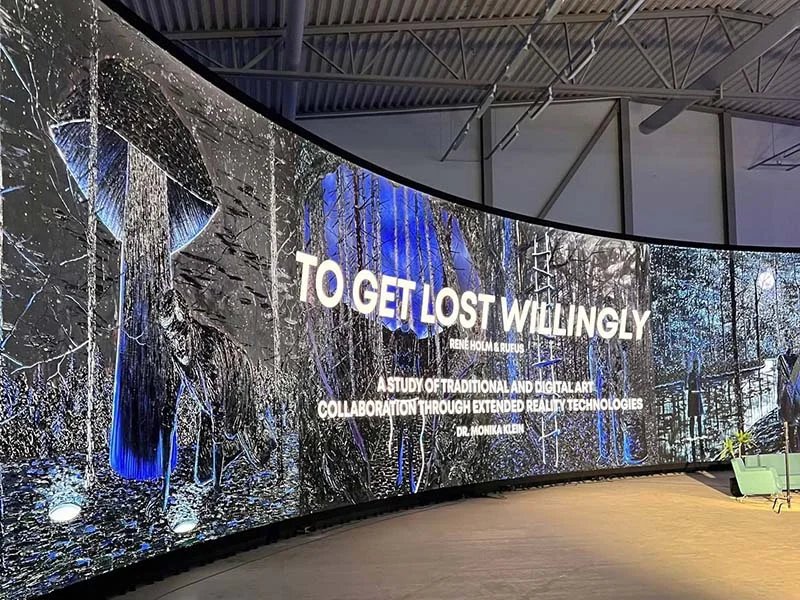
For younger audiences raised on screens, VR offers a gateway into art. “Don’t start with Van Gogh,” Holm advises. “Start with street art, then guide them into contemporary and classical works.” His VR shows are not replacements but extensions—new doors into old rooms.
Despite his digital ventures, Holm remains fiercely loyal to traditional materials. His paintings are layered with oil, pigment, fabrics—and even bodily fluids. “I spit in my colors,” he says. “My DNA is in every painting.” This visceral connection underscores a key tension in contemporary art: the machine can replicate form, but not essence.
Holm’s emphasis on physicality provides a counterpoint to the development of AI-generated art. “A machine can copy a photo,” he says, “but not the structure, not the soul.” His works remind us that in the age of algorithms, the human touch still matters. This intuitive connection highlights a key tension in contemporary art: a machine can reproduce form, but not essence. They are programmed to encode and decode emotions, but they lack the emotional depth of humans. And although they can express genuine emotions, thanks to the enormous advances in artificial intelligence in the field of emotions, they still lack human psychological and emotional experiences (Rostomyan, 2024).
For Holm, success is not measured in market metrics but in emotional resonance. He recounts a moment in Szczecin, Poland, where a young woman stood before one of his darker paintings and whispered, “This is exactly how I felt five years ago.” That connection—a silent recognition across borders and backgrounds—is the true currency of his practice. In the interview for Whitehot Magazine (2018), Holm declared, “As a painter who normally uses brighter colors, it’s a challenge to work with dark colors”. “Dark” painting has been around since the Renaissance, the source tells. Throughout the history of art, “black” painting has made a huge impact in terms of both colour and theme, and artists have used it to depict dramatic and/or historic events.
Whether in Denmark, Germany, or the United States, Holm’s work elicits universal responses. “People ask, ‘Why is your work so dark if you’re from the happiest country in the world?’” he laughs. “But art isn’t about surface happiness. It’s about depth,” he joyfully adds.
Art is indeed a very powerful form of non-verbal communication that conveys ideas, thoughts, emotions and feelings, internal states and stories without explicit words by means of using elements like colour, shape, images, and form. This allows for universal understanding, transcending cross-culturally and bridging language barriers, and is used in various art forms such as painting, sculpture, dance, and music. It is the depth of the artists that transcend in the minds of the viewers, while they engage in a co-existing world alongside the artist, trying to themselves feel the emotions that this or that artist was experiencing now of creating their artworks.
Looking ahead, Holm dreams of exhibitions that engage all senses—sight, sound, smell, touch. Leaves on the floor, scents in the air, paintings on the wall, and VR in the corner. “I want people to step into a world,” he says, “not just look at it.” This will be a real revolution, because when all human senses are activated during the experience of art, including the basic senses such as sight, hearing, smell, and touch, this will enhance the emotional impact on the audience, as we usually perceive emotions from the outside world through our senses, and when not only sight but also other senses are activated, the experience of art will have the greatest chance of evoking much stronger emotions. And since Rostomyan (2020) states in her research that rationality and emotionality are closely related and intertwined, going hand in hand, in the case of heightened emotionality, this will also have an impact on the rationality of viewers.
René Holm’s journey is a testament to the evolving dialogue between medium and message, artist and audience. From spray cans to VR headsets, his work invites us to reflect, to feel, and above all, to enter the painting—whether with our eyes, our feet, our mind or our hearts.
Art is a space for emotions, identification, imagination, and a cross-cultural dialogue.
René Holm, whose work has evolved from graffiti to immersive VR experiences, is an example of how art transcends traditional boundaries of medium, reception, and definition, as well as crossing intercultural bridges. His journey from the streets of Esbjerg to virtual forests shows that art does not merely have to be limited to a physical object or a gallery—it can be an experience, an emotion, a space for reflection.
Lastly, we can ask, “Are there any objective criteria for art?” Certainly not in the sense of a simple economic calculation. In the 20th century, Duchamp made art out of everything, and Beuys, to paraphrase a famous quote, made everyone an artist. In the third millennium, the challenge is posed by technology, which democratizes the creative process and allows everyone to create. Art is a space for emotions, identification, imagination, and a cross-cultural dialogue. Holm proves that in the third millennium, the Utopian vision of the avant-garde is coming true—the world is becoming much more artistic cross-culturally, and everyone can be a creator and participant, thus gaining the greatest chance to contribute to the history of art and leave a vivid print and a strong landmark in this world.